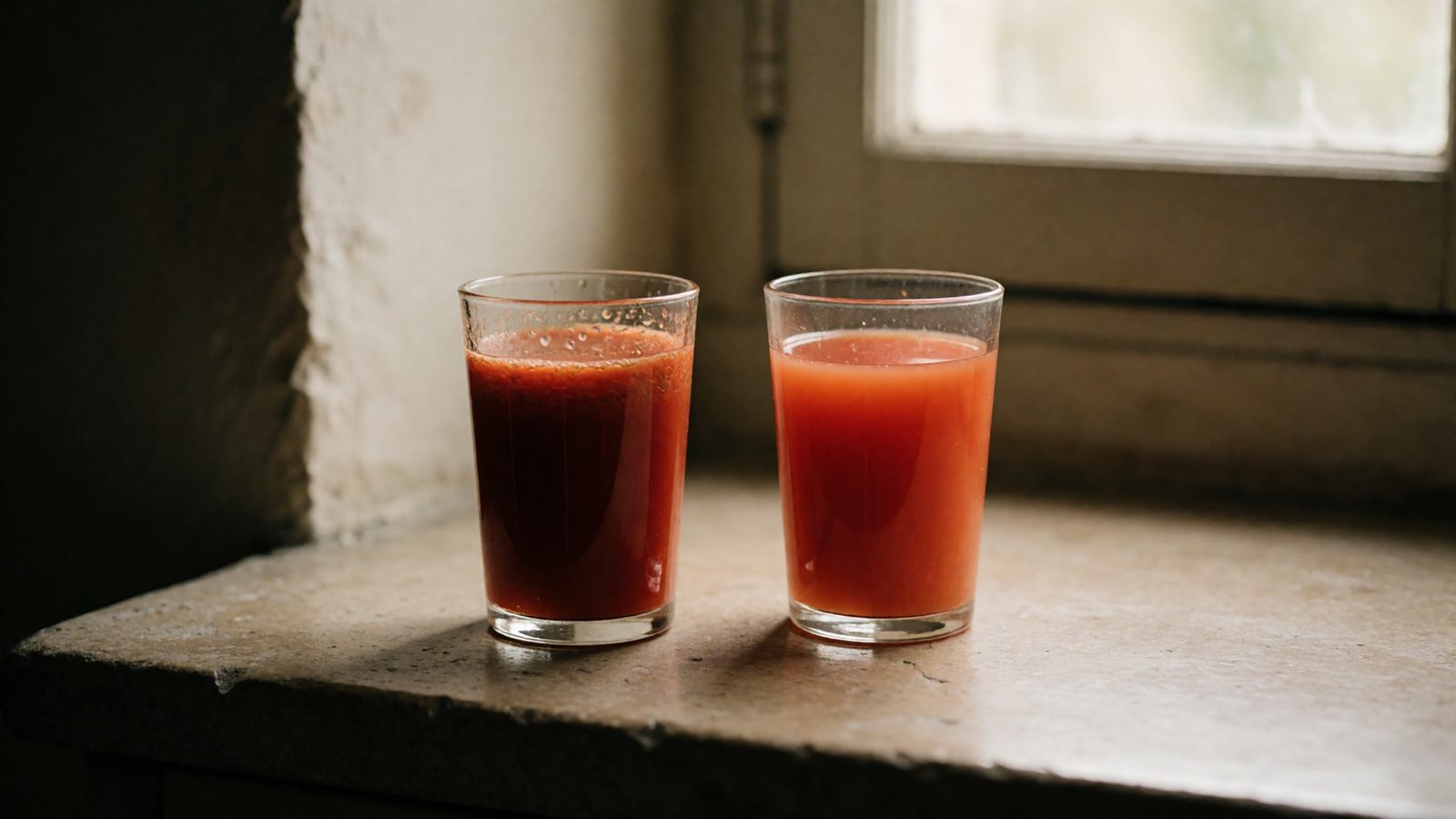
Stripping the sludge out of a Bloody Mary and ending up with a clear, intensely flavored tomato water is one of the more theatrical things you can do with this drink at home. There are three real ways to get there — freeze-thaw, agar, and gelatin clarification — and they work on genuinely different mechanisms, not just different levels of effort.
Freeze-thaw: the no-equipment method
Freeze salted tomato puree solid, then let it thaw slowly through a cheesecloth-lined strainer. Freezing ruptures the plant cell walls; as the block thaws, the water trapped inside those cells drains out through the broken structure, carrying dissolved flavor with it, while the solid pulp and pigment stay behind in the filter. No additives, no equipment beyond a freezer and a strainer — just time. Expect 12 to 24 hours from frozen block to finished tomato water.
Agar: the fast, precise method
Agar, a seaweed-derived hydrocolloid, sets a liquid into a firm gel when heated and cooled. Heat salted tomato puree with a small measured amount of agar powder, let it set, then break the gel into pieces and let it weep clear liquid through a strainer over a few hours. The gel structure holds solids in place while remaining permeable enough for water to slowly escape. It’s the fastest of the three methods start to finish, but it requires a gram scale (agar ratios need to be precise, usually around 0.5% of the puree’s weight) and agar powder, which isn’t a typical pantry item.
Gelatin Clarification: The Older Method
Before agar clarification became common in professional kitchens, gelatin did similar work through a different mechanism: warm salted puree to around 120°F, bloom and stir in gelatin, then freeze the mixture solid and thaw it through a strainer. As it thaws, the gelatin’s protein network collapses and releases clear liquid while trapping solids in the collapsed structure. It still requires the freeze step freeze-thaw uses on its own, plus an extra ingredient and an extra step, which is why most modern clarification guides treat it as a historical stepping stone to agar rather than the best available option today.
Why clarify a Bloody Mary at all
A clarified Bloody Mary trades body and visual familiarity for something genuinely different: a drink that tastes more purely and intensely of tomato because the pulp, seeds, and skins that normally carry a lot of the “green,” slightly bitter notes of raw tomato flesh have been left behind. What comes through instead is closer to the pure fruit sugar and acid of the tomato, without the vegetal undertone. It’s a legitimate flavor argument, not just a visual trick for a dinner party, though the visual effect (a drink that reads as suspiciously clear for something that tastes unmistakably like a Bloody Mary) is part of the appeal too.
This isn’t a technique for every occasion. A clarified build loses the substantial, almost food-like body that makes a traditional Bloody Mary work as a brunch centerpiece; it drinks more like a sophisticated aperitif than a hearty morning cocktail. Save it for when clarity and precision are the point, a dinner party, a tasting menu, a moment where the drink is meant to surprise rather than satisfy the way a full traditional build does.
Scaling up a batch
All three methods scale linearly with volume, but yield drops as volume increases, since clarification is inherently lossy; you’re extracting a fraction of the original liquid, not converting all of it. Expect to start with roughly twice the volume of raw tomato puree as the finished clarified liquid you want, regardless of which method you use. For a dinner party quantity (a batch clarifying enough for 6 to 8 drinks), the agar method’s speed advantage becomes more meaningful, since scaling up a multi-day freeze-thaw process for a large batch takes real freezer space and real patience that a same-day agar batch doesn’t require.
Which one to actually use
Freeze-thaw is the right starting point if you don’t already own a gram scale or agar powder — it needs nothing you don’t already have, just patience. Agar is worth the small investment if you plan to clarify things regularly; it’s faster and slightly more consistent between batches once you’ve dialed in the ratio. Gelatin is worth knowing about but rarely worth choosing over the other two for a home Bloody Mary project specifically, since it combines freeze-thaw’s time requirement with an extra ingredient and step.
Whichever method you use, don’t press or squeeze the solids to speed things up. All three techniques rely on gravity and passive drainage; forcing the process pushes pulp and pigment back through the filter and clouds the batch you were trying to clarify in the first place.
What to do with the leftover solids
All three methods leave behind a pulp that’s now been stripped of most of its liquid but still carries concentrated tomato flavor and, in the agar method’s case, a gelled texture. Don’t discard it reflexively. The strained solids work well stirred into a bloody mary mix intended for a traditional, non-clarified build, adding back concentrated tomato flavor without diluting a fresh batch the way plain water would. They also work as a base for a quick pan sauce or a shakshuka-style egg dish, since the flavor concentration that made them unwanted in a clear cocktail is exactly what makes them useful in a cooked application. Treating clarification as a zero-waste technique, using both halves of what the process produces, is more in keeping with treating this as serious kitchen craft than tossing half the tomato in the trash.
Frequently Asked Questions
How do you clarify tomato juice with agar agar?
Heat salted tomato puree with about 0.5% agar powder by weight to roughly 195°F, let it set into a firm gel in the refrigerator, then break the gel apart and let it drain through a cheesecloth-lined strainer for a few hours.
Can you use gelatin to clear a Bloody Mary?
Yes — bloom gelatin into warmed, salted tomato puree, freeze the mixture solid, then thaw it through a strainer. The collapsing gelatin structure releases clear liquid as it thaws.
Does freezing and thawing tomatoes make clear juice without any additives?
Yes — freezing ruptures the cell walls on its own, and slow thawing through a filter lets the released liquid drain clear while pulp and pigment stay behind. No gelatin or agar is required, just time.
Does boiling the puree ruin the flavor before clarifying?
Sustained boiling drives off some of the volatile compounds responsible for fresh tomato aroma. The agar method here only needs to reach about 195°F to dissolve the agar, well short of a rolling boil, to avoid that loss.
Sources
- These are standard professional-kitchen clarification techniques (freeze-thaw, gelatin clarification, agar/hydrocolloid clarification); no single claim above depends on a specific safety threshold requiring a dedicated citation.
A note on how this was written
The three techniques described are established culinary clarification methods; the comparison and recommendations here are reasoned from how each technique works, not a personally tasted side-by-side of all three. Treat the agar ratio and thaw times as reasonable starting points to refine.
Equipment worth having before you start
Freeze-thaw needs the least: a blender, a freezer container, cheesecloth or a coffee filter, and a fine mesh strainer, all likely already in a reasonably equipped kitchen. Agar clarification adds a gram scale (precision matters more here than almost anywhere else in home cocktail-making) and actual agar powder, sold in the baking or Asian grocery aisle of most well-stocked stores, or easily ordered online. Neither method needs specialized bar equipment, a centrifuge or a rotary evaporator the way some professional clarification techniques do; both are genuinely achievable in a normal home kitchen, which is the entire premise of covering them here rather than treating clarification as a restaurant-only technique.
Related Reading
- The Clarified Tomato Water Bloody Mary
- The Viscosity Variable — Nailing the Perfect Bloody Mary Mouthfeel
- For the classic build this technique departs from, see the bloody mary recipe.
Leave a Reply