Author: Claude Code

  • The Lower-Sodium Bloody Mary: Why It’s Making You Puffy, and How to Fix It

    The Lower-Sodium Bloody Mary: Why It’s Making You Puffy, and How to Fix It

    You wake up after a solid brunch session, two or three Bloody Marys deep. You paced yourself, drank water, did everything right, and you’re not exactly hungover. But your face looks puffy, your rings are tight, and your eyes have that faint, swollen look. That’s not alcohol. That’s the sodium in Bloody Mary mix, and a lot of it.

    The Sodium in Bloody Mary, Before the Vodka Goes In

    Most commercial Bloody Mary mixes run somewhere between 600 and over 900 milligrams of sodium per serving, before you’ve added anything else. And you always add something else: Worcestershire sauce brings sodium, prepared horseradish brings sodium, hot sauce brings sodium, olive brine brings sodium, and a celery salt rim adds still more on top. Stack a loaded garnish tower on top of all that, olives, bacon, cured meats, pickles, and the drink stops being a cocktail with a salty edge and starts being a genuine sodium bomb with a celery stalk in it.

    Why sodium specifically causes the puffiness

    Sodium pulls water into your bloodstream and tissues by osmosis, and a large sodium load, especially combined with alcohol’s own effect on kidney function, leads to short-term water retention. Puffiness in the face and tightness in rings and around joints are common, visible signs of that retention. It resolves on its own within a day as your kidneys process the excess sodium, but a glass this salty on a semi-regular basis is worth addressing at the source rather than just waiting it out each time.

    Building a genuinely lower-sodium version

    Start with no-salt-added tomato juice, and actually read the label: “low sodium” and “no salt added” are not the same claim, and a “low sodium” mix can still be bringing a meaningful amount to the glass. From there, control every other ingredient deliberately rather than free-pouring. A measured dash of Worcestershire instead of a heavy splash. A prepared horseradish rather than one packed in a salty brine. A hot sauce you’ve tasted on its own and actually know the salt level of, rather than assuming.

    Building your own base from scratch is the only way to fully control the sodium load. If you’d rather use a pre-made mix, compare labels rather than assuming all bottled mixes are equally salty; see this site’s supermarket mix showdown for a real side-by-side of what’s actually on a few major labels.

    On the rim and in the seasoning, celery salt is still worth using since it’s doing real flavor work beyond just being salty, but use it with intention rather than a heavy, unmeasured hand, and consider skipping a second salted element (a briny olive garnish on top of an already-salted rim, for instance) rather than stacking two or three sodium sources into the same glass.

    A reasonable target

    There’s no single “correct” sodium number for a cocktail, but a homemade build using no-salt-added tomato juice, a measured seasoning hand, and a single salted rim can land well under half of what a heavily garnished, bottled-mix-based drink often carries. A great Bloody Mary should read as bold, layered, and savory. It shouldn’t leave you looking like you slept face-down on a bag of pretzels.

    Frequently Asked Questions

    Are Bloody Marys bad for blood pressure?
    A single heavily salted drink isn’t a long-term blood pressure risk on its own, but someone already managing sodium intake for blood pressure reasons should treat a loaded Bloody Mary as a meaningful contributor to their daily total, not an afterthought.

    How do you lower the sodium in a brunch cocktail without losing flavor?
    Use no-salt-added tomato juice as the base, measure rather than free-pour salty seasonings like Worcestershire and hot sauce, and lean on flavor sources that aren’t primarily salt, like fresh citrus, black pepper, and horseradish’s heat, to keep the drink interesting.

    What is the lowest-sodium Bloody Mary mix?
    Of commercial mixes compared on this site, Zing Zang’s label runs lowest per serving, though serving sizes differ between brands enough that a direct ounce-for-ounce comparison takes some math. See the supermarket mix showdown for the full label comparison.

    Is clamato juice lower in sodium than tomato juice mixes?
    It varies by brand and isn’t a given either way; check the specific label rather than assuming Clamato is automatically lower or higher sodium than a tomato-only mix.

    Sources

    • Sodium and water-retention physiology (osmotic fluid shift into tissue) is standard, widely established physiology; no single claim above depends on a specific citation beyond general medical knowledge already reflected in this site’s hangover physiology piece, which cites Cleveland Clinic on the related alcohol-and-dehydration mechanism.

    A note on how this was written

    This page merges Gene’s original puffy-face post (published April 2026) with expanded sodium-reduction guidance. The original post’s own voice and opinions are preserved in substance; punctuation was updated to match this site’s current no-em-dash style guide, which postdates that original post. The physiology (sodium’s osmotic effect on fluid retention) is standard medical knowledge, not a personally tested claim.

    Related Reading

  • The Dinner Bloody Mary: Pairings for the Evening Glass

    The Dinner Bloody Mary: Pairings for the Evening Glass

    This site already has a brunch Bloody Mary food pairing guide, built around eggs and other classic morning food. This one is different on purpose: it’s about dinner, where a Bloody Mary’s acid, salt, and umami do a completely different job than they do next to a soft poached egg.

    Red meat is the obvious pairing, for a real reason

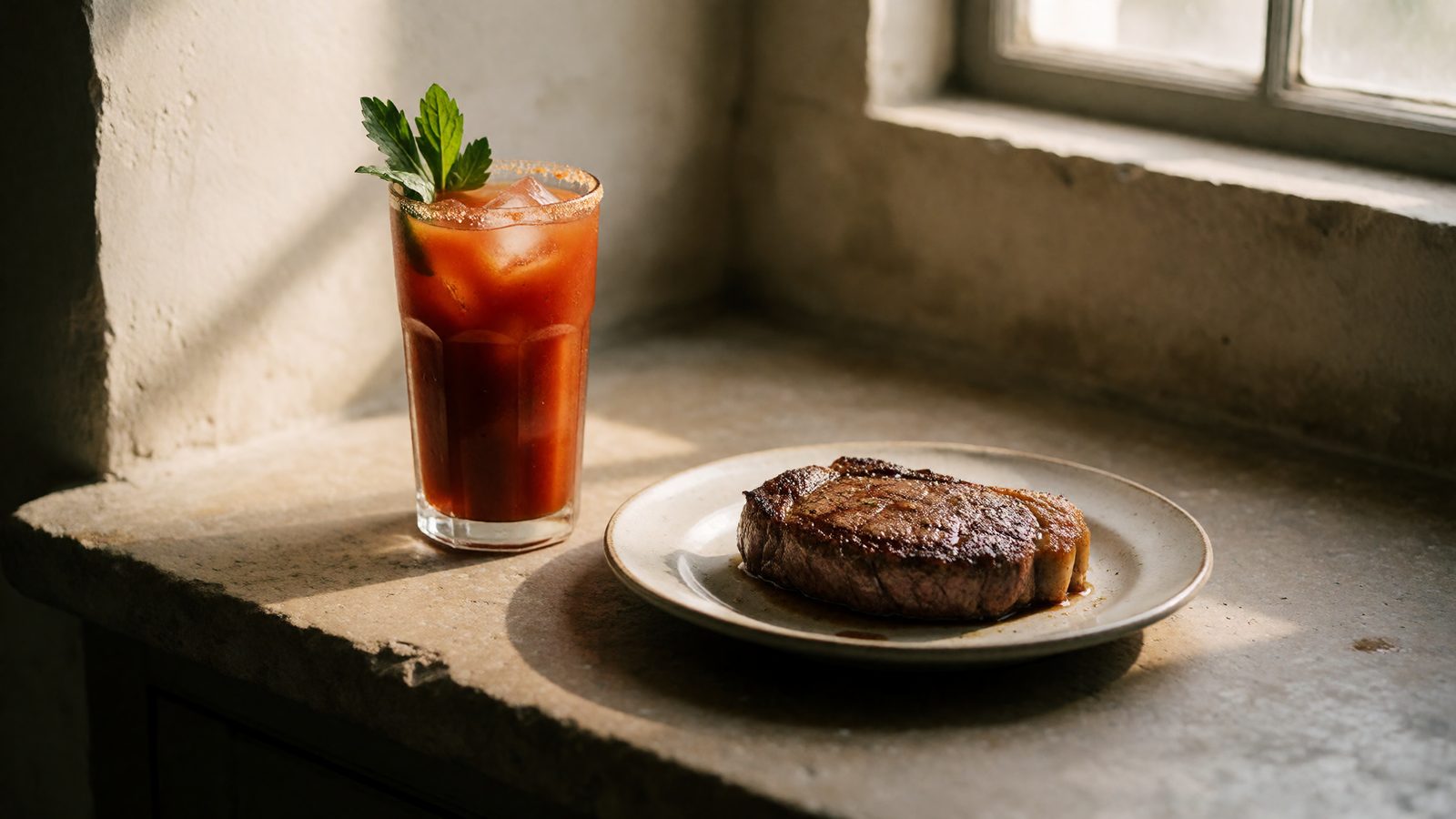
    A well-marbled steak is rich, fatty, and mineral in a way that needs a genuinely acidic, high-umami counterpunch — the same principle that makes a bold red wine work with red meat. A Bloody Mary brings tomato’s acid and glutamate, Worcestershire’s inosinate, horseradish’s sharp heat, and black pepper’s bite, all of which cut through fat the way a squeeze of lemon cuts through a rich pan sauce. It’s not a novelty pairing; it’s structurally the same job a steak sauce does, just in liquid form.

    Where it beats wine

    Wine pairs with red meat through tannin and acid. A Bloody Mary pairs through acid, salt, and umami synergy all at once — a wider set of tools working simultaneously. That makes it a genuinely useful pairing for dishes that fight most wine badly: something heavily spiced, something with a strong char or smoke element from the grill, or a dish built around Worcestershire or soy-based glazes that can make wine taste metallic or flat by comparison.

    More Bloody Mary Food Pairing Ideas Beyond Steak

    Grilled and smoked foods generally share red meat’s need for acid and salt to balance char and fat, which makes a Bloody Mary a natural match for barbecue, blackened fish, or a smoky roasted vegetable spread, not just a ribeye. Raw and cured seafood — oysters, a shrimp cocktail, ceviche — also pairs well, since a Bloody Mary’s briny, savory character echoes the sea rather than competing with it, similar to how a Caesar or a classic mignonette works alongside oysters.

    Matching the build to the specific cut

    A fattier cut like a ribeye or a short rib can take the full weight of a heavily spiced, horseradish-forward build without the drink getting lost; there’s enough fat on the plate to stand up to real heat. A leaner cut, a filet or a flank steak, does better with a slightly gentler hand on the spice, since there’s less richness on the plate to buffer against and an overly aggressive drink can end up dominating a delicate cut rather than complementing it. The same logic that governs pairing a big, tannic red with a fatty cut and a lighter red with a leaner one applies here, just with acid and heat standing in for tannin.

    Lamb, with its distinct mineral, slightly gamey character, pairs particularly well with a Bloody Mary built around fresh herbs, rosemary or mint muddled lightly into the base, which echoes classic lamb seasoning rather than fighting it. Pork, especially something with a sweet glaze like a barbecued rib or a ham, wants a build with more acid and less sweetness than usual to cut through that glaze rather than compound it.

    Batching for a dinner party

    A dinner-oriented Bloody Mary is one of the easier cocktails to batch ahead for a group, since its seasoned base actually improves over a few hours in the fridge the same way a marinade does. Batch the tomato base with all the seasoning except the alcohol earlier in the day, then build individual glasses to order at the table so each guest controls their own spirit level. This also solves the pacing problem a dinner party creates that brunch doesn’t: guests moving between wine, a Bloody Mary, and whatever else is being poured need to be able to opt in and out of alcohol without you remixing a whole pitcher, and a pre-batched base with vodka added glass by glass handles that cleanly.

    What doesn’t work as well

    Delicate white-fish preparations and most poultry, especially anything sauced lightly with butter or cream, tend to lose out next to a Bloody Mary’s assertive acid and spice; the drink simply overwhelms food that’s built around subtlety rather than richness. This isn’t a hard rule, a Bloody Maria alongside a well-spiced fish taco holds up fine, but a delicately poached sole or a simple roast chicken is better served by something quieter. Save the Bloody Mary for the meal that can actually stand up to it.

    Adjusting the build for an evening glass

    A dinner-oriented Bloody Mary can afford to run bolder than a brunch build — heavier Worcestershire, a spicier hot sauce, a more aggressive horseradish pour — since it’s meant to stand up to a substantial plate of food rather than ease someone into a Sunday morning. A smoked salt rim (see this site’s celery salt vs. smoked salt comparison) also reads more at home on a dinner table than it does with eggs, echoing a grill or smoker rather than a brunch spread.

    Glassware and serving temperature for an evening pour

    A brunch Bloody Mary is almost always served long, over plenty of ice, in a tall glass meant to last through a leisurely morning. A dinner pour can afford to be smaller and slightly less diluted, closer to a rocks glass with a single large ice cube than a full highball packed with cubes that melt and water the drink down over the course of a meal. Less dilution means the drink stays at full strength and full seasoning through the whole plate, which matters more at dinner, where the drink is meant to actively work alongside food rather than just accompany a long, unhurried morning.

    Garnish can also scale down for an evening pour. A brunch Bloody Mary garnished like a small meal (celery, olives, a strip of bacon) makes sense when it’s arriving instead of a full breakfast. At dinner, where a real plate of food is already on the table, a simpler garnish, a single lemon wedge or a sprig of the same herb used on the plate, keeps the drink from competing with the meal it’s meant to complement.

    Frequently Asked Questions

    What snacks or dishes pair best with a spicy Bloody Mary at dinner?
    Red meat, grilled or smoked foods, and raw or cured seafood all pair well, since the drink’s acid and umami are built to cut through fat and richness the way a bold red wine does with steak.

    Is a Bloody Mary too heavy to drink with a big meal?
    Not if the build is balanced — the acid and spice are what make it work alongside rich food rather than compete with it, the same logic behind pairing a bold red wine with steak.

    Should a dinner Bloody Mary be stronger or spicier than a brunch one?
    It can afford to be, since it’s meant to stand up to a full plate of food rather than ease into a morning. A bolder Worcestershire and horseradish pour, and a smokier rim, both suit an evening build well.

    What food doesn’t pair well with a Bloody Mary?
    Delicate preparations built around subtlety rather than richness, a lightly poached white fish or a simply roasted chicken, tend to get overwhelmed by the drink’s assertive acid and spice. Save it for food with enough fat or char to stand up to it.

    Can you batch a Bloody Mary base ahead of time for a dinner party?
    Yes, and it’s one of the easier cocktails to prep ahead: batch the seasoned tomato base without the alcohol earlier in the day, then build individual glasses to order so guests control their own spirit level.

    Sources

    • No claims in this piece require a specific external citation; the pairing logic (acid and umami cutting through fat) is standard, widely known culinary reasoning.

    A note on how this was written

    The pairing logic here is standard food-and-drink reasoning (acid and umami balancing fat and richness) applied specifically to dinner contexts, not a personally tasted set of pairings. Treat the specific dish suggestions as a starting point.

    Related Reading

  • Salt Brine Mathematics: The Formula for Perfect Fermentation

    Salt Brine Mathematics: The Formula for Perfect Fermentation

    Every lacto-fermentation recipe on this site, starting with the 5-day fermented Bloody Mary, depends on getting the salt percentage right, which is exactly what this salt brine calculator solves. Too little and spoilage organisms can outcompete the lactic acid bacteria before the batch turns safely acidic. Too much and the ferment stalls or turns harshly salty. The math is simple; it’s just easy to skip when a recipe says “add salt to taste” instead of giving you a number.

    The formula

    Weigh your vegetables and your water together, then multiply that total weight by your target percentage (as a decimal) to get the grams of salt you need.

    Total weight (grams) × target percent ÷ 100 = grams of salt

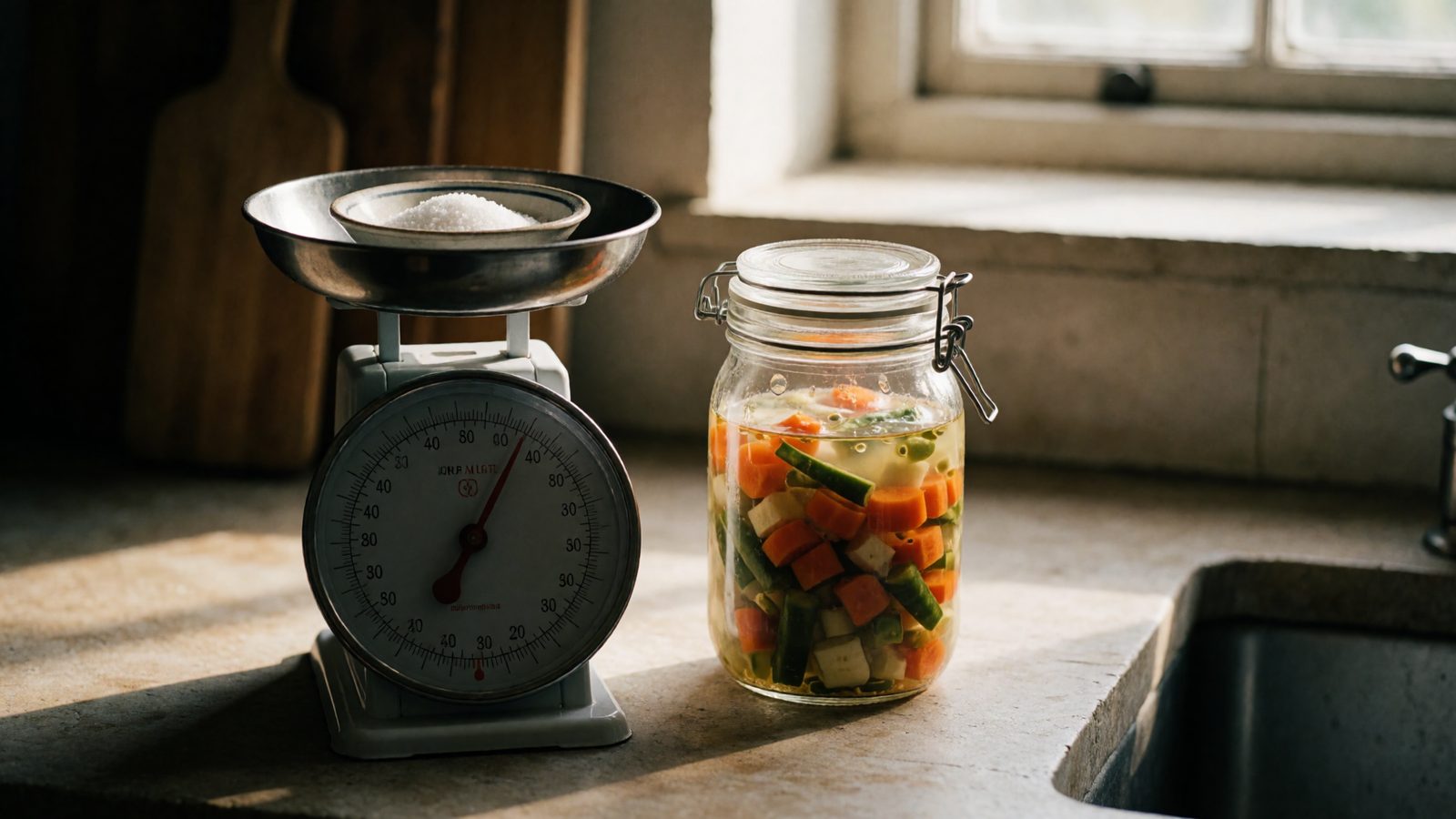
    For a 2% brine with 1,000 grams of combined tomatoes and water, that’s 1,000 × 2 ÷ 100 = 20 grams of salt. Use a kitchen scale, not measuring spoons — salt density varies enough between brands and crystal sizes (fine sea salt vs. coarse kosher, for instance) that a tablespoon of one isn’t a tablespoon of the other in actual grams.

    Salt Brine Calculator

    Brine %Salt needed
    2.0% (light, cocktail-base ferments)20.0 g
    2.5% (standard vegetable ferment)25.0 g
    3.0% (firmer vegetables, warmer rooms)30.0 g

    Why weight, not volume

    A tablespoon of fine sea salt and a tablespoon of coarse kosher salt are not the same amount of salt. Fine salt packs more tightly, so a tablespoon of it can weigh 25 to 30 percent more than the same volume of a coarse, flaky kosher salt. Recipes that specify salt by the tablespoon are making an assumption about which product you own, and that assumption is often wrong. A gram is a gram regardless of crystal size, which is the entire reason this math is worth doing on a scale rather than trusting a spoon. A basic digital kitchen scale, accurate to a single gram, costs less than a bottle of good vodka and removes this variable permanently from every ferment you make afterward.

    The same logic applies to the vegetables and water together, not just the salt. “Total weight” in the formula above means the combined weight of everything going into the jar that isn’t salt: the vegetables themselves, plus any water added to submerge them. If you’re using a vegetable that releases its own liquid as it sits (shredded cabbage for sauerkraut is the classic example), weigh it before that liquid comes out, since the water it releases is already accounted for in the vegetable’s own starting weight.

    How temperature changes the timeline, not the math

    The salt percentage itself doesn’t change with room temperature, but how quickly the ferment reaches a safe, stable pH does. Lactic acid bacteria are more active in a warmer room, generally in the 70 to 75°F range, and a ferment held there can reach a safely low pH a day or more faster than the same jar sitting somewhere closer to 60°F. This is why a firmer 3 percent brine is worth considering in a warm kitchen in summer: the higher salt level buys extra protection against spoilage organisms during the slower early phase before the lactic acid bacteria have produced enough acid to take over on their own.

    Going the other direction, a ferment left somewhere quite cool, a basement or an unheated pantry in winter, will simply take longer to reach the same endpoint rather than failing outright. Patience is the correct response to a slow, cool ferment, not more salt. Adding extra salt to compensate for a cold room just makes an already-slow ferment even slower, since lactic acid bacteria are somewhat salt-sensitive at the upper end of the safe range.

    Troubleshooting by the numbers

    If a ferment tastes flat, mushy, or slightly slimy rather than cleanly sour, the salt percentage was very likely too low for the conditions it fermented in, letting less desirable organisms get a foothold before the lactic acid bacteria could dominate. If a ferment refuses to develop any real sourness after a week or more and just tastes like salty water, the percentage may have been high enough to meaningfully slow the lactic acid bacteria down; this is more common at the very top of the range (3 percent and above) combined with a cool room. In both cases, the fix on the next batch is adjusting the percentage within the established 2 to 3 percent range and matching it to your actual room temperature, not abandoning weight-based measurement for guesswork.

    Which percentage to pick

    2% sits at the lighter end and is what this site’s lacto-fermented Bloody Mary recipe uses, since the base needs to stay pourable and mild enough to build a drink from, not eat as a pickle. 2.5% is the general-purpose standard for most vegetable ferments, a safe default if you’re not sure which to pick. 3% is worth using for firmer vegetables that hold up to more salt, or in a warmer room where a slightly higher salt level helps keep spoilage organisms in check while the lactic acid bacteria get established.

    Whichever percentage you use, the safety principle is the same: the National Center for Home Food Preservation’s general fermenting guidance puts the workable range at roughly 2 to 3 percent salt by weight for vegetable ferments, with the pH needing to drop below 4.6 before the batch is reliably safe from botulism risk. Going meaningfully below 2% is what actually risks a ruined batch, not a matter of taste preference.

    Frequently Asked Questions

    What is the salt ratio for fermenting vegetables?
    Roughly 2 to 3 percent salt by weight of the combined vegetables and water, per National Center for Home Food Preservation guidance. Lower risks spoilage outcompeting the lactic acid bacteria; higher can stall the ferment.

    Can you use table salt instead of kosher or canning salt?
    Not ideally — iodized table salt often contains anti-caking agents that can cloud a brine, and iodine itself can slow fermentation. Non-iodized kosher salt or canning/pickling salt is the standard choice.

    Does the salt percentage change with vegetable type?
    Slightly — firmer, denser vegetables generally tolerate the higher end of the 2 to 3 percent range better than something delicate like leafy greens, which are often fermented closer to 2 percent to avoid an overly salty result.

    Should the salt percentage be based on the vegetables alone, or the vegetables plus water together?
    The combined weight of everything in the jar, vegetables and any added water together. Basing the percentage on the vegetables alone and ignoring water added to submerge them will produce a brine that’s noticeably weaker than intended, since the salt ends up diluted across more total liquid than the calculation accounted for.

    What happens if I get the salt percentage wrong by a small amount?
    A percentage off by a few tenths of a point (2.3 percent instead of 2.5, for instance) rarely ruins a batch outright; the safe range has some built-in tolerance. Being off by a full percentage point or more, especially on the low side, is where real risk starts, which is why weighing rather than eyeballing matters more as the batch size grows.

    Sources

    A note on how this was written

    The salt percentage ranges and safety threshold come from the National Center for Home Food Preservation guidance linked above. The calculator is a straightforward arithmetic tool, not a tasted or tested claim.

    Related Reading

  • The 12-Person Brunch: An Hour-by-Hour Host Timeline

    The 12-Person Brunch: An Hour-by-Hour Host Timeline

    This site already has a blueprint for building a DIY Bloody Mary bar — batching ratios, station spacing, how much vodka to buy. This piece assumes you’ve read that and answers a different question: not what to set up, but when. A 12-person brunch fails or succeeds based on timing, not ingredients.

    T-minus 24 hours

    Batch the seasoned tomato base — juice, Worcestershire, hot sauce, horseradish, black pepper, everything except the alcohol — and refrigerate it overnight. The flavors round out and marry over a day the way they don’t in a base mixed an hour before guests arrive. This is also when you should do any grocery math: for 12 people at roughly 1.5 drinks each over a few hours, plan for about a liter and a half of vodka and a full gallon of base.

    T-minus 3 hours

    Prep every garnish component and store it separately, covered, in the fridge: celery stalks trimmed, lemon and lime wedges cut, olives on picks if you’re pre-skewering, bacon cooked and left whole (not sliced) so it stays crisp longer. Don’t assemble garnish combinations yet — a fully built skewer sitting for three hours gets soggy where a separated component doesn’t.

    T-minus 1 hour

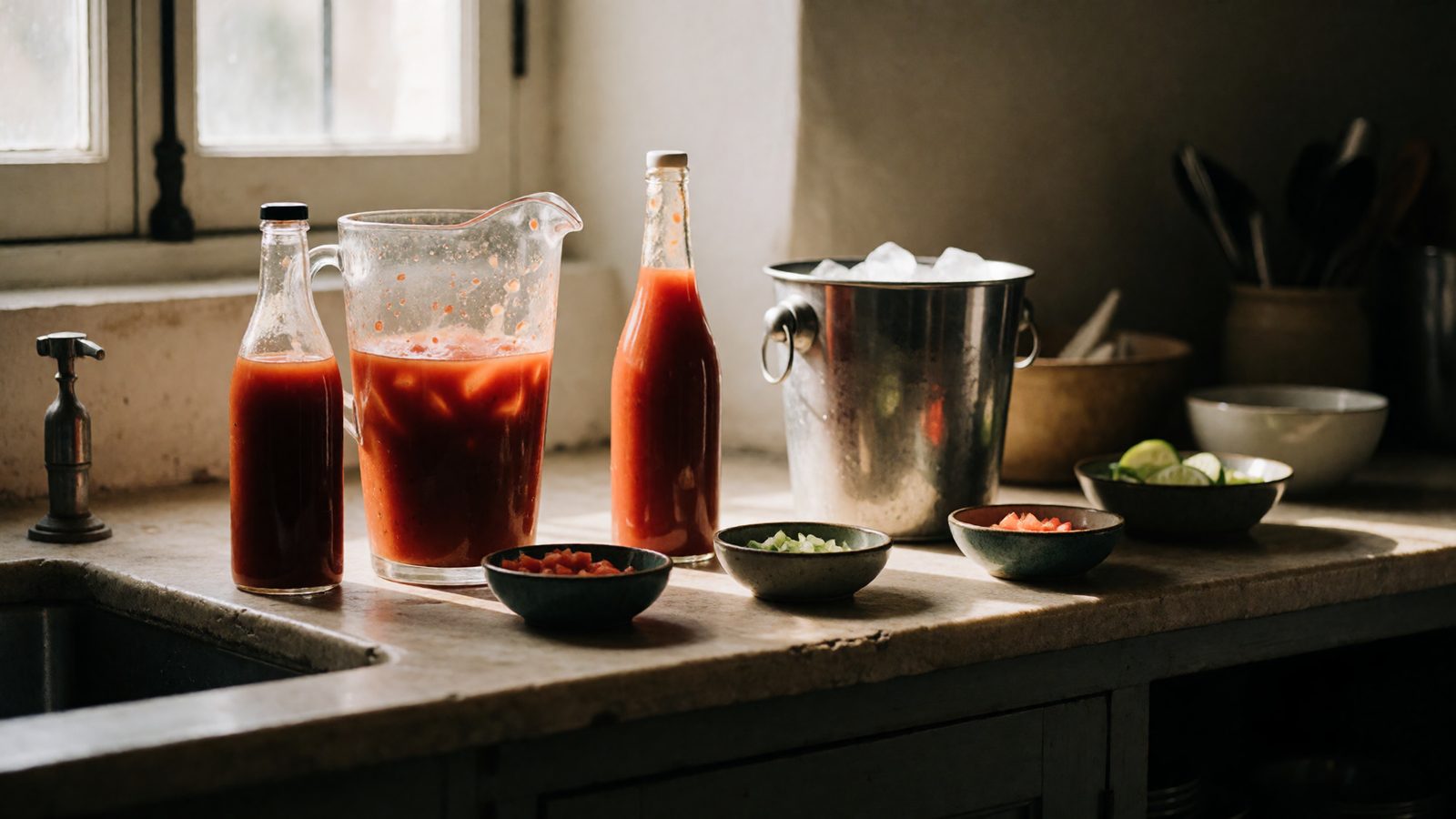
    Set up the physical bar: base in a large pitcher or dispenser, vodka in its own bottle nearby (never pre-mixed into the base — guests have different tolerances and a self-serve bar needs to respect that), rimming salt in a shallow dish, ice in a bucket with a scoop, and every garnish component in its own small bowl. This is also when you salt-rim a stack of glasses in advance, since a pre-rimmed glass saves each guest a step and keeps the salt dish from getting soggy fingers dipped in it all afternoon.

    T-minus 15 minutes

    Taste the batched base one more time before guests arrive — a day in the fridge can mellow the heat and salt slightly, and this is your last chance to adjust before it’s a self-serve station you’re not standing over. Refill the ice bucket. Put out a small printed card or a simple sign listing what’s in the base, since at least one guest at every brunch this size has a dietary question (usually about the Worcestershire, which contains anchovies) and it’s easier answered once than four separate times.

    Scaling Your DIY Bloody Mary Bar Up or Down

    This timeline is built around 12 guests, but the sequence holds regardless of group size; only the quantities change. For a smaller group of 6, halve the base and vodka amounts and the same T-minus schedule still applies. For a larger group of 20 or more, the timeline actually gets more important rather than less, since the margin for error shrinks: with more people pulling from the same pitcher faster, running out of ice or a garnish component mid-event is more likely, not less, which is why the “T-minus 15 minutes” ice-bucket refill step matters more as the group grows.

    For any group over about 15, consider a second, smaller backup batch of base kept in the refrigerator rather than trying to make one pitcher large enough to cover the whole event. A single oversized batch sitting out at room temperature for several hours is more of a food-safety consideration than a couple of smaller batches, one out and one refrigerated until needed.

    Handling dietary questions without derailing the morning

    Worcestershire sauce, a near-universal Bloody Mary ingredient, contains anchovies, which surprises people who don’t think of it as a fish product. If any guests keep kosher, halal, or a pescatarian-adjacent vegetarian diet, this is worth flagging on the printed card mentioned in the T-minus 15 minutes step rather than fielding the question one guest at a time. A simple fix, if it comes up: batch a small secondary portion of base using a Worcestershire substitute (a soy-sauce-and-balsamic blend approximates some of the same umami without the fish) and label which pitcher is which.

    What to prep the night before, if the morning is already packed

    If brunch is one part of a bigger event, a wedding morning, a holiday, a day with other logistics competing for your attention, push everything possible back to the night before rather than the T-minus 24 hour mark. The seasoned base can be made up to 48 hours ahead without losing quality, sometimes improving further with the extra day. Garnish prep (trimming celery, cutting citrus) holds for 24 hours refrigerated in an airtight container, though anything cut should go in the container dry, since wet-stored citrus and celery soften faster than the same items stored with a paper towel absorbing excess moisture. The only things that genuinely need same-day attention are the ice (which should be fresh, not a bag that’s been in the freezer accumulating freezer odors) and anything genuinely perishable, like a fresh seafood garnish.

    During: your only job is topping off

    If the first four steps were done on schedule, your only remaining job during the brunch itself is refilling the base pitcher and the ice bucket as they run low, and maybe restocking a garnish bowl that’s gone popular. Everything else — the actual mixing, the rimming, the garnishing — is the guest’s job now, which is the entire point of a self-serve bar: it exists so the host isn’t the bartender for three straight hours.

    Frequently Asked Questions

    How many ounces of vodka do you need for 12 guests?
    Figure roughly 1.5 drinks per person over a few hours at 2 oz of vodka each, which comes to about 36 oz total — a standard 1.75-liter bottle (about 59 oz) covers that with room to spare.

    Should you pre-batch the alcohol into the base, or let guests pour their own?
    Let guests pour their own. Batching the vodka into the base removes their ability to control their own drink strength, and makes it harder to serve a non-drinker from the same pitcher.

    How long does homemade Bloody Mary mix last in the fridge?
    A batched, seasoned tomato base (without alcohol) keeps well for 3 to 4 days refrigerated in a sealed container, which is why making it a full day ahead for a brunch is safe and actually improves the flavor.

    What’s the biggest timing mistake hosts make?
    Assembling garnishes too early. A fully built celery-and-olive skewer sitting out for three hours wilts and gets watery; keeping components separate until just before serving (or letting guests build their own) keeps everything crisp.

    Sources

    • No claims in this piece require a specific external citation; the timeline is standard event-hosting logistics applied to this drink.

    A note on how this was written

    This timeline is a reasoned application of standard event-prep logistics to a Bloody Mary bar specifically, not a personally run 12-person event. The quantities and timing windows are sensible starting points; adjust based on your own guests’ habits.

    After the last guest leaves

    Leftover batched base keeps for another 3 to 4 days refrigerated, so a too-generous batch isn’t wasted; it becomes the start of next weekend’s smaller batch rather than something to pour out. Leftover cut garnish, celery and citrus especially, holds up less well and is better used within a day or two in something else (a Bloody Mary garnish plate’s leftover celery makes a perfectly good snack with the same seasoned salt used for the rim) than saved indefinitely. The ice bucket and any dairy-adjacent garnish (a cheese cube, a dollop of horseradish cream) should be the first things cleared, both for food safety and because they’re the least likely to be usable again.

    Related Reading

  • The Clarification Wars: Gelatin, Agar, Freeze-Thaw

    The Clarification Wars: Gelatin, Agar, Freeze-Thaw

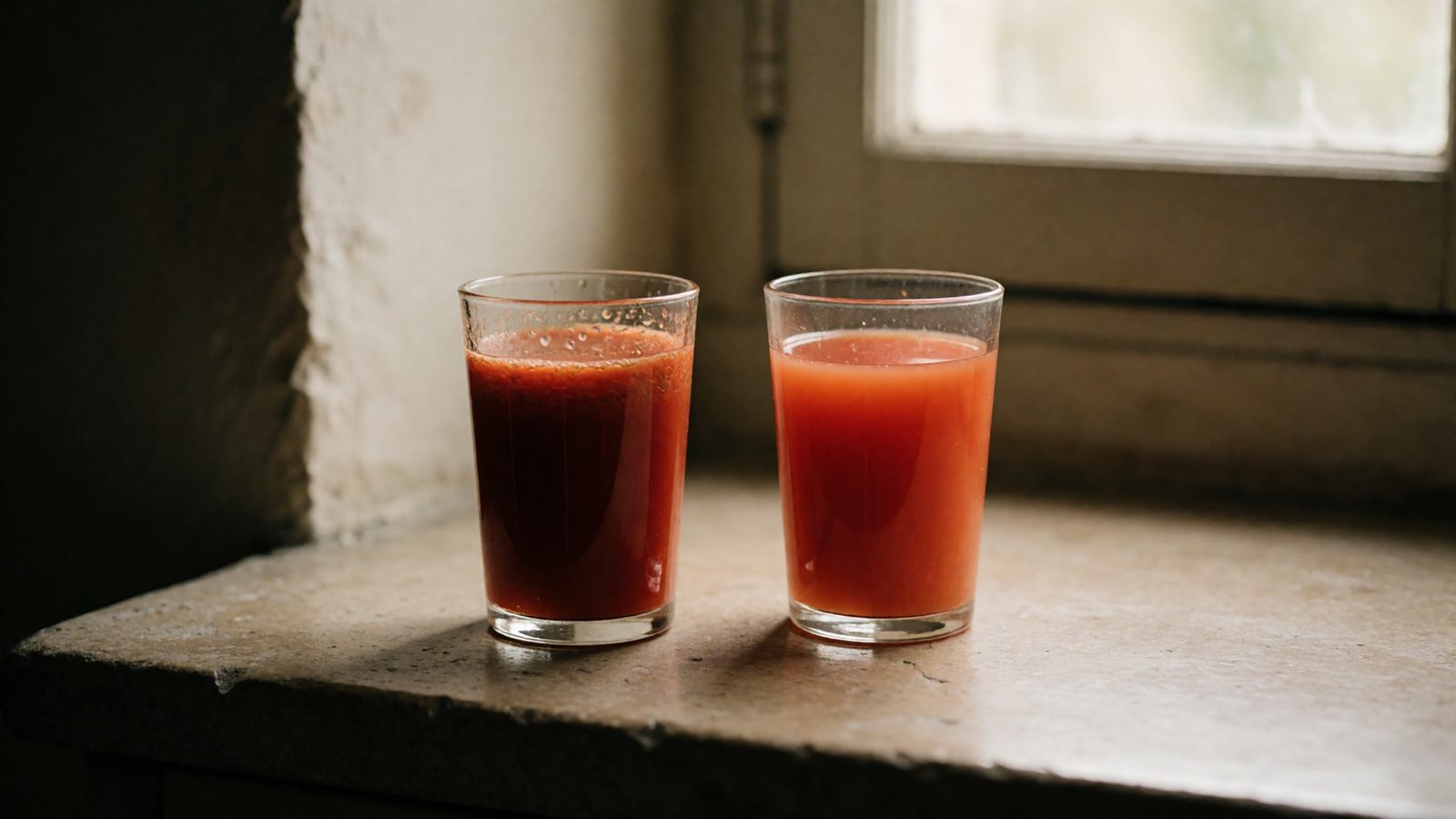
    Stripping the sludge out of a Bloody Mary and ending up with a clear, intensely flavored tomato water is one of the more theatrical things you can do with this drink at home. There are three real ways to get there — freeze-thaw, agar, and gelatin clarification — and they work on genuinely different mechanisms, not just different levels of effort.

    Freeze-thaw: the no-equipment method

    Freeze salted tomato puree solid, then let it thaw slowly through a cheesecloth-lined strainer. Freezing ruptures the plant cell walls; as the block thaws, the water trapped inside those cells drains out through the broken structure, carrying dissolved flavor with it, while the solid pulp and pigment stay behind in the filter. No additives, no equipment beyond a freezer and a strainer — just time. Expect 12 to 24 hours from frozen block to finished tomato water.

    Agar: the fast, precise method

    Agar, a seaweed-derived hydrocolloid, sets a liquid into a firm gel when heated and cooled. Heat salted tomato puree with a small measured amount of agar powder, let it set, then break the gel into pieces and let it weep clear liquid through a strainer over a few hours. The gel structure holds solids in place while remaining permeable enough for water to slowly escape. It’s the fastest of the three methods start to finish, but it requires a gram scale (agar ratios need to be precise, usually around 0.5% of the puree’s weight) and agar powder, which isn’t a typical pantry item.

    Gelatin Clarification: The Older Method

    Before agar clarification became common in professional kitchens, gelatin did similar work through a different mechanism: warm salted puree to around 120°F, bloom and stir in gelatin, then freeze the mixture solid and thaw it through a strainer. As it thaws, the gelatin’s protein network collapses and releases clear liquid while trapping solids in the collapsed structure. It still requires the freeze step freeze-thaw uses on its own, plus an extra ingredient and an extra step, which is why most modern clarification guides treat it as a historical stepping stone to agar rather than the best available option today.

    Why clarify a Bloody Mary at all

    A clarified Bloody Mary trades body and visual familiarity for something genuinely different: a drink that tastes more purely and intensely of tomato because the pulp, seeds, and skins that normally carry a lot of the “green,” slightly bitter notes of raw tomato flesh have been left behind. What comes through instead is closer to the pure fruit sugar and acid of the tomato, without the vegetal undertone. It’s a legitimate flavor argument, not just a visual trick for a dinner party, though the visual effect (a drink that reads as suspiciously clear for something that tastes unmistakably like a Bloody Mary) is part of the appeal too.

    This isn’t a technique for every occasion. A clarified build loses the substantial, almost food-like body that makes a traditional Bloody Mary work as a brunch centerpiece; it drinks more like a sophisticated aperitif than a hearty morning cocktail. Save it for when clarity and precision are the point, a dinner party, a tasting menu, a moment where the drink is meant to surprise rather than satisfy the way a full traditional build does.

    Scaling up a batch

    All three methods scale linearly with volume, but yield drops as volume increases, since clarification is inherently lossy; you’re extracting a fraction of the original liquid, not converting all of it. Expect to start with roughly twice the volume of raw tomato puree as the finished clarified liquid you want, regardless of which method you use. For a dinner party quantity (a batch clarifying enough for 6 to 8 drinks), the agar method’s speed advantage becomes more meaningful, since scaling up a multi-day freeze-thaw process for a large batch takes real freezer space and real patience that a same-day agar batch doesn’t require.

    Which one to actually use

    Freeze-thaw is the right starting point if you don’t already own a gram scale or agar powder — it needs nothing you don’t already have, just patience. Agar is worth the small investment if you plan to clarify things regularly; it’s faster and slightly more consistent between batches once you’ve dialed in the ratio. Gelatin is worth knowing about but rarely worth choosing over the other two for a home Bloody Mary project specifically, since it combines freeze-thaw’s time requirement with an extra ingredient and step.

    Whichever method you use, don’t press or squeeze the solids to speed things up. All three techniques rely on gravity and passive drainage; forcing the process pushes pulp and pigment back through the filter and clouds the batch you were trying to clarify in the first place.

    What to do with the leftover solids

    All three methods leave behind a pulp that’s now been stripped of most of its liquid but still carries concentrated tomato flavor and, in the agar method’s case, a gelled texture. Don’t discard it reflexively. The strained solids work well stirred into a bloody mary mix intended for a traditional, non-clarified build, adding back concentrated tomato flavor without diluting a fresh batch the way plain water would. They also work as a base for a quick pan sauce or a shakshuka-style egg dish, since the flavor concentration that made them unwanted in a clear cocktail is exactly what makes them useful in a cooked application. Treating clarification as a zero-waste technique, using both halves of what the process produces, is more in keeping with treating this as serious kitchen craft than tossing half the tomato in the trash.

    Frequently Asked Questions

    How do you clarify tomato juice with agar agar?
    Heat salted tomato puree with about 0.5% agar powder by weight to roughly 195°F, let it set into a firm gel in the refrigerator, then break the gel apart and let it drain through a cheesecloth-lined strainer for a few hours.

    Can you use gelatin to clear a Bloody Mary?
    Yes — bloom gelatin into warmed, salted tomato puree, freeze the mixture solid, then thaw it through a strainer. The collapsing gelatin structure releases clear liquid as it thaws.

    Does freezing and thawing tomatoes make clear juice without any additives?
    Yes — freezing ruptures the cell walls on its own, and slow thawing through a filter lets the released liquid drain clear while pulp and pigment stay behind. No gelatin or agar is required, just time.

    Does boiling the puree ruin the flavor before clarifying?
    Sustained boiling drives off some of the volatile compounds responsible for fresh tomato aroma. The agar method here only needs to reach about 195°F to dissolve the agar, well short of a rolling boil, to avoid that loss.

    Sources

    • These are standard professional-kitchen clarification techniques (freeze-thaw, gelatin clarification, agar/hydrocolloid clarification); no single claim above depends on a specific safety threshold requiring a dedicated citation.

    A note on how this was written

    The three techniques described are established culinary clarification methods; the comparison and recommendations here are reasoned from how each technique works, not a personally tasted side-by-side of all three. Treat the agar ratio and thaw times as reasonable starting points to refine.

    Equipment worth having before you start

    Freeze-thaw needs the least: a blender, a freezer container, cheesecloth or a coffee filter, and a fine mesh strainer, all likely already in a reasonably equipped kitchen. Agar clarification adds a gram scale (precision matters more here than almost anywhere else in home cocktail-making) and actual agar powder, sold in the baking or Asian grocery aisle of most well-stocked stores, or easily ordered online. Neither method needs specialized bar equipment, a centrifuge or a rotary evaporator the way some professional clarification techniques do; both are genuinely achievable in a normal home kitchen, which is the entire premise of covering them here rather than treating clarification as a restaurant-only technique.

    Related Reading

  • The Umami Synergy: Why Tomato and Worcestershire Multiply

    The Umami Synergy: Why Tomato and Worcestershire Multiply

    A Bloody Mary tastes more savory than a glass of straight tomato juice with vodka in it has any right to, and the umami synergy between its two main ingredients is why. Worcestershire sauce is most of the reason, and the reason isn’t just that Worcestershire tastes good. It’s that tomato and Worcestershire trigger a specific, measurable chemical synergy that makes the combination taste more intense than either ingredient predicts on its own.

    The Umami Synergy Is a Taste, Not a Vibe

    Sweet, sour, salty, and bitter were the accepted basic tastes for most of the 20th century. Umami — savory, brothy, meaty — joined the list once research confirmed a dedicated receptor mechanism for it, primarily triggered by glutamate, an amino acid naturally present in tomatoes, Parmesan, soy sauce, and dozens of other foods usually described as “savory.”

    Glutamate alone is pleasant. What’s more interesting is what happens when you add a second class of compound to it.

    The multiplier, not the sum

    Ribonucleotides — inosinate and guanylate, mainly — are a separate class of umami-active compound, concentrated in things like dried fish, cured meats, and dried mushrooms. On their own, they barely register as flavorful. Combined with glutamate, the perceived umami intensity jumps well beyond what adding the two effects together would predict. Researchers documenting the mechanism describe glutamate and inosinate as binding at adjacent sites on the same taste receptor, which is the physical basis for why the combination reads as dramatically more intense rather than just “a bit more.”

    This isn’t a folk theory. It’s the same principle behind Japanese dashi, built from kombu (glutamate) and dried bonito flakes (inosinate), and it’s why a soup made from both vegetables and meat consistently tastes deeper than either stock alone.

    Where a Bloody Mary already gets this right

    Tomato juice is one of the most glutamate-rich common beverages there is — part of why a Bloody Mary tastes savory even before any seasoning goes in. Worcestershire sauce, meanwhile, is fermented with anchovies as a core ingredient, which makes it a genuine inosinate source. Add Worcestershire to tomato juice and you’re not just adding a seasoning with its own flavor profile; you’re completing a synergy pair that multiplies both.

    This is also why a Bloody Mary tolerates a heavier hand with Worcestershire than most drinks would tolerate with any single seasoning — you’re not just adding more of one flavor, you’re activating a receptor effect that doesn’t scale linearly with quantity the way a simple seasoning does.

    A short history of noticing this by accident

    Umami itself was identified as a distinct taste in 1908 by Japanese chemist Kikunae Ikeda, who isolated glutamate from kombu seaweed while trying to explain why dashi tasted more satisfying than its individual ingredients suggested it should. The synergy effect specifically, the dramatic amplification when glutamate meets a ribonucleotide, was documented decades later by researcher Akira Kuninaka, who found that combining glutamate with guanylate produced an umami intensity far beyond simple addition. Japanese cooking had been exploiting this pairing for centuries before either discovery, through dashi’s kombu-and-katsuobushi combination, without a name for the mechanism behind why it worked.

    Western cooking arrived at the same principle independently and just as unknowingly: a French stock built from both bones and vegetables, an Italian sauce that layers Parmesan over a tomato base, a British Sunday roast finished with Worcestershire, all activate the same glutamate-ribonucleotide pairing without any chef involved ever needing to know the chemistry. A Bloody Mary belongs on that list, whether or not the person who first added Worcestershire to tomato juice knew why it worked.

    Why this isn’t the same as just adding more salt

    It’s worth being precise about what the synergy effect actually is, because it’s easy to confuse with simply making a drink saltier or more seasoned. Salt amplifies flavors broadly and works on an entirely different receptor pathway than umami does; a saltier Bloody Mary tastes more intense across the board, sweeter notes and sour notes included. The glutamate-inosinate synergy is narrower and more specific: it amplifies savoriness itself, not intensity generally, which is why a well-built umami-forward Bloody Mary can taste deep and satisfying without necessarily tasting saltier than a less deliberately built one. The two effects work together in a finished drink, but they’re not interchangeable tools, and reaching for more salt when what a recipe actually needs is a better umami pairing will make the drink louder without making it better.

    Where else the synergy hides

    Fish sauce works the same way Worcestershire does, for the same anchovy-derived reason — a small amount added to a tomato base activates the identical glutamate-inosinate pairing. Dried shiitake mushrooms bring guanylate instead of inosinate, a close chemical cousin with the same synergistic effect, which is the entire premise behind this site’s black garlic and shiitake recipe. Even a splash of soy sauce, an ingredient most people wouldn’t think to add to a Bloody Mary, is doing real chemistry rather than just adding saltiness.

    None of this means more is always better — a Bloody Mary oversaturated with every umami-boosting ingredient at once tends to collapse into a muddy, one-note heaviness. The synergy is a tool for depth, not a rule that doubling every savory ingredient doubles the result again. Use it deliberately: one glutamate source (the tomato base), one or two inosinate or guanylate sources (Worcestershire, and optionally fish sauce or a mushroom element), and let the pairing do the work rather than piling on more of everything.

    A practical checklist

    Before adding another dash of anything to boost a flat-tasting Bloody Mary, check whether the base already has one clear glutamate source (tomato) and at least one clear ribonucleotide source (Worcestershire, fish sauce, or a mushroom element) working together. If it has glutamate but no ribonucleotide pairing, that’s usually the actual gap, not a need for more salt or more of the same seasoning already in the glass. If it already has both and still tastes flat, the problem is more likely elsewhere: insufficient acid, insufficient salt generally, or a base that’s simply diluted past the point either compound can do its job.

    Frequently Asked Questions

    Why does Worcestershire sauce make tomato juice taste better?
    Worcestershire is fermented with anchovies, giving it a real inosinate content. Combined with tomato juice’s naturally high glutamate level, the two trigger a documented umami synergy effect that makes the pairing taste more savory than either ingredient predicts alone.

    What is umami synergy, exactly?
    The scientifically documented effect where combining glutamate with a ribonucleotide (inosinate or guanylate) produces a perceived umami intensity well beyond what simply adding the two effects together would predict.

    Does fish sauce belong in a Bloody Mary?
    Yes, on the same chemistry as Worcestershire — fish sauce is rich in inosinate from fermented fish, and a small amount pairs with tomato juice’s glutamate to the same effect.

    Can you put A1 steak sauce or soy sauce in a cocktail and have it actually help?
    Yes — both contain glutamate and, in the case of soy sauce, some inosinate from the fermentation process, so a small amount can meaningfully deepen a tomato base rather than just adding saltiness.

    Why do chefs add MSG to tomato dishes?
    MSG is a purified, stable form of the same glutamate naturally present in tomatoes. It amplifies umami directly, the same direction this synergy pairing works, just through a single compound rather than a combination of ingredients.

    Sources

    A note on how this was written

    The umami synergy science in this piece comes from the peer-reviewed source linked above. The specific application to Bloody Mary ingredients (Worcestershire, fish sauce, shiitake, soy sauce) is a reasoned extension of that science by an AI research pass, not a personally tasted comparison of exact ratios.

    Related Reading

  • Why Bartenders Hate the Bloody Mary, and Why That Proves the Point

    Why Bartenders Hate the Bloody Mary, and Why That Proves the Point

    Bartenders hate bloody marys at exactly this moment: order one at a crowded bar at nine on a Friday night and watch what happens to the bartender’s face. It isn’t hostility exactly. It’s closer to the specific fatigue of someone being asked to do a small, disruptive, out-of-rhythm task in the middle of a much faster one.

    This is the sequel to an essay we wrote about the Bloody Mary as the last kitchen cocktail. That piece argued the drink survives because it resists the shelf-stable, poured-from-a-can treatment every other classic has accepted. This one picks up the other half of that argument: the exact reasons a busy bar struggles with this drink are the reasons a home kitchen is where it actually belongs.

    Why Bartenders Hate Bloody Marys: A Dozen Ingredients, Mid-Rush

    Most cocktails a bar serves during a rush are built from two or three components measured fast: a spirit, a modifier, maybe a citrus. A properly built Bloody Mary asks for closer to a dozen: a base, a spirit, Worcestershire, hot sauce, horseradish, salt, pepper, a rim, and however many garnishes the house puts on it. None of that is hard. All of it is slow, relative to everything else a bartender is making in the same ninety seconds.

    That mismatch is well documented in industry-facing writing about bar work generally, and it’s specific enough a complaint that it has its own dedicated r/cocktails discussion thread asking the question outright. One reply, from a bartender posting as u/bobisagirl, lays out the actual problem better than any trade article does:

    “I hated making them because everyone likes them differently. Do you want what is effectively cold tomato soup, or vodka-flavoured hot sauce? To ice or not to ice? Do you want a weird pepper rim? Are you going to cry when we don’t have celery sticks? Why are you doing this to me?

    Solution: ‘Here is a glass of vodka and tomato juice. Here is all the other stuff. Flavour it yourself. That’ll be 6.50 please.’”

    u/bobisagirl, r/cocktails

    Another commenter, u/towehaal, replied that this isn’t hypothetical: some bars have built exactly that workaround into an actual self-serve setup, handing over a glass of vodka on ice and letting the customer build the rest at a station. That’s not a bartender giving up on the drink. It’s a bartender independently arriving at the same conclusion this site is built around: the Bloody Mary works best as something you build yourself, on your own timeline.

    The rinse sink problem

    Every bar has a small sink for rinsing glassware between drinks, and tomato juice is uniquely bad news for it — it’s viscous, it’s pigmented, and it clings to glass and steel in a way clear spirits and mixers don’t. One Bloody Mary mid-shift means a rinse sink that needs real attention, not a quick dunk, at the exact moment a bartender has the least time to give it.

    None of this is a design flaw in the drink. It’s a mismatch between what the drink needs and what a fast bar is built to deliver. A kitchen counter doesn’t have a rush. It doesn’t have a rinse sink shared by four other bartenders. It has a sink, a cutting board, and as much time as you want to take.

    The custom-order problem

    Beyond the ingredient count, a Bloody Mary is one of the few classic cocktails where every customer has genuine, specific opinions about the build. Nobody sends back a gin and tonic for having the wrong ratio, but a Bloody Mary arrives with an implicit menu of decisions: how much heat, whether horseradish is welcome or unwelcome, whether the ice is a plus or a dilution risk, what the garnish should be. A bartender making ten of them in a row during a busy brunch service isn’t making the same drink ten times, they’re negotiating ten small custom orders, each with its own chance to not match what the customer actually wanted.

    That variability is part of why professional brunch services often solve this the same way u/towehaal described: hand the customer the base components and let them build to their own taste, turning a bartender’s ten unpredictable custom orders into ten self-served drinks nobody can blame the bar for getting wrong.

    Ordering one after dark

    There’s a real etiquette question buried in here too: is it rude to order a Bloody Mary at 9pm? Functionally, no bar rule forbids it. Practically, a twelve-ingredient brunch cocktail ordered during a packed evening service reads to the person making it as a request that doesn’t match the room — less a moral failing than a timing mismatch, the same way ordering a flight of drip coffee at a nightclub would be a strange thing to ask for, not a crime.

    The Bloody Mary isn’t a rush-hour drink and was never really built to be one. It’s a slow, deliberate, ingredient-heavy ritual that happens to taste best in the morning, made by someone who isn’t racing a ticket printer. That’s not a compromise. That’s the whole appeal, and it’s exactly why this site exists to help you build it properly at home instead of apologizing for ordering it somewhere it doesn’t fit.

    None of this is an argument against ordering one at brunch, where the entire service is already built around exactly this kind of drink. A dedicated brunch bar has the ice, the garnish station, and the unhurried pace a Bloody Mary actually needs; the mismatch is specifically about time and place, a fast evening bar during a packed shift, not the drink or the people ordering it. Know the room, and the same drink that’s a burden at 9pm on a Saturday is exactly what a brunch bartender is set up to deliver well.

    Frequently Asked Questions

    Why do bartenders find Bloody Marys frustrating to make?
    The high ingredient count and custom build time don’t match the pace of a busy bar shift, unlike most cocktails that scale down to a fast two- or three-ingredient pour.

    Is it rude to order a Bloody Mary at night?
    Not against any actual rule, but it’s a mismatch of timing and expectation — a slow, ingredient-heavy brunch drink ordered in the middle of a fast evening rush stands out to whoever has to make it.

    Why is the rinse sink a problem for tomato juice specifically?
    Tomato juice is thick and pigmented compared to most bar mixers, and clings to glassware and steel tools in a way that needs real cleaning rather than a fast rinse — exactly the kind of task a busy bar has the least time for mid-shift.

    Do bartenders judge you for ordering extra garnishes?
    Some find it disruptive during a rush for the same reason the base drink is disruptive — every extra component is more time away from the rest of the queue. It’s a timing complaint, not a judgment of taste.

    Sources

    A note on how this was written

    This piece was written with AI research assistance. Gene pointed to a real r/cocktails thread asking this exact question and sent a screenshot of the actual comments, since Reddit blocks automated fetching from every angle tried (direct fetch, old.reddit mirror, the public .json API). The quotes above are transcribed directly from that screenshot, not reconstructed or paraphrased.

    Related Reading