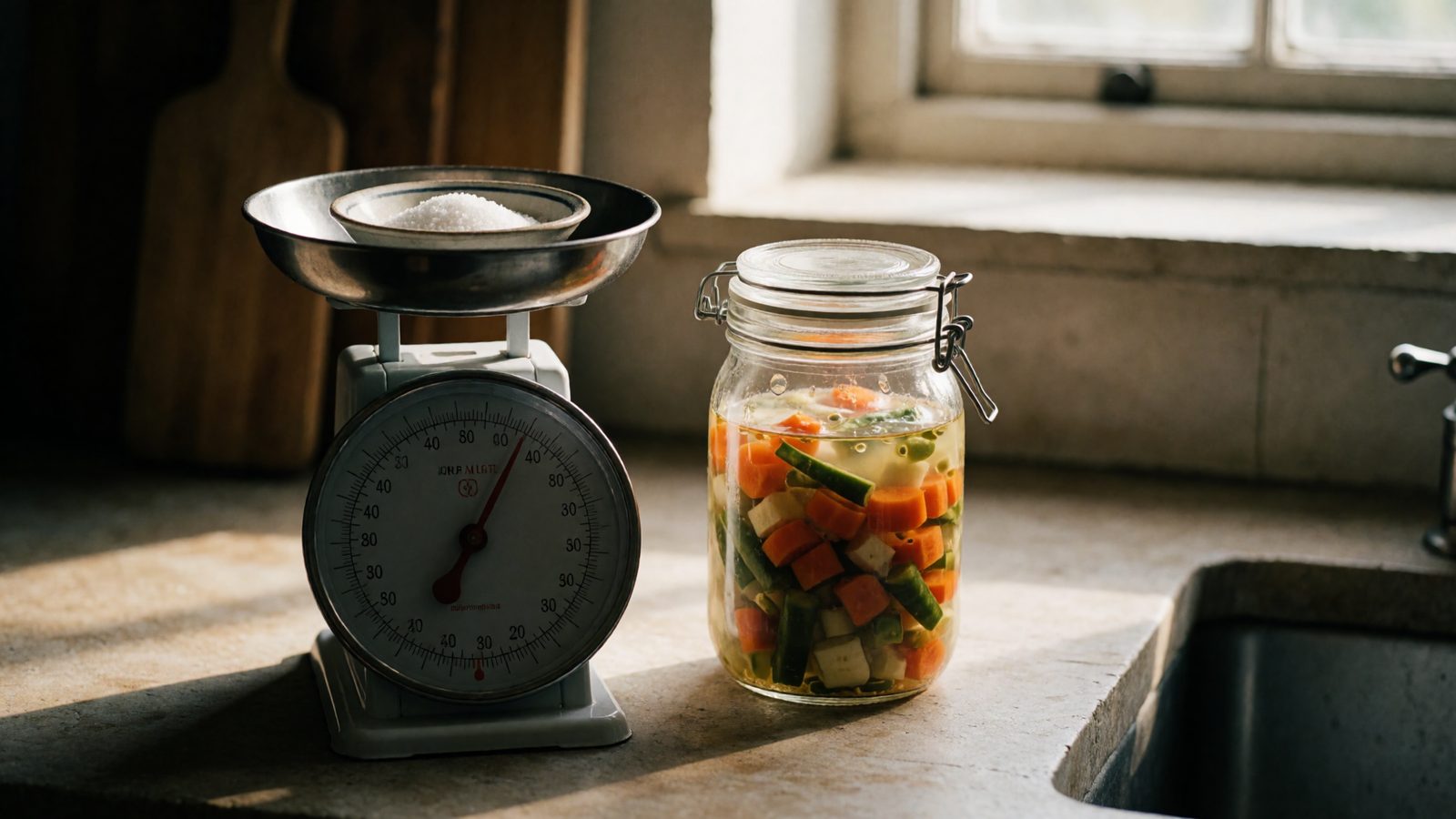
Every lacto-fermentation recipe on this site, starting with the 5-day fermented Bloody Mary, depends on getting the salt percentage right, which is exactly what this salt brine calculator solves. Too little and spoilage organisms can outcompete the lactic acid bacteria before the batch turns safely acidic. Too much and the ferment stalls or turns harshly salty. The math is simple; it’s just easy to skip when a recipe says “add salt to taste” instead of giving you a number.
The formula
Weigh your vegetables and your water together, then multiply that total weight by your target percentage (as a decimal) to get the grams of salt you need.
Total weight (grams) × target percent ÷ 100 = grams of salt
For a 2% brine with 1,000 grams of combined tomatoes and water, that’s 1,000 × 2 ÷ 100 = 20 grams of salt. Use a kitchen scale, not measuring spoons — salt density varies enough between brands and crystal sizes (fine sea salt vs. coarse kosher, for instance) that a tablespoon of one isn’t a tablespoon of the other in actual grams.
Salt Brine Calculator
| Brine % | Salt needed |
|---|---|
| 2.0% (light, cocktail-base ferments) | 20.0 g |
| 2.5% (standard vegetable ferment) | 25.0 g |
| 3.0% (firmer vegetables, warmer rooms) | 30.0 g |
Why weight, not volume
A tablespoon of fine sea salt and a tablespoon of coarse kosher salt are not the same amount of salt. Fine salt packs more tightly, so a tablespoon of it can weigh 25 to 30 percent more than the same volume of a coarse, flaky kosher salt. Recipes that specify salt by the tablespoon are making an assumption about which product you own, and that assumption is often wrong. A gram is a gram regardless of crystal size, which is the entire reason this math is worth doing on a scale rather than trusting a spoon. A basic digital kitchen scale, accurate to a single gram, costs less than a bottle of good vodka and removes this variable permanently from every ferment you make afterward.
The same logic applies to the vegetables and water together, not just the salt. “Total weight” in the formula above means the combined weight of everything going into the jar that isn’t salt: the vegetables themselves, plus any water added to submerge them. If you’re using a vegetable that releases its own liquid as it sits (shredded cabbage for sauerkraut is the classic example), weigh it before that liquid comes out, since the water it releases is already accounted for in the vegetable’s own starting weight.
How temperature changes the timeline, not the math
The salt percentage itself doesn’t change with room temperature, but how quickly the ferment reaches a safe, stable pH does. Lactic acid bacteria are more active in a warmer room, generally in the 70 to 75°F range, and a ferment held there can reach a safely low pH a day or more faster than the same jar sitting somewhere closer to 60°F. This is why a firmer 3 percent brine is worth considering in a warm kitchen in summer: the higher salt level buys extra protection against spoilage organisms during the slower early phase before the lactic acid bacteria have produced enough acid to take over on their own.
Going the other direction, a ferment left somewhere quite cool, a basement or an unheated pantry in winter, will simply take longer to reach the same endpoint rather than failing outright. Patience is the correct response to a slow, cool ferment, not more salt. Adding extra salt to compensate for a cold room just makes an already-slow ferment even slower, since lactic acid bacteria are somewhat salt-sensitive at the upper end of the safe range.
Troubleshooting by the numbers
If a ferment tastes flat, mushy, or slightly slimy rather than cleanly sour, the salt percentage was very likely too low for the conditions it fermented in, letting less desirable organisms get a foothold before the lactic acid bacteria could dominate. If a ferment refuses to develop any real sourness after a week or more and just tastes like salty water, the percentage may have been high enough to meaningfully slow the lactic acid bacteria down; this is more common at the very top of the range (3 percent and above) combined with a cool room. In both cases, the fix on the next batch is adjusting the percentage within the established 2 to 3 percent range and matching it to your actual room temperature, not abandoning weight-based measurement for guesswork.
Which percentage to pick
2% sits at the lighter end and is what this site’s lacto-fermented Bloody Mary recipe uses, since the base needs to stay pourable and mild enough to build a drink from, not eat as a pickle. 2.5% is the general-purpose standard for most vegetable ferments, a safe default if you’re not sure which to pick. 3% is worth using for firmer vegetables that hold up to more salt, or in a warmer room where a slightly higher salt level helps keep spoilage organisms in check while the lactic acid bacteria get established.
Whichever percentage you use, the safety principle is the same: the National Center for Home Food Preservation’s general fermenting guidance puts the workable range at roughly 2 to 3 percent salt by weight for vegetable ferments, with the pH needing to drop below 4.6 before the batch is reliably safe from botulism risk. Going meaningfully below 2% is what actually risks a ruined batch, not a matter of taste preference.
Frequently Asked Questions
What is the salt ratio for fermenting vegetables?
Roughly 2 to 3 percent salt by weight of the combined vegetables and water, per National Center for Home Food Preservation guidance. Lower risks spoilage outcompeting the lactic acid bacteria; higher can stall the ferment.
Can you use table salt instead of kosher or canning salt?
Not ideally — iodized table salt often contains anti-caking agents that can cloud a brine, and iodine itself can slow fermentation. Non-iodized kosher salt or canning/pickling salt is the standard choice.
Does the salt percentage change with vegetable type?
Slightly — firmer, denser vegetables generally tolerate the higher end of the 2 to 3 percent range better than something delicate like leafy greens, which are often fermented closer to 2 percent to avoid an overly salty result.
Should the salt percentage be based on the vegetables alone, or the vegetables plus water together?
The combined weight of everything in the jar, vegetables and any added water together. Basing the percentage on the vegetables alone and ignoring water added to submerge them will produce a brine that’s noticeably weaker than intended, since the salt ends up diluted across more total liquid than the calculation accounted for.
What happens if I get the salt percentage wrong by a small amount?
A percentage off by a few tenths of a point (2.3 percent instead of 2.5, for instance) rarely ruins a batch outright; the safe range has some built-in tolerance. Being off by a full percentage point or more, especially on the low side, is where real risk starts, which is why weighing rather than eyeballing matters more as the batch size grows.
Sources
A note on how this was written
The salt percentage ranges and safety threshold come from the National Center for Home Food Preservation guidance linked above. The calculator is a straightforward arithmetic tool, not a tasted or tested claim.
Related Reading
- The Lacto-Fermented Bloody Mary
- For the classic build this technique departs from, see the bloody mary recipe.
Leave a Reply