Author: The bloody-marys.com Editors

  • The Smoky Maria — When a Bloody Mary Needs an Encore

    The Smoky Maria — When a Bloody Mary Needs an Encore

    There’s a version of the Bloody Maria that plays it safe — blanco tequila, a little citrus, done. And then there’s the Smoky Maria, which decided safe was boring. Half the base is still tequila, but the other half is mezcal, and the whole thing gets finished under a few seconds of real smoke before it hits the table.

    The instinct to smoke a cocktail can go wrong fast — do it for the trick and the drink tastes like an ashtray. Do it right, and the smoke is a top note that fades into the chile-lime rim and the charred lime wheel underneath it, not a wall you have to drink through. That’s the whole design goal here: theater that doesn’t get in the way of the drink actually being good.

    Get the full The Smoky Maria recipe →

    This is the Bloody Maria for people who already think the regular version is a little tame. It rewards a heavier hand with the mezcal and a real char on that lime wheel — don’t be gentle with either.

  • The Tomato Varietal Test — San Marzano vs. Roma for a Bloody Mary

    The Tomato Varietal Test — San Marzano vs. Roma for a Bloody Mary

    Most Bloody Mary advice starts with the bottle — Clamato, V8, plain tomato juice — and skips right past the question of what happens if you build the base from fresh tomatoes instead. The varietal you choose changes almost everything downstream, because different tomatoes carry meaningfully different sugar, acid, and water content, and that’s the actual foundation everything else in the drink gets layered on top of.

    San Marzano: dense, low-water, balanced acid

    San Marzano tomatoes are prized in Italian cooking specifically because they carry less water and fewer seeds than most varieties, with a dense, meaty flesh and a balanced acid profile that’s neither sharply tart nor flat. Juiced and strained for a Bloody Mary base, that lower water content produces a naturally thicker, more concentrated result without needing added puree or thickener — you’re closer to the velvety body a good commercial mix achieves through processing, but from a fresh tomato instead.

    Roma: higher acid, firmer texture, more assertive

    Roma tomatoes are close cousins to San Marzanos in shape and are often used interchangeably in cooking, but they typically run slightly higher in acid and firmer in texture, with a flavor that reads as a bit more assertive and less rounded. In a Bloody Mary base, that translates to a brighter, sharper drink that needs less added citrus to hit the same acidity — but can tip toward sharp rather than balanced if the rest of the seasoning doesn’t pull back to match.

    What this actually means in the glass

    A San Marzano-based mix tends to taste rounder and more forgiving, with room for a heavier hand on hot sauce or Worcestershire without the drink feeling unbalanced. A Roma-based mix comes in sharper and more acidic out of the gate, which can be an asset if you’re building toward a spicier, more citrus-forward style but works against you if you’re aiming for something smooth and sippable. Neither is objectively better — they’re simply different architectural starting points that call for different seasoning decisions built on top.

    A practical note on juicing fresh tomatoes

    Fresh tomato juice oxidizes and separates faster than a processed, bottled mix, and it lacks the salt and stabilizers that keep a commercial product shelf-stable and consistent. If you’re juicing fresh for a Bloody Mary, plan to use it within a day, strain it well to control seed and skin content, and expect to season a little more assertively than a bottled base requires — fresh tomato juice is genuinely brighter, but it’s also genuinely more work.

  • Garnish Architecture: The Structural Guide to a Bloody Mary Garnish

    Garnish Architecture: The Structural Guide to a Bloody Mary Garnish

    Somewhere along the way, the Bloody Mary garnish stopped being a garnish and became a competitive sport: sliders, whole fried chicken wings, entire cheeseburgers balanced on a rim. It makes for a striking photo and a genuinely confusing drinking experience. A garnish that actually works isn’t about volume. It’s structural engineering, the same discipline that goes into any weight-bearing design: each element has a job, a position, and a reason for being exactly where it is.

    Bloody Mary Garnish: Think in Flavor Categories, Not Objects

    A well-built garnish usually pulls from four categories: something acidic or pickled to brighten each sip, something savory or umami-rich to deepen it, something with real textural contrast, and one element that’s genuinely edible on its own rather than purely decorative. A single celery stalk technically checks one box. A loaded skewer that hits all four does actual work.

    Pickled elements are doing more than adding tang

    A cornichon, a pickled okra, a pepperoncini: beyond the acidity, the brine itself matters. Anything pickled has been sitting in a liquid that’s absorbed salt, vinegar, and often garlic or dill, and a few drops of that brine dripping into the glass as you drink continues seasoning the Bloody Mary in real time. This is part of why pickle-adjacent garnishes read as more integrated than something like a plain lemon wedge, which mostly just sits there.

    Smoked and cured meats need restraint

    Bacon, salami, and other cured meats bring real savory weight, but they’re also the easiest way to overload a garnish into something more like an appetizer plate than a drink accessory. One strip, crisped enough to hold its shape on a skewer without going soft in the glass, does the job. More than that competes with the drink instead of complementing it.

    Seafood garnishes: the highest payoff, the highest risk

    A shrimp, an oyster, or a piece of smoked fish can be genuinely spectacular on a Bloody Mary; the brine and mineral notes of good seafood pair naturally with tomato and horseradish. The risk is temperature and timing: seafood that’s sat out too long or isn’t properly chilled turns a great idea into a food safety problem fast. If you’re going this route, garnish immediately before serving, not thirty minutes ahead for a party.

    Weight distribution: why order on the skewer isn’t cosmetic

    Build from the glass outward, heaviest and sturdiest first: something that can sit in the liquid without falling apart, then pickled elements, then anything delicate or perishable last, closest to the mouth of the glass where it’s least likely to get soggy before the drink is finished. A heavy garnish (a slider, a whole shrimp, a thick-cut bacon slab) needs a wide base of support at the rim, not a single thin pick trying to cantilever all that weight off the glass edge. Two shorter, sturdier skewers spanning the rim will hold a heavy load that a single tall pick will tip over.

    Rimming: before the ice, not after

    Salt or spice the rim before adding ice, using a citrus wedge to wet the glass first so the salt has something to adhere to. Rimming after the glass is already full and cold means condensation, not citrus oil, is doing the wetting, which gives an uneven, patchy result. This is a small sequencing detail with an outsized effect on how the finished glass actually looks.

    The printable blueprint

    Download the one-page printable garnish blueprint for a quick visual reference of the four flavor categories and the glass-outward weight order, without re-reading the full article each time.

    Frequently Asked Questions

    How do you keep skewers from falling over in the glass?
    Use two shorter skewers spanning the rim rather than one tall pick for a heavy garnish, and load the heaviest, sturdiest elements closest to the base of the skewer near the rim, not at the top.

    Should you rim the glass before or after adding ice?
    Before. Wet the rim with a citrus wedge while the glass is still empty, then add the ice and build the drink. Rimming a cold, condensation-covered glass gives a patchy, uneven result.

    What is the best salt for a Bloody Mary rim?
    Celery salt is the standard for good reason: it contributes real flavor, not just texture. See this site’s full celery salt guide for brand recommendations and a 5-minute DIY version.

    Can you put a slider or a full appetizer on a cocktail skewer?
    Structurally, yes, with the right support (two skewers spanning the rim rather than one), but it’s worth asking whether it serves the drink or just the photo. This guide leans toward garnish that extends flavor rather than volume for its own sake.

    When did people start putting celery in Bloody Marys?
    The celery stalk became closely associated with the drink in mid-20th-century America, though exact origin claims vary; it endures because it works as both an edible garnish and a built-in stirrer, not just tradition for its own sake.

    Sources

    • No claims in this piece require a specific scientific citation beyond standard food safety practice (garnishing perishable seafood immediately before serving) and general culinary technique.

    A note on how this was written

    This is a rebuild of an existing post on this site, keeping its original flavor-category and skewer-order reasoning while reorganizing it around a structural-engineering framing and adding the weight-distribution and rimming-sequence sections. Punctuation was updated to match this site’s current no-em-dash style. The printable blueprint PDF is flagged above as a still-pending asset.

    Related Reading

  • The Ice Dictate — Controlling Dilution in a Bloody Mary

    The Ice Dictate — Controlling Dilution in a Bloody Mary

    Craft cocktail bars have spent the last decade obsessing over ice — clear versus cloudy, big cubes versus small, how fast something melts — and almost none of that conversation has made it into how people think about a Bloody Mary. That’s a mistake. A Bloody Mary is a high-volume glass filled mostly with ice, which means ice isn’t a background detail here. It’s one of the biggest variables in the entire drink.

    Ice is an active ingredient, not a prop

    Every cube added to a Bloody Mary begins melting the second it touches the liquid, and that melt is pure dilution — it’s actively thinning the drink’s acidity, salt, and spice with plain water in real time. A drink seasoned to taste perfect the moment it’s built can taste noticeably flatter and blander ten minutes later purely from ice melt, independent of anything else changing.

    Why cloudy ice melts faster than clear ice

    Standard freezer ice is cloudy because it freezes from all directions at once, trapping air bubbles and mineral impurities throughout the cube in a way that also weakens its structure. That trapped air acts almost like insulation gaps, and the irregular structure gives water more surface area to escape from as it melts — which means cloudy ice dilutes a drink measurably faster than dense, clear ice of the same size. Clear ice, made by directional freezing that pushes impurities out as it forms, is denser and melts slower purely because of its more uniform internal structure.

    Big cubes versus small cubes

    Surface area, not total ice volume, drives dilution speed. A few large cubes have significantly less total surface area exposed to the liquid than the same volume of ice broken into many small cubes, which is why bars serving anything meant to be sipped slowly — including a Bloody Mary — increasingly favor a small number of large cubes over a full glass of small ones.

    What this means for your glass at home

    If you’re building a Bloody Mary to sip over twenty or thirty minutes rather than drink immediately, season it slightly more aggressively than tastes perfect on the first sip, and use the largest, densest ice you can — even just filling ice trays with filtered water and letting them freeze a little longer than usual measurably slows the melt. The goal is a drink that tastes intentional at minute one and at minute twenty, not just the moment it’s poured.

  • Regional Rivalries — The Midwestern “Snit” That Comes With Every Bloody Mary

    Regional Rivalries — The Midwestern “Snit” That Comes With Every Bloody Mary

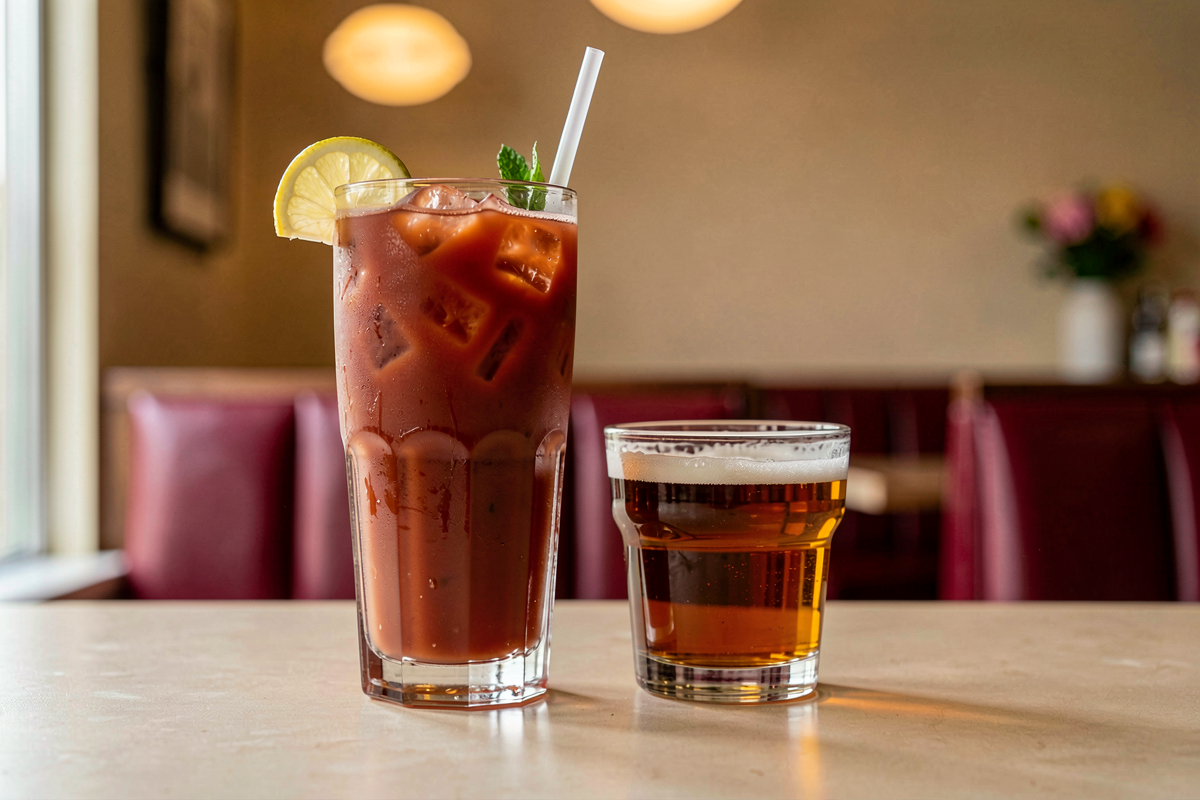
    Order a Bloody Mary in Minnesota, Wisconsin, or the Dakotas and you might get something you didn’t ask for: a small glass of beer sitting quietly next to it, usually four to six ounces, served without explanation because in that part of the country none is needed. It’s called a snit, and it isn’t a regional gimmick — it’s a genuine supper-club tradition with a real reason behind it.

    What a snit actually is

    A snit is simply a short pour of beer, smaller than a standard glass, traditionally served as an accompaniment to a Bloody Mary rather than a drink in its own right. The word itself is thought to derive from “schnitt,” a German and Wisconsin-German term referring to a small cut or portion of beer — a linguistic fingerprint of the upper Midwest’s heavy German and Scandinavian settlement.

    Why beer next to tomato and vodka makes sense

    The pairing isn’t random. A Bloody Mary is acidic, salty, and often heavily spiced — all things that build up on the palate fast. A small pour of a clean, mildly bitter lager acts as a palate reset between sips, cutting through the acidity and salt without the sweetness a mixer or juice chaser would add. It’s the same logic behind pairing a briny oyster with a crisp beer, just applied to brunch instead of a raw bar.

    A regional habit that never needed marketing

    Unlike a lot of cocktail traditions that get manufactured and pushed by a spirits brand, the snit spread the old-fashioned way — through supper clubs, VFW halls, and corner bars passing the habit down for generations without ever needing to explain it to a wider audience. It’s largely stayed contained to the upper Midwest precisely because nobody outside the region ever had a reason to ask for it, and nobody inside the region ever thought to mention it was unusual.

    How to try it at home

    Skip anything hoppy or heavy — a light American lager or a pilsner is closest to what’s traditionally poured, and the whole point is a clean, neutral chaser rather than a second flavor competing with the drink. Pour four to six ounces, no more, and treat it exactly like the tradition intends: a palate reset between sips of your Bloody Mary, not a second beer to work through on its own.

  • The Blueprint for the Ultimate Self-Serve Bloody Mary Bar

    The Blueprint for the Ultimate Self-Serve Bloody Mary Bar

    A self-serve Bloody Mary bar sounds simple until eight guests are standing around one bottle of vodka and a single spoon, and the line isn’t moving. Professional hospitality teams solve this with math most home hosts never think about — batching ratios, station spacing, and deliberate pacing. None of it is complicated, but almost none of it is intuitive either.

    Batch the base, not the whole drink

    The single biggest mistake in a home Bloody Mary bar is trying to keep the alcohol in the pre-mixed base. Batch the seasoned tomato mix — juice, Worcestershire, hot sauce, black pepper, all of it — in one large pitcher or dispenser, and keep the vodka completely separate for guests to pour themselves. This does two things: it lets non-drinkers and early risers build a Virgin Mary without a special batch, and it means nobody has to guess how much alcohol is already in a communal pitcher.

    A workable ratio for a party of ten is roughly 80 ounces of seasoned mix to a standard 750ml bottle of vodka, assuming a 5-ounce mix pour and a 1.5-ounce spirit pour per drink — that’s about sixteen drinks per batch, with some buffer for people who build theirs stronger.

    Spacing prevents the bottleneck

    The bottleneck at almost every self-serve bar isn’t the drink itself — it’s the garnish. Give the mix and the spirits their own dedicated space, physically separated from the garnish spread, so pouring and garnishing can happen in parallel instead of everyone queuing at one cutting board. A linear layout works better than a cluster: mix and ice first, spirits second, garnish last, in the order guests actually move through building the drink.

    Garnish triage: pick fewer, better options

    A garnish bar with fifteen options looks impressive in a photo and creates total gridlock in practice. Five to seven well-chosen garnishes — a fresh herb, a pickled element, a protein like bacon or shrimp, a citrus wedge, and one or two condiments like extra hot sauce or horseradish — cover almost every preference without turning the station into a decision paralysis exercise for twelve people at once.

    Keep the cold side cold

    Anything perishable on the bar, the seasoned mix and proteins like bacon or shrimp, should sit over ice rather than on a bare counter. Nest the pitcher and each garnish bowl in a larger bowl of ice, put out small portions, and swap in fresh cold bowls from the refrigerator instead of topping off what’s already been out. That’s USDA’s advice for any party buffet: keep cold foods cold by nesting serving dishes in bowls of ice, and replace empty platters instead of adding fresh food to an existing dish. For the full hour-by-hour plan, see The 12-Person Brunch: An Hour-by-Hour Host Timeline.

    Sources

    Pacing: batch size to guest count

    For groups under eight, one pitcher and one garnish spread is plenty. Past twelve guests, split into two identical stations rather than one bigger one — it halves wait time far more effectively than doubling the size of a single line, and it’s the same logic caterers use for any self-serve station, from taco bars to mimosa carts.

  • The Viscosity Variable — Nailing the Perfect Bloody Mary Mouthfeel

    The Viscosity Variable — Nailing the Perfect Bloody Mary Mouthfeel

    Most Bloody Mary advice is entirely about flavor — more or less heat, more or less umami, which hot sauce, which salt. Almost nobody talks about texture, even though it’s often the single biggest thing separating a mix that tastes like a restaurant made it from one that tastes like tomato juice with vodka stirred in. Mouthfeel is a real, physical variable, and it’s controllable.

    What “body” actually means in a glass

    A Bloody Mary’s body comes down to three physical factors working together: the viscosity of the tomato base itself, how well the citrus and other thin liquids integrate into that base rather than sitting apart from it, and how much air or dilution gets folded in during mixing. Get all three right and the drink coats the glass and the palate in a way that reads as substantial. Get any one wrong and even a perfectly seasoned drink can taste thin, watery, or strangely disconnected.

    Tomato juice, tomato puree, and everything in between

    Straight tomato juice is thin by design — it’s been strained and processed to pour easily and stay shelf-stable. A tomato puree or a thicker Clamato-style base carries far more suspended solids, and those solids are exactly what create the velvety, coating sensation professional bars are usually after. The tradeoff is that a puree-heavy base needs more careful seasoning, since thicker liquid mutes perceived saltiness and acidity slightly compared to a thinner one — the palate has to work through more material before it registers the seasoning underneath.

    Why stirring technique matters more than people think

    Vigorous shaking introduces air and can actually thin out a Bloody Mary’s apparent body by diluting it faster over ice and breaking down some of the suspended tomato solids. A gentle, thorough stir — six to ten rotations, not a violent shake — keeps the base intact and integrates the citrus and thinner ingredients without beating air into the mix. This is one of the few cocktails where less agitation, not more, produces a better result.

    The citrus integration problem

    Fresh lime or lemon juice is thin and sits differently in a glass than a thick tomato base — poured in carelessly, it can create a layered, uneven drink where the first sip is sharp and citrus-forward and the last sip is flat. Adding citrus early and stirring it fully into the base before adding the heavier seasonings solves this, letting the acid distribute evenly through the body of the drink instead of floating as a separate layer.

    A simple test

    Pour your finished mix slowly down the inside of a tilted glass. If it runs like water, your base needs more body — reach for a thicker tomato product or reduce the amount of thin liquid you’re adding. If it clings and moves slowly, coating the glass as it goes, you’ve got the structure a professional bar is aiming for.

  • Deconstructing the Dive Bar Bloody Mary

    Deconstructing the Dive Bar Bloody Mary

    Every city has one: a dark, unpretentious tavern where the Bloody Mary is somehow better than the version at the polished cocktail bar three blocks away, despite — or maybe because of — a rail vodka, a mix that’s clearly made in a giant batch, and a bartender who’s poured ten thousand of these and stopped measuring anything years ago. This isn’t a recipe for one specific place. It’s an attempt to reverse-engineer what actually makes that whole category of drink work, structurally, when it so obviously shouldn’t.

    It’s not the ingredients. It’s the ratios.

    Dive bar Bloody Marys are rarely built on anything exotic. Most use a commercial tomato-forward mix, a well vodka, and whatever hot sauce is already sitting behind the bar for wings. What separates the good ones from the merely adequate ones is almost never the ingredient list — it’s that the good ones are seasoned like they’re meant to be finished in five minutes flat, at room temperature, over ice that’s already half-melted by the time it reaches you.

    That means more acid, more salt, and more heat than a home recipe would suggest, because dilution and warmth are actively working against the drink from the moment it’s poured. A Bloody Mary built to be sipped slowly in an air-conditioned dining room needs a completely different balance than one built to survive a loud, warm room and a heavy pour of ice.

    The rim tells you everything

    A proper dive bar rim is rarely delicate. It’s often a coarse celery salt, sometimes cut with black pepper, applied heavy-handed rather than in a thin, photogenic ring. That’s not sloppiness — it’s a working bartender’s shortcut to seasoning every single sip without having to build more complexity into the mix itself. The rim is doing labor the recipe isn’t.

    Smoke, char, and the stuff that doesn’t show up in a recipe card

    The best versions of this style often carry a faint char or smoke note that has nothing to do with a fancy technique and everything to do with decades of the same well-seasoned garnish tray, the same hot sauce bottle refilled from the same big jug, the same pickled peppers sitting in brine that’s absorbed flavor from everything that’s touched it. It’s less a recipe than an ecosystem, and it’s genuinely difficult to replicate at home in one sitting.

    What you can actually take from this

    Season more aggressively than feels reasonable, especially if you’re serving over a heavy pour of ice. Go coarse and generous on the rim instead of delicate. And don’t be afraid of a hot sauce that’s been sitting open on the counter for a while — a little oxidation and mellowing is doing more work than you’d think. The dive bar version isn’t sloppy. It’s just optimized for a completely different set of constraints than the drink you’d photograph.

  • The Altitude Effect — Why Tomato Juice Tastes Better at 30,000 Feet

    The Altitude Effect — Why Tomato Juice Tastes Better at 30,000 Feet

    Ask a flight attendant which drink runs out first on a long flight and the answer is rarely wine. It’s tomato juice. There’s a reason “why does tomato juice taste better on a plane” is one of the most searched questions in the entire Bloody Mary universe, and it isn’t nostalgia or boredom. It’s biology.

    What altitude actually does to your palate

    A pressurized cabin at cruising altitude sits at the equivalent of roughly 6,000 to 8,000 feet of elevation, and the air inside it is drier than almost anywhere on Earth — often below 20% humidity, drier than most deserts. That combination does measurable things to how your mouth and nose process flavor. Dry air dries out your nasal passages and the mucous membranes that carry aroma to your olfactory receptors, and since a huge share of what we perceive as “taste” is actually smell, blunting that channel mutes flavor across the board.

    Sweetness and saltiness take the biggest hit — some research on in-flight taste perception has found sweet perception drops by as much as 30%, which is exactly why airline meals taste under-seasoned and why airlines oversalt and oversweeten catering to compensate. But umami, the deep, savory fifth taste carried by glutamates, doesn’t fade the same way. Some studies suggest it holds up close to its ground-level intensity, or is even perceived as more intense against a background where everything else has quietly gone flat.

    Tomato juice is one of the most glutamate-rich beverages that exists. At sea level it reads as pleasant and a little vegetal. At altitude, with sweet and salty perception dialed down and background cabin noise raising your threshold for what registers as “flavorful” at all, that same glass of tomato juice suddenly tastes concentrated, savory, and exactly like what a dry, pressurized body is asking for.

    The Bloody Mary is built for this environment

    A Bloody Mary isn’t just tomato juice with vodka — it’s a small stack of some of the most umami-dense ingredients in a home bar: Worcestershire sauce, hot sauce, black pepper, sometimes horseradish. Every one of those ingredients is doing the same job tomato juice is doing on its own, just more of it. That’s likely a real part of why the Bloody Mary specifically, rather than a Mary-adjacent drink like a michelada or a virgin tomato cocktail, became the unofficial signature drink of air travel starting in the 1960s and never really let go.

    Who actually decides what’s in that can

    If you’ve ever wondered why the tomato juice on one airline tastes different from another, or why certain airport bars pour a noticeably better Bloody Mary than the plane itself, the answer usually has less to do with the airline and more to do with who’s running food and beverage at that specific hub. Airport concessions — the bars and restaurants inside the terminal — are typically operated by third-party hospitality groups under contract with the airport authority, and it’s largely those companies, not the airlines or the airport itself, who decide which Bloody Mary mix, which vodka well pour, and which garnish program shows up at a given gate.

    That’s worth knowing next time a terminal Bloody Mary is dramatically better or worse than the one you’ll get in the air an hour later — you’re tasting a completely different supply chain, made by a completely different decision-maker, at both ends of the same trip.

  • Bloody Mary Salt — How to Make Your Own Finishing Seasoning

    Bloody Mary Salt — How to Make Your Own Finishing Seasoning

    Most Bloody Mary rim salts come from a tin labeled “celery salt” that’s been sitting on the shelf since 2022. The flavor is fine. Adequate. Forgettable.

    The version you make yourself — with dried tomato powder, celery seed, smoked paprika, and a few other building blocks — is dramatically more interesting. It takes about 20 minutes of active work, costs about $4 in ingredients, and produces a finishing salt that does more than just rim cocktails. It’s also one of the best small gifts you can give someone who cooks.

    The principle

    A Bloody Mary’s flavor architecture is mostly assembled from dry ingredients you could, in theory, blend together into a single seasoning. Salt is the carrier. Celery seed, paprika, pepper, and citric acid (the dry equivalent of the lemon juice in a Bloody Mary) are the supporting cast. Dried tomato powder is the genius addition — it brings the actual tomato flavor into the rim itself, so the first sip of the drink hits the tomato note before the liquid ever reaches your tongue.

    The result is a seasoning that captures the soul of a Bloody Mary in 1/8 teaspoon. Once you have a jar of it on hand, you find dozens of uses for it — and at that point the question stops being “do I want to rim my glass with this” and becomes “where else can this go.”

    The base recipe

    This is the version to start with. Six ingredients, about 20 minutes of work, fills a small mason jar (about 4 oz).

    • 3 tablespoons coarse kosher salt or flaky sea salt (Maldon if you have it)
    • 1 tablespoon dried tomato powder (sun-dried tomatoes, blitzed in a spice grinder until powdery)
    • 1 tablespoon celery seed
    • 1 teaspoon smoked paprika (sweet or hot, your call)
    • ½ teaspoon citric acid powder
    • ½ teaspoon coarse-ground black pepper (Tellicherry preferred)

    The method: Combine everything in a small bowl and whisk together until evenly distributed. Pulse in a spice grinder for two or three short pulses if you want a finer texture — but don’t over-grind; you want to see the individual ingredients in the final blend, not turn it into uniform powder.

    Transfer to a small jar with a tight-fitting lid. Label it. Store in a dark cabinet.

    Making the tomato powder

    The hardest ingredient to source is dried tomato powder. You can buy it (Penzey’s sells it, Amazon carries it) but making it yourself is dramatically better and not hard.

    Take a handful of sun-dried tomatoes — the dry kind, not the oil-packed kind. If you only have oil-packed, drain them on paper towels and let them sit on a low oven (200°F) for 20 minutes to dry them out before grinding. Pulse in a spice grinder or blade coffee grinder until you have a coarse red powder. The flecks should be small but you should still be able to see them — uniform powder is over-processed.

    One tablespoon of dried sun-dried tomatoes yields about one tablespoon of powder. Make extra — it’s useful in dozens of other applications.

    Six variations worth trying

    Once you have the base recipe down, the variations are where it gets interesting. Each starts with the base above and modifies from there.

    1. Smoky version: Replace the regular paprika with smoked paprika (heaping teaspoon), add ½ teaspoon ground chipotle, drop the regular black pepper. Reads as if the drink was made over a campfire.

    2. Spicy version: Add 1 teaspoon Aleppo pepper and ½ teaspoon cayenne to the base. Slow-building heat that doesn’t obliterate the other flavors. (For more on Aleppo pepper, see the Aleppo Pepper post.)

    3. Old Bay version: Add 1 tablespoon Old Bay seasoning and drop the paprika (since Old Bay already has paprika). The Maryland upgrade — works dramatically well with a shrimp garnish on the cocktail.

    4. Garlic-forward: Add 1 teaspoon garlic powder and ½ teaspoon onion powder. Reads as more savory and dinner-like, less morning-brunch.

    5. Citrus-forward: Double the citric acid (1 teaspoon total), add 1 teaspoon dried lemon zest (zest a lemon, dry the zest in a low oven for 15 minutes, then add). Brighter, more electric on the rim.

    6. Umami bomb: Add 1 teaspoon dried shiitake mushroom powder (blitz dried shiitake in a spice grinder same way you did with the tomatoes) and ½ teaspoon nori flakes (toasted seaweed crumbled). The combination delivers concentrated glutamate from three sources — tomato, mushroom, seaweed — in the rim alone.

    How to rim a glass with it

    Pour 1-2 tablespoons of the salt onto a small flat plate. Take a lemon wedge (not water — citric acid in the lemon locks the salt to the glass much more reliably) and run it around the top edge of the glass. Press the rim into the salt and rotate the glass once to coat evenly.

    Don’t shake off the excess. A heavy rim is the point. The salt should make a clear visible band along the top inch of the glass.

    Where else this salt belongs

    Once you have a jar of this on the counter, the uses multiply. The ones I keep returning to:

    • Deviled eggs — finish each one with a small pinch on top. Unexpected, transformative.
    • Grilled tomatoes — split a beefsteak tomato, grill cut-side down, sprinkle with the salt while still hot. The seasoning sinks in.
    • Popcorn — toss freshly popped popcorn with a few tablespoons of melted butter, then dust with the salt. Genuinely one of the best popcorn variations you’ll ever make.
    • Avocado toast — replace your usual everything bagel seasoning with this. The tomato powder works with the avocado in a way the standard seasoning can’t match.
    • Roasted potatoes — toss with olive oil before roasting, then dust with the salt while still hot from the oven.
    • Cheddar cheese cubes — pre-dinner appetizer. Sharp aged cheddar dusted with this salt is one of the best three-ingredient bar snacks possible.
    • Bloody Mary, obviously — rim of the glass, or stirred into the drink itself.

    The gift angle

    This salt is one of the best small gifts you can give someone who cooks or entertains. The economics are excellent — about $4 in ingredients makes enough to fill four 4-oz jars. Add a handwritten label with the name and a few suggested uses, tie a small piece of twine around the neck of the jar, and you have a $20-feeling gift for a $1 cost per recipient.

    A note on how this was written

    This post was written with AI assistance. The base recipe is mine, refined over many batches of Bloody Mary preparation. The deviled eggs and popcorn applications are the two I’d try first if you’re skeptical that a Bloody Mary salt belongs anywhere other than on a rim.

    Related Reading

  • The Bloody Samurai — The Maximalist Japanese Bloody Mary

    The Bloody Samurai — The Maximalist Japanese Bloody Mary

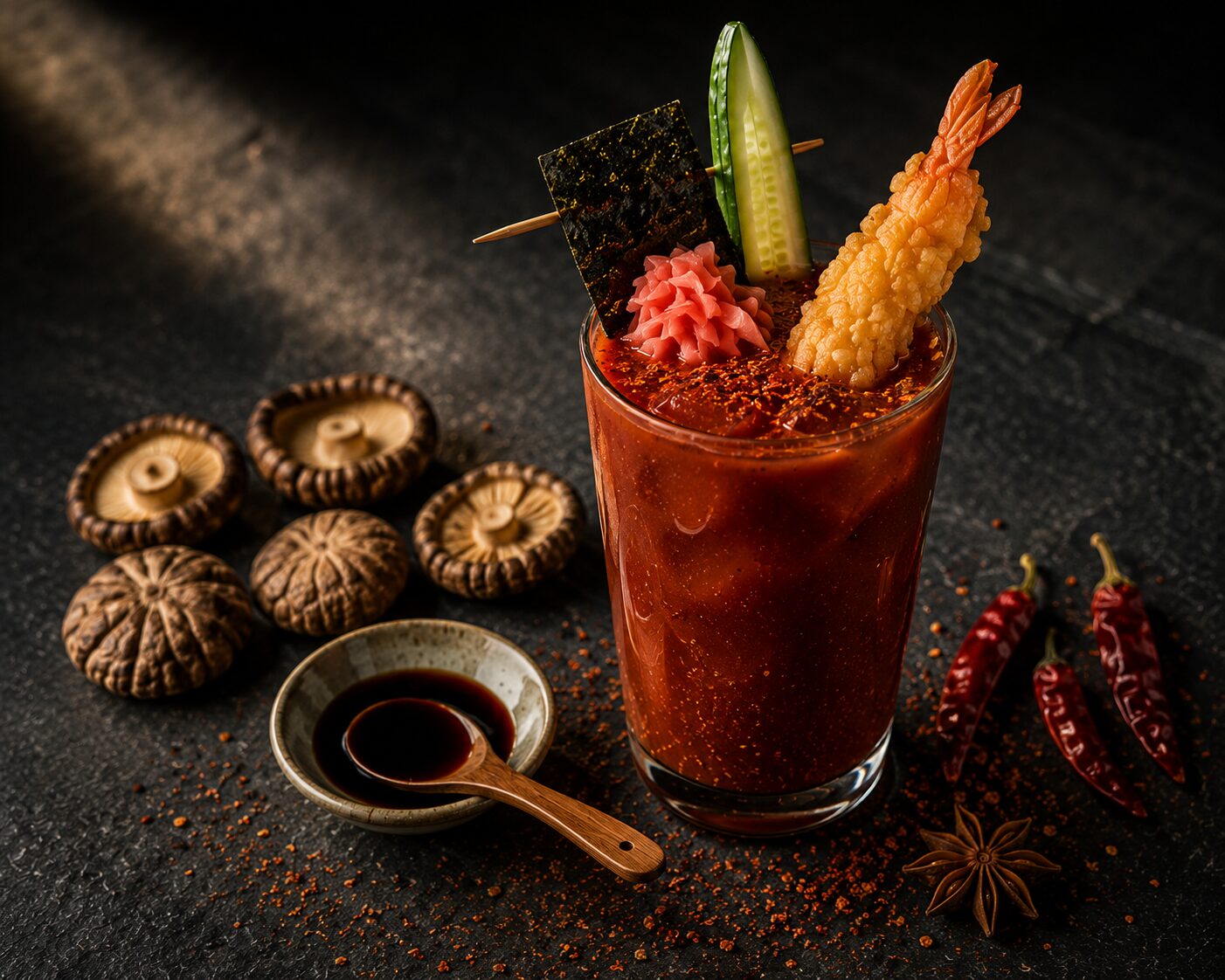
    If the Sake Mary is the restrained Japanese interpretation, the Bloody Samurai is the maximalist one. Dashi, soy, miso, fish sauce, and shichimi all stacked into a single glass alongside a piece of shrimp tempura skewered on the rim like it’s daring you to drink and eat at the same time.

    This isn’t a cocktail so much as an izakaya meal in a glass. The umami density is the point. People who have one will remember it for years.

    The principle

    Where the Sake Mary subtracts (lighter base, restrained accents), the Bloody Samurai adds. Five distinct umami sources work simultaneously: tomato glutamate, dashi inosinate, soy glutamate, miso glutamate, and fish sauce glutamate. Each contributes a different note of savory depth, and the combination is dramatically greater than the sum of its parts because of umami synergy — the phenomenon where glutamate and inosinate together register on the palate at roughly 8x the intensity either delivers alone.

    This is the same chemistry that makes a good ramen broth taste so much more savory than its individual ingredients suggest. You’re bringing it to a cocktail.

    The recipe

    For one drink in a tall pint glass:

    • 1.5 oz vodka OR 1 oz vodka + 0.5 oz shochu (mugi or imo style)
    • 4 oz tomato juice (V8 or similar — full-bodied here, not the lighter version)
    • 2 oz cold dashi (instant dashi powder mixed with water works — about ½ teaspoon dashi powder per 2 oz hot water, cooled)
    • 1 teaspoon Japanese soy sauce (shoyu or tamari)
    • ½ teaspoon white miso paste, whisked into the drink until dissolved
    • ½ teaspoon fish sauce (Red Boat or Three Crabs)
    • ½ teaspoon yuzukoshō (fermented green chile-yuzu paste) — or substitute ½ teaspoon sriracha + a small squeeze of lime
    • Generous pinch of shichimi togarashi
    • Ice — large cubes preferred

    Garnish (don’t skip — they’re half the drink):

    • Long english cucumber spear, standing in the glass
    • Small piece of nori (toasted seaweed) skewered like a flag on a wooden cocktail pick
    • Pickled ginger (gari — the pink kind from sushi), folded onto the same pick
    • One piece of shrimp tempura perched on the rim, tail up — optional but transformative

    The method

    The miso step is the only tricky part. Miso doesn’t dissolve in cold liquid the way salt or sugar does — it needs to be coaxed.

    In a small bowl, whisk together the miso, soy sauce, fish sauce, and yuzukoshō with a tablespoon of the dashi until you have a smooth paste. This pre-mix step is what separates a great Bloody Samurai from one with a clump of miso sitting at the bottom of the glass.

    Fill the pint glass two-thirds with ice. Add the vodka (or vodka-shochu blend). Pour in the dashi-miso pre-mix. Add the tomato juice. Stir gently with a long bar spoon — eight or nine turns to fully integrate. Sprinkle shichimi togarashi across the top.

    Garnish heavily. The cucumber spear stands in the drink. The nori-and-ginger skewer rests across the top. The shrimp tempura perches on the rim like a flag claiming the glass. Serve immediately while the tempura is still warm if possible.

    The shochu question

    Shochu is Japanese distilled spirit — clearer than whiskey, drier than vodka, around 25-35% ABV. It comes in several base ingredient styles:

    • Mugi shochu (barley) — clean, slightly sweet, easiest substitute for vodka
    • Imo shochu (sweet potato) — earthy, distinctive, polarizing (people either love it or hate it). Adds dramatic character.
    • Kome shochu (rice) — soft, slightly sweet, the gentlest option

    Replacing half the vodka with mugi shochu is the safest move and adds a layer of grain-derived depth. Replacing it with imo shochu makes a much more dramatic drink — earthy and distinctive in a way nothing else can replicate. Try both versions over time.

    If you don’t want to track down shochu, the all-vodka version is excellent too. The drink doesn’t depend on the shochu.

    The shrimp tempura argument

    A piece of shrimp tempura on the rim transforms this drink from “interesting cocktail” to “small meal.” The hot crispy tempura against the cold drink is one of the best texture contrasts in cocktail garnishing. The drink already has dashi as a base, which means the tempura tastes like it belongs there.

    If you don’t want to make tempura from scratch, frozen tempura shrimp from any Asian market will work. Air-fry or oven-bake from frozen, takes about 8 minutes. The texture won’t be as good as fresh but the difference is small.

    Without the tempura, this is still a great drink. With it, it’s a memorable one.

    Sourcing the ingredients

    This drink requires a shopping trip. The good news is that all of these ingredients are foundational to Japanese home cooking, so the investment opens up a lot more than just one cocktail.

    • Dashi powder: Asian markets. Hondashi brand is the standard. Lasts a year.
    • White miso: Most grocery stores now carry it (refrigerated section). Marukome and Hikari are common brands.
    • Yuzukoshō: Asian markets, harder to find. Worth the search — there’s no real substitute that captures the same fermented chile-yuzu character. Sriracha + lime is a workable approximation.
    • Shochu: Larger liquor stores or Japanese specialty stores. iichiko is a widely available mugi shochu.
    • Nori, pickled ginger, shrimp tempura: Any Asian market, or the international aisle of a decent grocery store.

    When to serve this

    Weekend dinners that lean Asian. Late lunches that should have been dinner. Any moment when you want one drink to be the meal. The Bloody Samurai is too heavy for early-morning brunch — it’s not a wake-up cocktail, it’s a sit-down-and-think cocktail.

    It’s also the right drink to make for someone who claims they don’t like Bloody Marys. The umami density is so different from the standard American Bloody Mary that most skeptics revise their opinion mid-glass.

    The two-recipe argument

    The Sake Mary and the Bloody Samurai together represent the two ways Japanese cuisine can inflect a Bloody Mary. Restraint and abundance. Subtraction and addition. Morning and evening. Brunch and izakaya.

    Make both within a week of each other. The contrast is more interesting than either drink alone.

    A note on how this was written

    This post was written with AI assistance. The umami synergy chemistry is verified against actual food science (the phenomenon was first formally described by Japanese researchers in the 1950s). The shrimp tempura garnish is from a Bloody Mary I had once at an izakaya in San Francisco that I’ve been trying to replicate ever since.

    Related Reading

  • The Sake Mary — The Elegant Japanese Bloody Mary

    The Sake Mary — The Elegant Japanese Bloody Mary

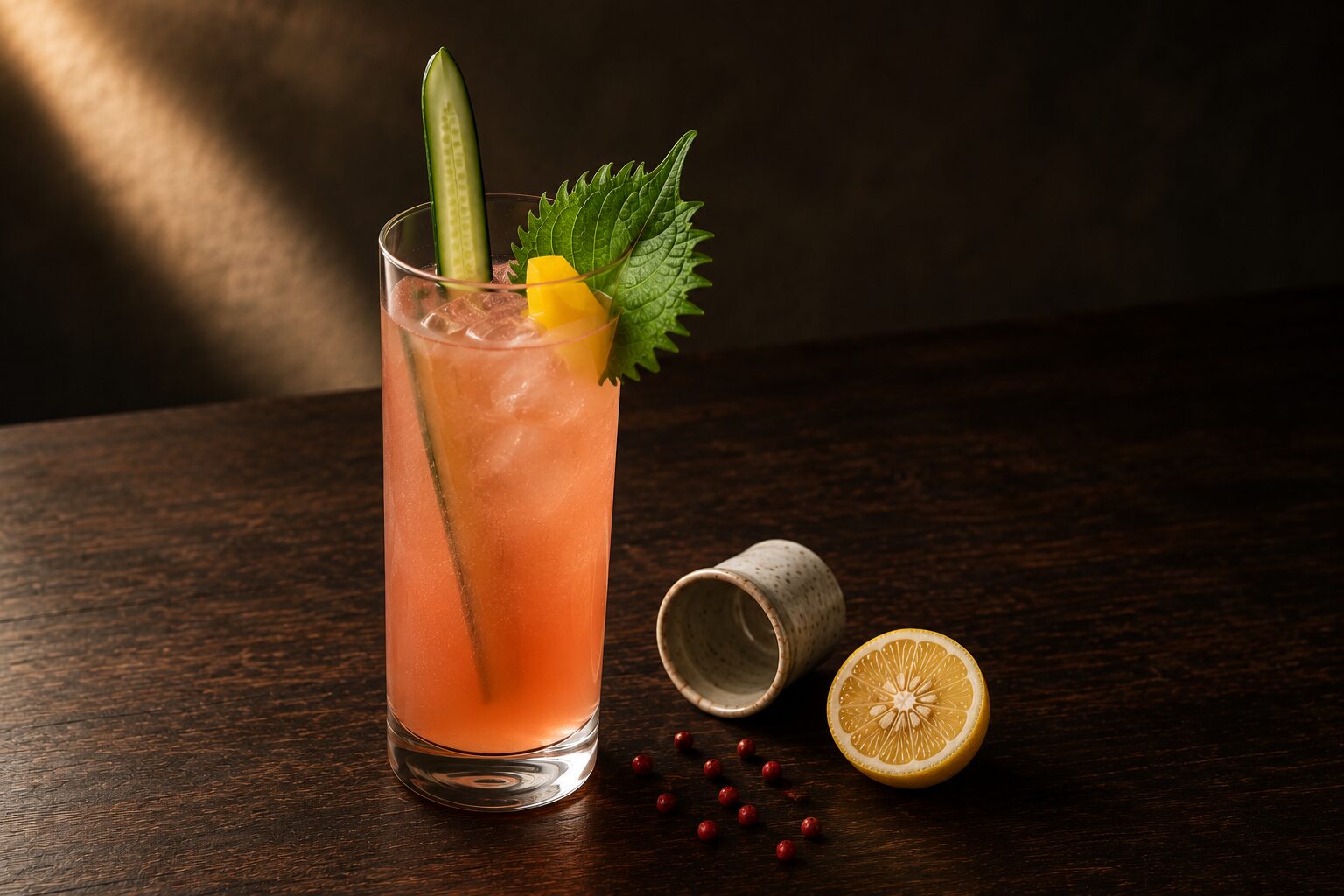
    The Sake Mary is what happens when you put a Bloody Mary through a Japanese lens with restraint. It’s the elegant interpretation — lighter, more refreshing, lower alcohol, dramatically more drinkable in the morning. The brunch drink for people who think they don’t like Bloody Marys.

    If you want the maximalist Japanese version with full umami and izakaya energy, see the Bloody Samurai. This one stays quiet on purpose.

    The principle

    Sake is about 15% ABV, compared to vodka’s 40%. It also carries character — delicate rice, slight sweetness, sometimes melon or pear top notes depending on the brewery. You can’t treat it like vodka. If you build a Bloody Mary the usual way and just swap vodka for sake, you crush the sake’s identity under Worcestershire and horseradish.

    The fix is to swap the supporting cast for ingredients that complement sake instead of fighting it:

    • Soy sauce replaces Worcestershire — same umami function, no anchovy or molasses to clash with the rice
    • Fresh-grated wasabi (or wasabi paste) replaces horseradish — same heat compound, smaller dose, cleaner finish
    • Yuzu juice replaces lemon — same acid function, lighter and more aromatic
    • Shichimi togarashi replaces black pepper — same warm-heat function, Japanese 7-spice character
    • Unsalted tomato juice (or tomato water) replaces V8 — lighter base, lets the sake show through

    The result is a drink with the same Bloody Mary architecture but a completely different voice. Restrained, clean, intentional.

    The recipe

    For one drink in a tall slender highball:

    • 2 oz junmai sake (chilled — a clean, dry style works best)
    • 4 oz unsalted tomato juice (Lakewood Organic is the standard)
    • ½ oz yuzu juice (bottled is fine, look for “100% yuzu juice” not a sweetened mix)
    • 1 teaspoon soy sauce (Japanese shoyu or tamari, not Chinese-style)
    • ¼ teaspoon wasabi paste (or ⅛ teaspoon fresh-grated wasabi)
    • Pinch of shichimi togarashi
    • Ice — large cubes if you have them

    Garnish: long thin spear of english cucumber standing in the glass, single fresh shiso leaf perched on the rim, small piece of pickled daikon (takuan) on a wooden cocktail pick.

    The method

    Fill the glass two-thirds with ice. Add the sake, yuzu juice, soy sauce, and wasabi directly to the glass. Top with the tomato juice. Stir gently — five or six turns with a long bar spoon. Sprinkle the shichimi togarashi across the top. Add the garnishes.

    That’s the whole drink. The first sip should hit shiso aroma, then yuzu brightness, then the subtle umami of sake-and-tomato underneath. The wasabi shows up two or three sips in — slow heat that builds rather than punches.

    The sake selection question

    Any decent junmai sake works. You don’t need anything expensive — a $15 supermarket sake is fine, and arguably better than a $50 junmai daiginjo because the premium sakes have delicate floral notes that get lost in the drink.

    The styles to consider:

    • Junmai — full-bodied, rice-forward, the default. Best general-purpose choice.
    • Junmai ginjo — lighter and more aromatic. Excellent if you want the floral notes to come through.
    • Honjozo — drier and slightly higher in alcohol (some have added distilled alcohol). Works well, especially if you find pure junmai too sweet.
    • Nigori — unfiltered, milky, sweet. Skip it for this drink — the cloudiness fights the visual.

    Drink the rest of the bottle chilled with the rest of breakfast. The sake left over from making one drink is the perfect amount for two or three small ochoko cups alongside.

    Sourcing the ingredients

    The Sake Mary requires some ingredients that aren’t in every American kitchen. The good news is that all of them keep well and are useful in other applications, so the initial investment pays off across many drinks and meals.

    • Sake: Most decent liquor stores. Whole Foods carries it. If you have an Asian market nearby, the selection is dramatically better.
    • Yuzu juice: Asian markets, or Amazon. Search for “100% yuzu juice.” A small bottle lasts months.
    • Wasabi paste: The tubes at any grocery store work fine (and remember, most “wasabi” in tubes is dyed horseradish — see the horseradish post). Real wasabi is rare and expensive; not necessary here.
    • Shichimi togarashi: Penzey’s, Whole Foods, or any Asian market. Wide availability now.
    • Shiso leaves: The hardest to source. Asian markets in larger cities. If unavailable, substitute fresh mint — different flavor but similar aromatic role.
    • Pickled daikon (takuan): Asian markets. Look for the bright yellow variety.

    The variation worth knowing

    If you can’t find unsalted tomato juice, make tomato water instead. Roughly chop 2 lbs of ripe tomatoes, salt them with a teaspoon of kosher salt, let them sit in a strainer over a bowl for 30 minutes. The clear pinkish liquid that collects in the bowl is tomato water — pure tomato flavor without the body or color of tomato juice.

    A Sake Mary built on tomato water is almost translucent — a pale pink drink that looks more like a Hibiscus cocktail than a Bloody Mary. Some people consider this the platonic version. It’s definitely more elegant. Try it once.

    When to serve this

    Morning brunches where the food is leaning Japanese or Asian — onigiri, tamagoyaki, fish, anything sushi-adjacent. Garden lunches in summer. Any moment where you want a Bloody Mary’s structure but not its weight. The 15% alcohol means you can have two without writing off the afternoon.

    Not the right drink for a hangover. The whole point of a hangover Bloody Mary is the salt-fat-spice intensity. The Sake Mary is too restrained for that job — it’s the morning-after-the-night-before drink for people who didn’t actually go that hard.

    Junmai vs. Daiginjo: which sake actually works here

    Not all sake behaves the same way once it hits an acidic, savory tomato base, and the style matters more than the brand. Junmai sake — made from rice, water, koji, and yeast alone, with no added distilled alcohol — carries a fuller, slightly higher-acid profile that holds its own against tomato’s own acidity rather than disappearing into it. It’s the right default for this recipe: rounder, more food-friendly, less likely to taste thin once diluted into a full glass.

    Daiginjo, by contrast, is a highly polished, more delicate and aromatic style, often prized for sipping on its own specifically because of how much of the rice grain has been milled away to reach that fragrance. Put it in a Bloody Mary and most of what makes a Daiginjo special (the floral, fruit-forward aromatics) gets buried under Worcestershire, horseradish, and tomato. It isn’t ruined, but it’s a waste of a more expensive bottle. Save Daiginjo for drinking neat and reach for Junmai, or a Junmai Ginjo, for this build.

    Soy and wasabi as garnish, not gimmick

    A small dish of soy sauce and a dab of real or good-quality prepared wasabi on the garnish plate, rather than in the drink itself, gives a Sake Mary a second way to interact with it: a sip from the glass, then a taste of soy and wasabi alongside, the way you’d eat sashimi with a condiment plate rather than pouring soy sauce directly over the fish. It keeps the base drink clean and quiet, in keeping with this recipe’s own restraint, while still nodding to the izakaya flavors its maximalist cousin, the Bloody Samurai, builds directly into the glass.

    A note on how this was written

    This post was written with AI assistance. The ingredient substitutions are verified across multiple traditional Japanese cocktail references; the tomato water variation is from my own kitchen and worth the small extra effort.

    Related Reading

  • Black Pepper in Bloody Marys — Fresh-Cracked, Pre-Ground, or White?

    Black Pepper in Bloody Marys — Fresh-Cracked, Pre-Ground, or White?

    Pepper is the ingredient most people grab the cheap supermarket can for. It’s also one of the three or four flavors you actually taste on the front of every sip of a Bloody Mary. The gap between those two facts is the entire point of this post.

    The difference between freshly cracked Tellicherry peppercorns and the pre-ground pepper that’s been in your cabinet since 2022 is bigger than the difference between Tito’s vodka and Grey Goose. And it costs less to fix.

    The chemistry

    Black pepper’s flavor comes from piperine — a chemical cousin of capsaicin (the compound that puts the heat in chili peppers). Like capsaicin, piperine is volatile. It evaporates fast once the peppercorn is broken open.

    Pre-ground pepper loses approximately 40 to 60 percent of its piperine within two weeks of grinding. The can that’s been sitting in your spice cabinet since 2022 is mostly inert. The pepper is still there. The pepper flavor isn’t.

    This is why fresh-cracked pepper tastes alive and pre-ground pepper tastes flat. The chemistry doesn’t allow a different outcome.

    The grades worth knowing

    Tellicherry — the gold standard, grown on the Malabar coast of southwest India. Larger berries than standard black pepper because they’re left on the vine longer to fully mature. More complex flavor: floral and citrus top notes, a clean pepper bite, no harshness. The best general-purpose pepper for a Bloody Mary. Costs about $12-15 for a quarter pound, lasts a year.

    Lampong — Indonesian, the workhorse pepper of the spice trade. Sharper than Tellicherry, less floral, more straight-ahead heat. Excellent in a Bloody Mary when you want the pepper to register clearly rather than blend into the background.

    Sarawak — Malaysian, mild and fruity with almost cardamom-like top notes. Lovely for premium builds where you want the pepper to whisper rather than shout. Most home cooks have never tasted it; Bloody Marys are an excellent first introduction.

    Kampot — Cambodian, harder to source, expensive. Smoky and complex with a depth that no other peppercorn matches. Worth it for special occasions. The kind of ingredient you bring out for a Bloody Mary you want someone to remember.

    The fresh-cracked vs. pre-ground test

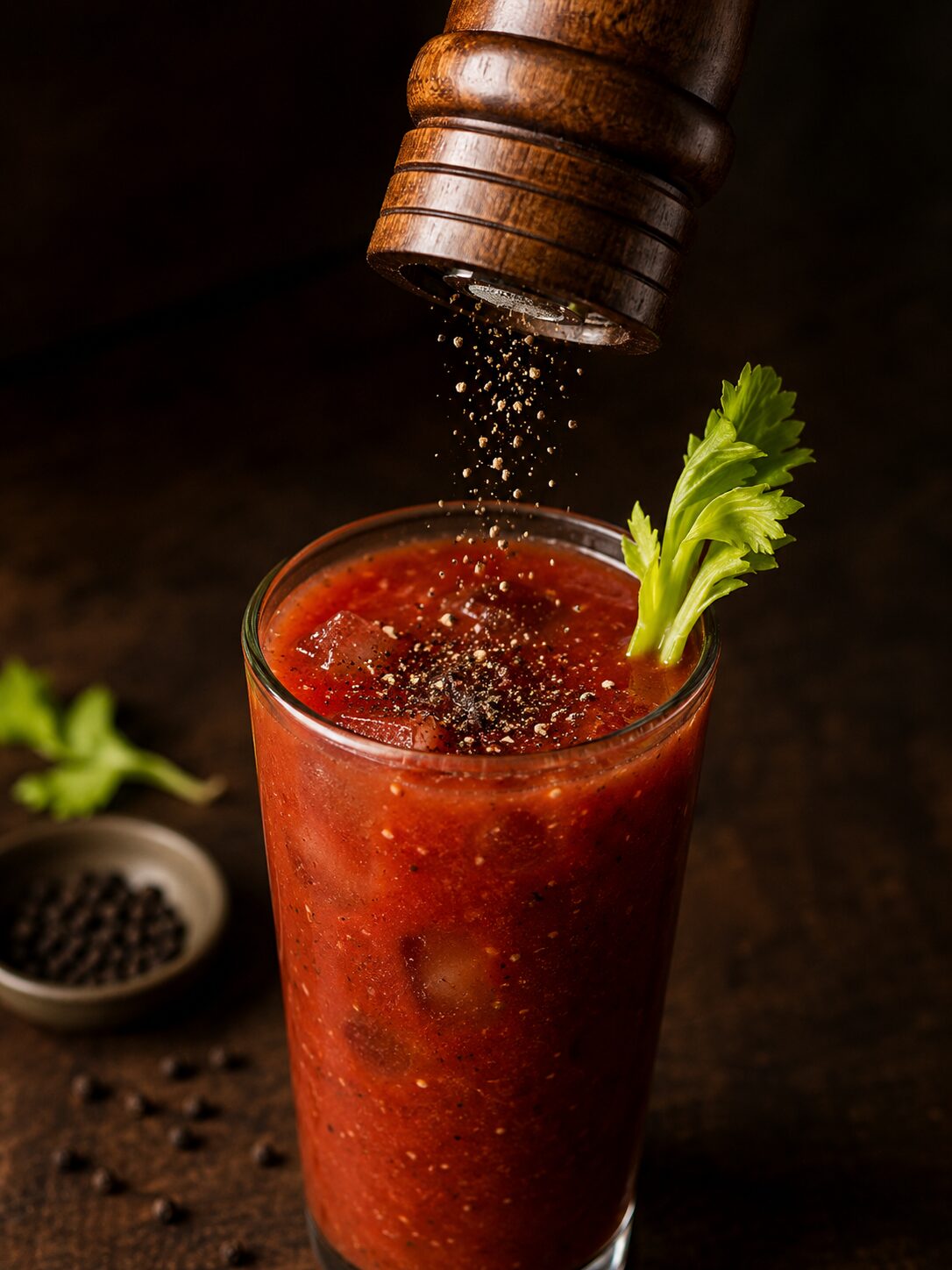
    Pour two identical Bloody Marys. Add a heavy eight grinds of fresh Tellicherry to one. Add an equivalent volume of pre-ground supermarket pepper to the other. Same drink otherwise — same vodka, same Worcestershire, same hot sauce. Cover the glasses, shuffle, taste.

    The fresh-cracked drink tastes alive. The pre-ground drink tastes flat in a way you can’t articulate until you have them side by side. Then it’s obvious.

    This test convinces more skeptics than any other comparison in the Bloody Mary tasting playbook. People who told you “pepper is pepper” leave the table reorganizing their spice cabinet.

    White pepper as an alternative

    White pepper is black pepper with the outer hull removed and a slightly different fermentation process. Less assertive than black pepper, more “background warmth,” and — crucially — invisible in the drink. No visible specks.

    Used in some Asian cuisines for cocktails and in classic French cooking where visible pepper specks would be considered a flaw. Underused in Bloody Marys. Worth trying as a contrarian move, especially on a Bloody Maria where white pepper plays well with lime and tequila in a way that black pepper doesn’t quite achieve.

    For a Bloody Mary specifically, try replacing half your black pepper with white. The result is rounder, gentler, and surprisingly elegant.

    Peppercorn-infused vodka

    The upgrade move that almost no home recipe mentions.

    Add one tablespoon of cracked Tellicherry peppercorns to a 750ml bottle of vodka. Steep 36 to 48 hours. Strain through a fine-mesh strainer back into the bottle, discarding the peppercorns.

    The resulting vodka carries a soft pepper finish through every sip of the drink. Pepper integrated into the alcohol works differently than pepper added at the end — it’s smoother, more diffuse, and present in a way that ground pepper on top of the drink can’t replicate.

    Substitute one ounce of pepper vodka for one ounce of regular vodka in a standard Bloody Mary. The drink develops a quiet, persistent pepper note that runs from the first sip to the last.

    How much per drink

    A Bloody Mary can take more pepper than most people add. Be generous.

    • 2-3 grinds — timid. Pepper is barely registering.
    • 4-6 grinds — present. The pepper is doing useful work.
    • 6-10 grinds — assertive. This is the sweet spot for most Bloody Marys.
    • 10+ grinds — heavy. The pepper is a top note, not a background. Some drinks call for this.

    If you can’t see flecks of pepper visibly suspended in the drink, you’ve under-peppered. Fresh-cracked pepper is meant to be a top note, not a whisper.

    The serving-time rule

    Pepper added five or more minutes before serving sinks and integrates. The piperine has time to disperse, the heat blends into the overall flavor profile, and you get a drink that’s evenly peppered throughout.

    Pepper added at the moment of serving floats and lands on the first sip as a sharp top note. The piperine is concentrated at the surface; subsequent sips taste milder.

    Both are valid. The first is the right move for batch pitchers where consistency matters. The second is more dramatic and gives the drink a real opening punch — useful for individual cocktails where you want the first impression to land.

    The grinder question

    Burr grinders beat blade grinders. Burr mechanisms (ceramic or steel) crush the peppercorn cleanly, releasing piperine without generating heat. Blade grinders bruise the peppercorns, generating heat and releasing more bitter compounds along with the piperine.

    A $30 manual ceramic burr grinder outperforms most $5 pre-filled disposable grinders by a large margin. The disposable grinders also tend to come pre-filled with pepper that’s already lost most of its volatile compounds before you bought it.

    If your Bloody Mary game is serious enough to be reading a 1,200-word post on pepper, replace your grinder before you replace your vodka. The return on investment is higher.

    The pairing test

    Identical drinks. One with pre-ground supermarket pepper. One with fresh-cracked Tellicherry. Eight grinds in each, equivalent by volume.

    The difference registers within two seconds of the first sip. The fresh-cracked drink has pepper character that runs through the entire glass — top note, mid-palate, finish. The pre-ground version has flat pepper character that arrives once and never quite returns.

    This is the cheapest meaningful upgrade you can make to your Bloody Mary game. A bag of Tellicherry peppercorns and a burr grinder cost less than a bottle of the vodka you’re trying to drink. The difference in the finished drink is larger.

    The principle

    Most Bloody Mary writing focuses on the dramatic ingredients — the horseradish, the hot sauce, the Worcestershire. Black pepper gets a single line in most recipes. “Black pepper, to taste.” Almost no one explains what “to taste” should taste like, or what kind of pepper you should be tasting with.

    Get the pepper right and the rest of the drink reads better. Get it wrong and the whole architecture sags a little. This is the smallest investment with the largest invisible payoff in the entire Bloody Mary canon.

    A note on how this was written

    This post was written with AI assistance. The piperine chemistry and the regional descriptions of pepper grades are verified. The dosing rules, the white pepper experiment, and the peppercorn-vodka infusion are from my own kitchen. The “replace your grinder before your vodka” advice is hard-won and slightly heretical, but right.

    Related Reading

  • Garlic in Bloody Marys — Fresh, Powder, Salt, or Infused

    Garlic in Bloody Marys — Fresh, Powder, Salt, or Infused

    Garlic appears in almost every Bloody Mary recipe in some form — and almost no recipe explains which form. The differences between fresh, powdered, salted, and infused garlic are bigger than they sound, and they matter more than the average home bartender realizes.

    This is the breakdown nobody writes.

    A quick bit of chemistry

    Garlic’s flavor is allicin — a sulfur compound that doesn’t exist in the whole clove. Allicin is created the moment garlic is crushed, cut, or grated, when an enzyme called alliinase converts alliin (which is in the intact clove) into allicin (which carries all the flavor and aroma).

    This is why a whole peeled garlic clove smells mild but a grated one knocks you backward.

    Allicin behaves very differently across forms:

    • Heat destroys it. This is why roasted garlic tastes so different from raw garlic.
    • Acid preserves it. Which is why garlic in pickles and salsas holds its flavor.
    • Drying transforms it into milder thiosulfinates that are gentler but more stable.
    • Oxygen slowly degrades it. Fresh-crushed garlic peaks within minutes and fades over hours.

    Each form of garlic delivers a different version of the same underlying molecule. The form matters.

    Fresh garlic, crushed

    The most assertive option. Also the most polarizing.

    A single grated clove per 80 oz pitcher adds sharp, pungent garlic flavor that’s unmistakable on the first sip. It fades within thirty minutes as the allicin oxidizes in the acid environment of the tomato juice, but during that window it dominates the drink.

    Useful in single-drink builds you’ll drink immediately. Problematic in pitcher recipes that sit, because the flavor profile shifts as the allicin breaks down — what you tasted right after mixing isn’t what your guests will taste an hour later.

    Grate the clove on a microplane, never chop. Microplaning ruptures more cell walls and releases dramatically more allicin than knife-chopping. The difference is visible — finely chopped garlic in a Bloody Mary settles to the bottom of the glass as small chunks; microplaned garlic dissolves into the drink.

    Garlic powder

    The most consistent option. Almost universally underrated by people who think “fresh is always better.” For a Bloody Mary, garlic powder is often the right call.

    The dehydration process breaks down allicin into milder thiosulfinates that play better with cold drinks. Half a teaspoon per 80 oz pitcher delivers warm, rounded garlic flavor that holds across days. The drink you batch on Saturday morning will taste the same on Sunday afternoon — which fresh garlic can’t promise.

    Recipe writers default to garlic powder for a reason. It’s not laziness. It’s chemistry.

    Best brands: Penzey’s, Frontier Co-op, and Spice Islands. Avoid the cheapest supermarket-aisle garlic powder, where the volatile compounds have often degraded before the jar reaches the shelf.

    Garlic salt

    Salt with 25-30% garlic powder by volume. Convenient. Problematic for Bloody Marys because it’s mostly salt — which means you can’t dose the garlic without over-dosing the salt.

    Skip it. The savings of having one jar instead of two aren’t worth the loss of control over both ingredients.

    Use celery salt and garlic powder separately. You’ll get a better drink and your salt levels will stay where you want them.

    Garlic-infused vodka — the connoisseur move

    This is the upgrade that takes a Bloody Mary from competent to memorable.

    Steep four to six peeled garlic cloves in a 750ml bottle of clean vodka for 24 to 48 hours. No longer than 48 — past that, the flavor turns sharply harsh. Strain through a fine-mesh strainer back into the bottle and discard the cloves.

    The result tastes like vodka with a soft garlic finish, not garlic-flavored vodka. The distinction matters — garlic vodka would dominate the drink; garlic-finished vodka contributes warmth that runs through every sip without ever announcing itself.

    Substitute one ounce of garlic vodka for one ounce of regular vodka in a standard Bloody Mary build. You’ll get savory depth that no other form of garlic delivers, integrated into the alcohol itself rather than sitting on top of the drink.

    Roasted garlic puree — the dark horse

    The form most upscale brunch spots actually use, and the one home cooks rarely consider.

    Roast a head of garlic at 400°F for about 40 minutes (cut the top off, drizzle with olive oil, wrap in foil). When cool, squeeze the soft cloves out and mash with a fork.

    A single teaspoon per 80 oz pitcher contributes sweetness, depth, and a mellow caramelized note that no other form of garlic can deliver. Roasting destroys the sharp allicin and develops Maillard reactions that create entirely new flavor compounds — the same chemistry that makes browned butter taste so different from melted butter.

    If you’ve ever had a Bloody Mary at a serious restaurant brunch and wondered what made it taste richer than your home version, roasted garlic puree is often part of the answer.

    The “too much garlic” problem

    Garlic overpowers tomato in a way that’s hard to dial back once you’ve crossed the line.

    Past about two cloves’ worth of garlic per 80 oz pitcher (in any form), the drink stops tasting like a Bloody Mary and starts tasting like savory tomato-garlic juice. There’s a threshold, it’s lower than most people think, and crossing it is one of the most common Bloody Mary mistakes.

    Approximate equivalences for “two cloves’ worth”:

    • 2 medium fresh cloves, grated
    • ½ teaspoon garlic powder
    • 1 teaspoon roasted garlic puree
    • 2 oz garlic-infused vodka in the build

    Stay under these and the garlic supports the drink. Exceed them and the garlic is the drink.

    A useful combination

    Fresh garlic in the mix (½ clove grated per pitcher) plus a tiny pinch of garlic powder mixed into the celery salt rim.

    The fresh contributes the bright top note you taste first. The powder contributes the rounded background warmth that holds through the entire glass. Together they layer in a way that neither form delivers alone.

    This is the trick that competition-grade home bartenders use without writing it down.

    A note on social consequences

    If you’re drinking these at brunch with other people, the dried and powdered forms of garlic are dramatically more socially survivable than fresh. Fresh garlic carries allicin into your breath for hours. Dried garlic powder, having lost most of its volatile sulfur compounds in the dehydration process, doesn’t.

    This is not a small consideration when the next thing on your schedule is a meeting or a kiss.

    The pairing test

    Make three identical Bloody Marys. One with no garlic. One with ½ a fresh clove grated in. One with ½ teaspoon of garlic powder. Cover the glasses, shuffle, taste.

    The “no garlic” version reads as missing something most tasters can identify within seconds — there’s a savory layer absent.

    The fresh-garlic version dominates aggressively. Some tasters love it. Others find the drink unbalanced.

    The garlic-powder version wins decisively for most. Warm, rounded, integrated — the drink tastes more like itself, not “more like garlic.” Which is what you want from this ingredient.

    A note on how this was written

    This post was written with AI assistance. The allicin chemistry is verified. The roasted garlic puree recommendation comes from years of asking the cooks at upscale brunch restaurants what they’re doing differently. The “two cloves’ worth” threshold is my own — derived empirically, one over-garlicked pitcher at a time.

    Related Reading

  • The Fish Sauce Secret — The Umami Bomb Almost No One Knows About

    The Fish Sauce Secret — The Umami Bomb Almost No One Knows About

    Here’s a contrarian claim: the single most powerful ingredient I add to my Bloody Mary mix isn’t horseradish or Worcestershire or hot sauce. It’s a quarter-teaspoon of fish sauce per 80 oz batch.

    Nobody can taste it directly. Everybody can taste what it does. And almost no Bloody Mary recipe in print mentions it.

    What fish sauce actually is

    Fish sauce is fermented anchovies and salt, aged six to eighteen months in clay or wooden vessels, primarily in Vietnam, Thailand, and the Philippines. The fish are layered with salt in barrels and left to break down through enzymatic action. The resulting amber-brown liquid is drained off, filtered, and bottled.

    The result is one of the most glutamate-dense liquids in any kitchen. Pure umami in concentrate form. Two ingredients on the label, eighteen months of fermentation, and a flavor that’s foundational to most of Southeast Asian cooking and shows up nowhere in the American Bloody Mary tradition. That last fact is a mistake.

    Why it works in a Bloody Mary specifically

    Three layers of umami chemistry working together.

    Tomato juice contains natural glutamate — that’s why ripe tomatoes taste savory and umami-rich. The longer a tomato ripens, the more glutamate it accumulates. Canned tomato juice is concentrated glutamate. That’s already working in your favor before you add anything.

    Worcestershire sauce contains anchovy-derived glutamate, in much smaller concentration. About 0.5% of the bottle by weight is fermented anchovy extract. That’s why Worcestershire registers as savory rather than just salty.

    Fish sauce delivers approximately ten times the glutamate of Worcestershire by volume. A quarter teaspoon of fish sauce adds more umami compound to a drink than two tablespoons of Worcestershire. In the right dose, this amplifies the tomato’s natural umami without contributing identifiable fishiness.

    The “doesn’t taste like fish” claim, explained

    Fish sauce at low concentrations behaves very differently than fish sauce at high concentrations. This is the entire secret.

    Below about 0.1% concentration of total liquid volume, the glutamate compounds register as savory depth on the tongue while the volatile compounds responsible for the “fishy” smell stay below human detection threshold. The umami arrives. The fish doesn’t.

    Above 0.1% concentration, the volatile compounds reach perceptible levels and the drink starts tasting identifiably like fish sauce — which is wrong for a Bloody Mary in roughly the same way that putting cumin in a coffee would be wrong. Right ingredient, wrong context.

    The trick is staying below the threshold. For a Bloody Mary, that means a tiny amount, distributed across the entire batch.

    The dosing rule

    One teaspoon of fish sauce per 80 oz of Bloody Mary mix is the floor. One and a half teaspoons is the ceiling. Past that, you cross from “stealth umami” to “Asian-flavored Bloody Mary,” and not in a good way.

    For a single drink (8 oz), the equivalent dose is one to two drops. Use an eyedropper, not a measuring spoon. A teaspoon of fish sauce in a single drink is approximately seven times too much.

    This is the most precise dosing rule in the entire Bloody Mary canon. Get it right and the drink transforms. Get it wrong and the drink is ruined.

    Brand comparison

    Red Boat — Vietnamese, single ingredient on the label (pure anchovy extract, no water added), the gold standard. About $12 for a small bottle. Lasts forever because you use so little. This is what serious cooks use.

    Three Crabs — Thai, slightly sweeter than Red Boat because some sugar is added during fermentation. Common in supermarkets, about $5 for a large bottle. The workhorse. Works perfectly in a Bloody Mary.

    Squid Brand — Thai, saltier and more aggressive than Three Crabs. Fine in a Bloody Mary if you reduce the salt elsewhere. Common in Asian grocery stores.

    Tiparos — cheap, watery, the entry-level fish sauce. Skip it. The flavor isn’t dense enough to do useful work in a Bloody Mary at low doses, which means you’d need to use more, which means you’d cross the detection threshold for fishiness.

    The vegan question

    Vegan fish sauce exists — Ocean’s Halo, Forage Fish Free are the brands worth knowing. They’re made from seaweed (which contains natural glutamate from kelp extract) and shiitake mushrooms (which contribute the second umami compound, guanylate).

    The functional result is roughly half the umami density of real fish sauce. Use about twice the amount of vegan substitute compared to traditional fish sauce. The flavor profile is slightly different — more mushroom-forward, less aggressively salty — but the underlying mechanism (concentrated glutamate raising the umami floor of the entire drink) works the same way.

    The blind taste experiment

    This is the experiment that converts skeptics.

    Make two identical 16 oz batches of Bloody Mary mix. Add 1/8 teaspoon of fish sauce to one batch. Stir. Don’t tell anyone which is which. Pour two drinks from each batch and have tasters identify which one “tastes more like a Bloody Mary.”

    The fish sauce version wins consistently. Tasters describe it as “more complete,” “more savory,” “deeper,” “more like the Bloody Mary at that one restaurant.” They almost never say “I taste fish sauce.” Because at that dose, you can’t.

    The version without fish sauce reads as missing something they can’t name. The version with fish sauce reads as the one a good bartender would have made.

    Why almost no recipe mentions it

    Fish sauce reads as exotic to American home cooks. Recipe writers leave it out to keep ingredient lists approachable and to avoid the “you want me to put what in my Bloody Mary?” pushback from readers who haven’t tried it.

    The professional bartenders who built the modern Bloody Mary canon use it. Audrey Saunders at Pegu Club. Toby Maloney at The Violet Hour. Many of the best cocktail programs in the country have a small bottle of fish sauce on the back bar specifically for Bloody Marys. They just don’t advertise it.

    Which means the most important ingredient in a great Bloody Mary is the one almost no consumer recipe will tell you to use. This is the secret.

    The Weekend Batch tie-in

    Fish sauce is one of the ingredients in the Weekend Batch recipe specifically because of everything above. Half a teaspoon per pitcher — in a recipe that also uses chipotle adobo, pickled jalapeño brine, and Worcestershire — is the structural ingredient that holds the entire flavor architecture together.

    If you’ve made the Weekend Batch and wondered why it tastes more dimensional than your usual Bloody Mary even though the other ingredients look similar to what you’d normally use — the fish sauce is doing most of that work. Try the recipe without it once, just to confirm. You’ll put it back in for the next batch.

    Half a teaspoon of fish sauce in your next pitcher will be the smallest change with the biggest payoff in your entire Bloody Mary career. The math is hard to beat.

    A note on how this was written

    This post was written with AI assistance. The glutamate chemistry is verified against published food science. The bartender names are public knowledge — Audrey Saunders and Toby Maloney are both well-documented users of fish sauce in cocktail applications. The dosing rules and Weekend Batch recommendation are from my own kitchen.

    Related Reading

  • Pickle Juice in Bloody Marys — Brine, Heat, and the Wisconsin Way

    Pickle Juice in Bloody Marys — Brine, Heat, and the Wisconsin Way

    In Wisconsin and Minnesota, a Bloody Mary without pickle juice would be considered incomplete. In most coastal cities, it’s still treated as a hack — something a bartender did when they ran out of an ingredient and rolled with it. The Midwest has been right about this for fifty years.

    Pickle juice isn’t a substitute for something else in a Bloody Mary. It’s its own ingredient, with its own chemistry, and the drink gets noticeably better when it’s in there.

    The chemistry of why brine works

    A standard dill pickle brine is vinegar, water, and salt, plus dill, garlic, mustard seed, peppercorn, and bay leaf as flavor agents. Nine seasonings — count them — before you’ve added anything else.

    Adding an ounce of pickle brine to a Bloody Mary is essentially adding a pre-seasoned acidic salt solution that’s been steeping with dill and aromatics for weeks or months. The flavor isn’t “pickly” in the drink. It’s deep, savory, and brightly acidic, in roughly that order. People who say they don’t like pickles routinely prefer Bloody Marys with pickle brine in them when tasted blind — they just don’t know they’re drinking the version with brine.

    The categories of pickle brine — and which work

    Dill pickle brine. The default. Works on any Bloody Mary. The combination of dill, garlic, and mustard seed plays perfectly with everything else in a classic build.

    Half-sour pickle brine. Brighter, lower acidity, less aggressive than full dill. Excellent in lighter Bloody Mary builds where you don’t want to dominate the tomato base.

    Bread-and-butter brine. Skip it. The sugar throws off the entire savory profile, and you end up with a drink that’s slightly sweet in a way that fights every other ingredient in the glass. This is the one brine that genuinely doesn’t work.

    Pickled jalapeño brine. A serious upgrade if you want heat with depth. This is what’s in the Weekend Batch recipe — the jalapeño brine contributes acid, salt, dill (most pickled jalapeños have it), and a slow chile heat that builds across the glass rather than punching you on the first sip. Among the best single-ingredient upgrades to a standard Bloody Mary build.

    Pickled okra brine. Southern alternative. Works beautifully. Slightly vegetal note from the okra, otherwise similar to dill pickle brine in function.

    Olive brine (the dirty Bloody Mary). Technically not pickle brine but operates similarly — high salt, low sweetness, with the addition of the olive’s bitter-savory character. Different drink, valid choice. Use about half the dose you’d use for pickle brine because olive brine is dramatically saltier.

    Brand notes (this matters more than you’d think)

    The brine you want comes from a good pickle jar. Specifically:

    Bubbie’s — refrigerator section, naturally fermented, live cultures. The brine has actual depth from the lacto-fermentation process. Best option you’ll find in a typical grocery store.

    Grillo’s — also refrigerated, vinegar-based but with high-quality whole spices and lots of fresh dill. Brighter than Bubbie’s. The brine alone has won fans who don’t even eat the pickles.

    Claussen — the gateway refrigerator pickle. Less complex than Bubbie’s or Grillo’s, but dramatically better than shelf-stable. The brine works fine in a Bloody Mary.

    What to avoid: The cheapest shelf-stable supermarket pickles where vinegar is listed first and pickle ingredients are an afterthought. Those brines are 90% vinegar with almost no aromatic complexity — they give you acid in the drink but none of the savory depth that makes pickle brine worthwhile.

    How much per drink

    Half an ounce to one ounce of pickle brine per drink. That’s roughly one to two tablespoons.

    • ½ oz — present but background. The drink has depth you can’t quite identify.
    • ¾ oz — noticeable. People who know what pickle brine tastes like will pick it up.
    • 1 oz — assertive. The brine is now a defined flavor in the drink.
    • 1½ oz or more — the drink starts tasting like cocktail-flavored pickle juice instead of Bloody Mary.

    For batch recipes: about 2/3 cup of pickle brine per 80 oz pitcher is right.

    Match your garnish to your brine

    If pickle brine is in the drink, the garnish should be a pickle spear. The visual and flavor consistency matters more than people realize — a Bloody Mary with pickle brine in the mix but a celery garnish reads as confused. The eye expects to see what the tongue is tasting.

    If you’re using pickled jalapeño brine in the mix, garnish with a pickled jalapeño slice. If you’re using olive brine, garnish with skewered olives. The principle is consistent: the brine and the garnish should reinforce each other, not pull in different directions.

    The Wisconsin “beer back” tradition

    In Wisconsin, a Bloody Mary is served with a small glass of beer alongside — usually called a “snit” or “chaser.” The beer (typically Spotted Cow, PBR, or another light lager) cleanses the palate between sips of the dense, savory cocktail. You alternate.

    Wisconsin has had brunch figured out for longer than most of the country has been Anglo. The beer-back tradition is unironic and works extraordinarily well. The lager resets the tongue between sips and the Bloody Mary tastes brighter on the second sip than it would have without the beer interlude.

    Try it. The first time will feel slightly silly. By the second weekend you’ll wonder why every brunch place doesn’t do this.

    The blind comparison

    Make two identical Bloody Marys. One with 1 oz of pickle brine in the mix. One without. Everything else the same — same vodka, same garnish, same dose of Worcestershire and horseradish.

    Even people who claim not to like pickles consistently pick the version with brine as “better.” Most can’t articulate why. They don’t taste pickle in the drink. They taste depth. The brine version reads as more dimensional, more complete, more like the Bloody Mary they had at that one bar in Milwaukee years ago that they still remember.

    The bartenders in Milwaukee weren’t trying to be clever. They were just doing what Bloody Mary should do.

    A note on how this was written

    This post was written with AI assistance. The pickle brine chemistry is verified. The Wisconsin beer-back tradition is real and documented.

    Related Reading

  • Tajín on a Bloody Mary — Mexican Chile-Lime Salt Done Right

    Tajín on a Bloody Mary — Mexican Chile-Lime Salt Done Right

    The most important hot-sauce-adjacent product to hit American bars in the last decade isn’t a hot sauce. It’s a little red bottle of seasoned salt with three ingredients on the label, and you’ve almost certainly tasted it on a mango.

    Tajín took over the margarita rim somewhere around 2018. The Bloody Mary world is still catching up. Here’s what to know.

    A short history

    Tajín Clásico was created in 1985 in Mexico by Horacio Fernández Castelló, inspired by a chile-lime salt his grandmother made at home. The brand is named after Tajín, an ancient Totonac archaeological site in Veracruz. The product was a hit in Mexico almost immediately. It took American grocery stores another twenty years to figure out what to do with it.

    Three ingredients on the label, in order: dried chile peppers (a blend of de árbol, guajillo, and pasilla), sea salt, and dehydrated lime. Plus silicon dioxide as an anti-caking agent. That’s it. Everything else is the marketing.

    The chemistry

    The chiles are mild — Tajín runs around 800 Scoville total, which is below most hot sauces. The salt anchors. The lime contributes citric acid and bright top notes. Together they hit sour-salty-warm in that exact order, in roughly two seconds, every time.

    That predictability is what made Tajín explode commercially. It’s a flavor experience that’s identical every time, plays well with fruit, plays well with fried things, plays well with anything that benefits from a sour-salty-mild-heat finish. The brand expanded into chip seasonings, snack mixes, and chamoy candy because the flavor profile is so versatile.

    When Tajín works on a Bloody Mary — and when it doesn’t

    Tajín is wrong on a classic vodka Bloody Mary. The lime brightness fights with the Worcestershire’s malt-vinegar acidity, and the chile-lime salt overpowers the celery salt in a way that leaves the drink tasting confused. Not bad — just identifiably off.

    Tajín is right on:

    • Bloody Maria — Tajín and tequila were made for each other. The agave, the lime in the drink, the chile-lime on the rim all reinforce each other.
    • Coctel de Camaron — the Mexican shrimp cocktail version of a Bloody Mary. Tajín is essentially mandatory.
    • Michelada — vodka or beer-based, the spicy tomato Mexican beer cocktail. Tajín rim is the standard.
    • Any tequila or mezcal Bloody Mary build — if you’re not using vodka, you’re probably in Tajín territory.

    The principle: Tajín works when the rest of the drink is leaning Mexican. It fights when the drink is leaning toward the classic British-American Bloody Mary profile of Worcestershire, horseradish, and celery salt.

    The right Bloody Maria build with Tajín

    Five ingredients. Tajín rim. Clamato base instead of plain tomato juice (the umami from the clam is critical). Blanco tequila. Fresh lime. One dash of Mexican hot sauce (Valentina or Cholula).

    That’s it. No Worcestershire, no horseradish, no celery salt. This isn’t a classic Bloody Mary with a swap — it’s a different drink built on the same fundamental insight, with Tajín doing the seasoning work that celery salt and Worcestershire would do in the classic version.

    The result is dramatically more refreshing than a classic Bloody Mary. Lower viscosity. Brighter top notes. Easier to drink in hot weather. The right brunch drink in Phoenix or San Diego in July.

    The wrong move (a warning)

    Don’t put a Tajín rim on a Bloody Mary that already has Worcestershire and horseradish in the mix. You’ll get a drink that pulls in two directions — the warm umami of the classic build versus the bright Mexican character of the Tajín. The result is not greater than the sum of its parts. It’s lesser.

    If you want Tajín, commit to the Mexican version of the drink. Strip out the British-American seasonings and let Tajín do its job. Don’t try to have both.

    DIY Tajín for when you can’t find it

    Available almost everywhere now, but if you find yourself in a kitchen without it:

    • 2 tablespoons kosher salt
    • 1 tablespoon ancho chile powder (or a mix of de árbol and guajillo if you have them)
    • ½ teaspoon citric acid powder
    • Zest of one lime, dried in a low oven (200°F) for 20 minutes

    Pulse together in a spice grinder until uniform. Stays fresh six weeks. Tastes about 80% as bright as the real thing — the proprietary blend of chiles in Tajín is genuinely hard to replicate at home — but functional in every application where Tajín belongs.

    How to rim with Tajín properly

    Wet the rim with lime juice, not water. The citric acid in the lime locks the bottom layer of Tajín to the glass much more reliably than water does. Roll the rim through fresh lime juice on a small plate, then dip and rotate through Tajín on a second plate. Don’t shake off the excess. You want a heavy rim that delivers chile-lime salt with every sip.

    If you’re making more than one drink, do the rims all at once before pouring. The lime juice dries in about thirty seconds, and a dry-rimmed glass won’t take a Tajín coat properly.

    Three drinks where Tajín belongs

    Bloody Maria — already covered. The platonic Tajín drink.

    Coctel de Camaron — the Mexican shrimp cocktail variant. Tajín rim, Clamato base, lime, hot sauce, poached shrimp piled visibly above the rim. A meal that drinks itself.

    Michelada — the spicy Mexican beer cocktail that uses similar seasoning architecture to a Bloody Mary. Tajín rim, lime, hot sauce, a splash of tomato or Clamato, topped with cold Mexican lager. The right summer afternoon drink.

    The pairing test

    Make two identical Bloody Marias. One with celery salt rim. One with Tajín rim. Everything else the same. Taste blind.

    The Tajín version wins for almost everyone except hardcore classicists. The celery salt version reads as proper. The Tajín version reads as exciting. For a Bloody Maria specifically — not a classic Bloody Mary — Tajín is the right answer.

    The classicists who pick celery salt are usually pretending. Run the test honestly and most of them will admit the Tajín version is more interesting. They just didn’t want to give up the tradition.

    A note on how this was written

    This post was written with AI assistance. The Tajín history is from public sources; the brand’s exact chile blend is proprietary. The dosing rules, the DIY recipe, and the lime-juice-on-the-rim trick are mine, refined over many margaritas and a respectable number of Bloody Marias.

    Related Reading

  • Old Bay in a Bloody Mary — Maryland’s Gift to the Brunch Glass

    Old Bay in a Bloody Mary — Maryland’s Gift to the Brunch Glass

    If you’ve had a Bloody Mary in Maryland, Virginia, or anywhere on the Chesapeake, you’ve had Old Bay in it. It’s not a variation. It’s not a twist. It’s the regional default, the way celery salt is the default everywhere else.

    And once you’ve had a proper Old Bay Bloody Mary with a shrimp on the rim, you’ll understand why Marylanders look slightly bewildered when other places skip it.

    A short history (because it’s a good one)

    Old Bay was invented in 1939 in Baltimore by Gustav Brunn, a German Jewish refugee who fled Frankfurt with his family in 1938 and brought along a small spice grinder that he managed to carry through Ellis Island in his luggage. He set up shop near the Baltimore wharf where blue crabs were being unloaded by the bushel, and the seasoning he created — meant to make Maryland blue crabs taste like the spice trade — became the regional seasoning the Chesapeake didn’t know it needed.

    The name comes from the Old Bay Line, a steamship line that ran passengers and freight from Baltimore to Norfolk through the 19th and early 20th centuries. The ships are gone. The seasoning has outlived them by several generations.

    McCormick bought the brand in 1990 and has wisely left it almost entirely alone. The recipe today is functionally identical to what Brunn was grinding by hand in 1939.

    What’s in it

    The published list, in approximate order: celery salt, paprika, mustard, black pepper, red pepper, cinnamon, allspice, nutmeg, cardamom, cloves, ginger, mace, and bay leaf. Some historical sources say there are eighteen ingredients; McCormick officially says twelve. The exact ratios remain proprietary.

    What’s striking about that list isn’t the savory components — celery salt, paprika, mustard, peppers — which you’d expect in any seafood seasoning. It’s the warm baking spices: cinnamon, allspice, nutmeg, cardamom, cloves. These are the spices you’d expect in pumpkin pie, not in a seasoning for steamed crabs.

    That combination is what makes Old Bay genuinely sophisticated. The warm spices don’t read as “sweet” against savory ingredients — they read as depth. The same trick that makes mole sauce or a good chili so layered.

    Why it works in a Bloody Mary

    Three reasons.

    One: The celery salt is already there — which means Old Bay amplifies the celery salt you’d be adding anyway. You’re not introducing a new flavor so much as reinforcing the foundation.

    Two: The paprika adds color and warmth without adding heat. A Bloody Mary with Old Bay reads as deeper red than a plain Bloody Mary, and the warmth lingers on the back of the palate.

    Three: The cardamom-allspice-clove-bay complex contributes depth that no single ingredient achieves alone. You can’t replicate Old Bay by adding more celery salt. The whole spice library matters.

    Three ways to deploy it

    Rim the glass. Old Bay on the rim instead of plain celery salt. Wet the rim with a lemon wedge, dip in Old Bay, and you’ve upgraded a standard Bloody Mary in three seconds. The most popular Maryland approach.

    In the mix. Half a teaspoon directly into the drink itself, plus your usual celery salt. The Old Bay disperses through the entire glass and gives every sip the layered character, not just the first.

    Both. Rim and mix together. This is the assertive version, and the right call when you have shrimp or crab as a garnish. Don’t be subtle.

    The shrimp garnish argument

    Old Bay and shrimp are inseparable. A Bloody Mary with Old Bay rim, a single 21/25 shrimp on the rim, celery, and a lemon wedge is not really a cocktail any more. It’s a meal that happens to come in a glass.

    If you’re poaching the shrimp specifically for this purpose: bring salted water to a bare simmer (not boiling — boiling toughens them), drop the shrimp in, cook 2-3 minutes until just opaque, drop into an ice bath. Peel, leaving the tail on for a handle. Skewer through the meaty top of the shrimp so it perches naturally on the rim.

    This is the Chesapeake answer to the Mexican coctel de camaron — different spice profile, same fundamental insight: shellfish and Bloody Mary belong together, and the right seasoning is what makes the pairing work.

    The dialing-up move

    Old Bay + a half teaspoon of horseradish + a generous Worcestershire pour creates the savory profile most people are reaching for when they say a Bloody Mary “needs more something” but can’t identify what. This combination delivers four layers of umami simultaneously — celery, paprika, horseradish, and Worcestershire — and the drink reads as more like a Bloody Mary should taste in a way that’s hard to articulate but impossible to miss.

    Brand variations worth knowing

    Old Bay (McCormick) — the original, available everywhere, about $5 for a yellow tin that lasts a year of Bloody Marys.

    J.O. Spice Co. Crab Seasoning No. 1 — Baltimore-based, the restaurant trade equivalent. Slightly more complex, a touch more heat, harder to find outside the Mid-Atlantic but available online. Many Baltimore restaurants use J.O. specifically because the customers can’t taste the exact familiarity of Old Bay and assume the kitchen is doing something special.

    What to skip: “Cajun-style” or “Creole” seasoning blends. They’re built around different spice architecture (more cayenne, less warm spice, no cardamom) and they don’t substitute for Old Bay in this application.

    How much per drink

    Start light. Half a teaspoon in the mix is the working dose. The cardamom and clove notes build over the first few sips, so what feels right immediately after mixing will read as slightly too much by the third sip. A Bloody Mary is meant to be drunk slowly — dose for the back end of the glass, not the front.

    For the rim, be heavy. The rim is one bite per sip; you can’t really overdo it. Wet the rim with lemon, dip generously, don’t shake off the excess.

    The pairing test

    Make two identical Bloody Marys. One with plain celery salt on the rim and in the mix. The other with Old Bay in both places. Garnish both with a single poached shrimp. Taste blind.

    The Old Bay version wins decisively for almost everyone except absolute classicists. The celery salt version reads as cleaner. The Old Bay version reads as finished.

    You can drink Bloody Marys for a decade without ever trying Old Bay in one. You shouldn’t. The Chesapeake figured this out in the 1940s. The rest of us are still catching up.

    A note on how this was written

    This post was written with AI assistance. The history of Gustav Brunn and the Old Bay Line is sourced from published accounts. The dosing rules and the shrimp pairing technique are mine. The J.O. Spice tip is from a Baltimore restaurant owner who shouldn’t be named.

    Related Reading

  • Hot Sauce in Bloody Marys — Tabasco vs. Cholula vs. Crystal vs. Frank’s

    Hot Sauce in Bloody Marys — Tabasco vs. Cholula vs. Crystal vs. Frank’s

    The single most under-considered ingredient in the Bloody Mary canon isn’t the vodka or the tomato juice. It’s the hot sauce. Most people grab whatever’s already in the door of the fridge and shake in three dashes without thinking about it.

    The hot sauce matters more than the vodka. Here’s why, and what to actually buy.

    A quick framework

    Every hot sauce contributes three things to a Bloody Mary: heat, vinegar, and character. Heat is the capsaicin. Vinegar is the acid carrier — almost every hot sauce is some form of pepper suspended in vinegar. Character is everything else: fermentation notes, smoke, garlic, herbs, the specific cultivar of pepper. The ratio between those three is what defines each sauce and determines whether it belongs in your glass.

    The classic American hot sauces — Tabasco, Cholula, Crystal, Frank’s — sit at different points on that three-way map. Knowing which one you’re reaching for, and why, is what separates a thoughtful Bloody Mary from one that just happens to be spicy.

    Tabasco

    McIlhenny Company has been making Tabasco on Avery Island, Louisiana since 1868. Straight tabasco peppers, salt, and distilled vinegar, fermented in oak barrels for three years before bottling. The fermentation is the whole point.

    Heat: Moderate, 2,500-5,000 Scoville. Vinegar: High. Character: Clean, bright, faintly woody from the oak.

    Tabasco is the platonic Bloody Mary hot sauce. It works because it disappears into the drink instead of dominating it. The three-year ferment adds depth that no other classic American hot sauce matches. If you’re going to keep one bottle in the bar specifically for Bloody Marys, this is it.

    Cholula

    Mexican, made in Jalisco. Pequin and arbol peppers, vinegar, water, and a small blend of spices including garlic and onion. The wooden-capped bottle is the most recognizable hot sauce on most American shelves.

    Heat: Low-medium, about 1,000-2,000 Scoville. Vinegar: Medium. Character: Warm, rounded, Mexican-leaning, slightly herbal.

    Cholula is the right hot sauce for a Bloody Maria or any tequila build. The garlic and Mexican spice profile harmonize with agave and lime in a way that Tabasco doesn’t. In a classic vodka Bloody Mary, Cholula is fine but slightly off — the spice notes fight with the Worcestershire.

    Crystal

    Made in New Orleans by Baumer Foods since 1923. Three ingredients on the label: cayenne pepper, distilled vinegar, salt. That’s it. No fermentation, no aging, no spice blend.

    Heat: Low-medium, about 800-1,200 Scoville. Vinegar: Very high. Character: Sharper than Tabasco, less complex, more straightforward Louisiana hot sauce.

    Crystal is the choice when you want acidity and heat without the wood-aged complexity of Tabasco. It’s the standard hot sauce in New Orleans bars and restaurants for a reason — it gets out of the way. In a Bloody Mary, Crystal works beautifully if you want the drink to taste like the hot sauce is a seasoning rather than a feature.

    Frank’s RedHot

    Cayenne and garlic, vinegar, salt, and a small amount of natural flavoring. Slightly mellower than Crystal because of the garlic. The hot sauce that built the entire Buffalo wing genre.

    Heat: Low-medium, about 450 Scoville (genuinely mild by hot sauce standards). Vinegar: High. Character: Rounded, slightly garlicky.

    Frank’s surprises people in a Bloody Mary. The garlic plays well with celery salt and Worcestershire in a way the pure cayenne sauces don’t quite match. It’s the most “American” of the four — warm, familiar, never aggressive. A solid default for anyone who finds Tabasco too sharp.

    Three dark horses worth mentioning

    Valentina Black Label — Mexican, dirt cheap, complex, slightly smoky from the chipotle in the blend. My personal favorite. The bottle costs about $3 and outperforms most $15 craft hot sauces in a Bloody Mary.

    El Yucateco Black Label Reserve — genuinely smoky, almost mezcal-like character from black habaneros aged in oak. Brings more presence to the drink than a typical hot sauce. Use less.

    Yellowbird Habanero — fruity heat that catches people off guard. The habanero comes through as more “tropical” than “spicy.” Works in lighter brunchy Bloody Marys where the Worcestershire load is dialed back.

    The four-way blind test

    Make four identical Bloody Marys side by side. Add 4 dashes of Tabasco to one. Cholula to the second. Crystal to the third. Frank’s to the fourth. Same vodka, same mix, same garnish. Cover the glasses, have someone shuffle them, and taste in order.

    Almost everyone has a clear preference within thirty seconds. Almost no one’s preference matches the one they thought they had before the tasting. The hot sauce you grab without thinking is rarely the one you actually prefer when you stop to taste.

    For most tasters, the rankings tend to be: Tabasco for “most classic Bloody Mary,” Frank’s for “most approachable,” Cholula for “best with food,” Crystal for “wakes the drink up the fastest.” But run the test for yourself.

    How much per drink

    • 2 dashes — timid. The sauce is decorative rather than functional.
    • 3-5 dashes — the working range. The sauce contributes without dominating.
    • 6-8 dashes — assertive. The drink reads as “spicy” rather than “savory with a kick.”
    • 9+ dashes — the hot sauce becomes the dominant flavor and the Bloody Mary becomes a vehicle for it.

    Most home recipes underdose. Three dashes is the floor.

    The layering move

    The professional bartender’s secret with hot sauce is that one bottle is rarely the right answer. Three bottles, layered, almost always outperform a single sauce at any dose.

    Try this: 2 dashes of Tabasco for the bright vinegar layer, 2 dashes of Cholula for warm Mexican character, 1 dash of Crystal for sharpness on top. Five dashes total — same total volume as a heavy single-sauce build — but the drink has three distinct hot sauce notes instead of one.

    This is the move that takes a good Bloody Mary to a memorable one. It costs nothing extra and takes three seconds longer than a single-sauce pour.

    The principle

    The best Bloody Mary hot sauce isn’t the hottest. It’s the one that disappears into the drink and amplifies everything else. Heat is the easiest flavor to add. Complexity is the hardest. Choose the sauce that brings complexity and let the heat come along for the ride.

    A note on how this was written

    This post was written with AI assistance. The Scoville ratings and historical notes were verified against actual sources; the dosing rules, brand opinions, and the layering technique are mine, refined over years of pitchers. The Valentina Black Label preference is non-negotiable.

    Related Reading

  • Celery Salt — The Most Important Ingredient You’re Probably Buying Wrong

    Celery Salt — The Most Important Ingredient You’re Probably Buying Wrong

    Every Bloody Mary recipe ever written includes celery salt. Almost no one buys it on purpose. Most people own a dusty bottle in the back of the spice cabinet, label half-faded, dated somewhere around the Obama administration. This is the post that fixes that.

    Celery salt is the single most important seasoning in the Bloody Mary canon, and it’s also the one that gets the least attention. Worth twenty minutes of your reading time.

    A short history

    Celery salt is a 19th-century invention, first commercialized in Belgium in the 1800s using smallage seed — wild celery, the bitter ancestor of the supermarket celery stalk. It was sold first as a digestive tonic, then as a savory seasoning, then quietly worked its way into American spice cabinets via the same trade routes that gave us paprika and curry powder.

    By the time the Bloody Mary was being seriously codified in American bars in the 1930s and 1940s, celery salt was already on every bartender’s prep counter. It was an obvious addition: it tasted like celery without the texture of celery, and the salt was already doing useful work in the glass.

    The Old Bay seasoning blend, invented in Baltimore in 1939, is essentially a souped-up celery salt with paprika, mustard, and warm baking spices added — which is why Old Bay works so well in a Bloody Mary too. Same skeleton, more layers.

    What’s actually in the jar

    Celery salt is exactly two things: ground celery seed and salt. Sometimes a third ingredient — an anti-caking agent like silicon dioxide or calcium silicate — but functionally, two things.

    The ratio varies dramatically by brand. Penzey’s celery salt runs heavier on the celery seed, which is why it tastes brighter and more vegetal. McCormick runs heavier on the salt, which is why it tastes more like “savory salt” with a hint of celery. Both are technically celery salt; they’re different products in practice.

    Celery seed itself contains two compounds doing the heavy lifting: apiol (the volatile oil that makes celery taste like celery) and 3-n-butylphthalide (which contributes the rounded, slightly bitter background note). Both compounds degrade slowly in storage, which is why old celery salt tastes like nothing.

    Why it works in a Bloody Mary

    Two reasons. First, celery seed gives you “celery flavor” without “celery texture.” A drink benefits from the vegetal complexity of celery without needing the actual stalk dissolved into it. The garnish celery stalk handles the visual and the snack; the celery salt handles the flavor.

    Second, salt itself is a glutamate amplifier. The same way salt makes tomatoes on a summer afternoon taste like the platonic ideal of tomato, salt in a Bloody Mary amplifies the natural umami of the tomato base. Celery salt does double duty: it delivers celery flavor and it makes the whole drink taste more like itself.

    The rim debate, briefly

    I’ve written about this elsewhere in more depth (see Celery Salt vs. Smoked Salt linked at the bottom), but the short version: celery salt on the rim is the gold standard for Bloody Marys. Nothing else really works as well.

    Plain kosher salt is too salty and lacks dimension. Sugar rims feel wrong on a savory drink. Smoked salt overpowers everything else in the glass. Tajín works on Bloody Marias and tequila-based builds (it’s earned its own post in this series) but tilts a classic Bloody Mary toward Mexican-leaning flavors that fight the Worcestershire.

    Celery salt on the rim is the right default. Don’t outsmart it.

    In the drink itself

    Here’s where most home recipes underdeliver: celery salt belongs in the mix as well as on the rim. A pinch — somewhere between an eighth and a quarter teaspoon per drink — deepens the savory profile and makes the celery character read throughout the glass rather than just at the first sip.

    For batch recipes, this means roughly a tablespoon of celery salt per 80 oz pitcher. Add it to the mix, let it dissolve over several hours, and the result is a Bloody Mary with celery character running from the rim down through every sip.

    Brand by brand

    Penzey’s — the best quality you can buy. Higher ratio of celery seed to salt, fresher inventory turnover than supermarket brands, brighter flavor across the board. Mail order or in-person at Penzey’s stores. About $5 for a jar that lasts a year.

    Frontier Co-op — the best supermarket pick. Found in the natural foods aisle, organic, decent ratio, costs about $4. The default I recommend when someone asks what to buy at Whole Foods or Sprouts.

    McCormick — the default in most American kitchens. Saltier ratio, less celery-forward, perfectly fine for a Bloody Mary. The bottle you probably already own.

    Old Bay — technically a seasoning blend, not celery salt, but functionally close enough. The cardamom and bay notes add layers that plain celery salt doesn’t have. Worth keeping a second jar of for variation.

    The 5-minute DIY

    Better than anything in a jar. Tastes noticeably brighter. Stays fresh about three months.

    • 2 tablespoons whole celery seed
    • 4 tablespoons kosher salt or coarse sea salt

    Pulse together in a spice grinder, blade coffee grinder, or mortar and pestle until the celery seed is broken but not powdered. You want some texture — visible flecks of dark green seed in the salt. Pour into a jar, label, store in the cabinet.

    The flavor difference between fresh-ground celery salt and pre-ground celery salt is dramatic. The volatile oils in the celery seed degrade quickly once ground, so a jar that’s been sitting on a shelf for two years is functionally inert. Grinding your own gives you the full intensity for the first month and a usable signal for the next two.

    Two upgrade variations worth trying

    Celery salt + smoked paprika — adds a half teaspoon of smoked paprika to the base recipe above. The result gives you a “smoked salt feel” on the rim without the smoked salt overpowering everything else in the glass. The smoke registers as a top note rather than a dominant flavor.

    Celery salt + citric acid powder — adds a quarter teaspoon of citric acid to the base recipe. The rim gives you a small electric sour kick on the first sip that wakes up the entire drink. Sounds gimmicky; isn’t. Try it before you dismiss it.

    The blind test

    Make three identical Bloody Marys. One with no celery salt anywhere. One with celery salt only on the rim. One with celery salt in both rim and drink. Same garnish, same vodka, same everything else. Cover the glasses, shuffle them, taste.

    Most tasters pick the third — celery salt in both rim and drink — as the most complete. The rim-only version is closer to expectation but feels slightly hollow once you compare it side by side. The no-celery-salt version reads as “missing something” and most people can’t name what.

    The right answer was always “use more celery salt than you think you need, in two places, and grind it yourself if you can.” None of this is glamorous. All of it is right.

    A note on how this was written

    This post was written with AI assistance. The history of celery salt and the chemistry of apiol come from research; the brand opinions, the DIY ratios, and the upgrade variations are from my own kitchen. The “celery salt + citric acid” rim is the kind of thing you only discover after a few too many Saturday morning experiments. Worth the experiments.

    Related Reading

  • The Horseradish Question — Fresh, Jarred, Cream, or None?

    The Horseradish Question — Fresh, Jarred, Cream, or None?

    Here’s the dirty secret about horseradish in America: most of what’s in the jar isn’t horseradish. It’s vinegar. Read the label.

    The good brands run 30 to 40 percent actual horseradish root. The supermarket brands at the bottom of the shelf run closer to 15 percent. The first listed ingredient — by FDA labeling rules, the one there’s the most of by weight — is white distilled vinegar in almost every jar on the American grocery shelf.

    That doesn’t mean prepared horseradish is bad. It means you should know what you’re buying.

    A short biology tangent that’s actually relevant

    The heat in horseradish isn’t capsaicin (the chili pepper compound). It’s allyl isothiocyanate — the same compound that puts the punch in wasabi and the bite in mustard. Three roots in the same family, three slightly different expressions of the same chemistry.

    This matters because allyl isothiocyanate is volatile. It’s released when the root is cut or grated, it peaks within minutes, and it dissipates within hours. Acid (vinegar) preserves it. Heat destroys it. Air slowly degrades it.

    This is why fresh-grated horseradish is sinus-clearing for twenty minutes and then becomes vegetal mush, why prepared jarred horseradish (in vinegar) holds its bite for months, and why nobody can serve you “freshly grated horseradish” in a sauce that’s been sitting in the fridge for two days. The chemistry doesn’t allow it.

    Fresh horseradish root

    Most grocery stores carry horseradish root near the ginger, year-round but most reliably in winter and spring. Look for firm, heavy roots without soft spots. A 4-inch piece will get you through several pitchers of Bloody Mary.

    Grate it on a microplane. Outdoors if you can manage it. The fumes are intense and they will make your eyes water in a way that’s hard to forget. Restaurants that grate horseradish to order do it in a designated corner of the kitchen for a reason.

    Add fresh horseradish to your drink in the last ten minutes before serving. Earlier than that and the volatile compounds fade. Use about a quarter teaspoon per drink. Fresh horseradish is dramatically more potent than the jarred stuff — typically three or four times stronger by volume.

    Fresh horseradish is amazing for a single drink at a serious dinner. It’s almost impossible for batch recipes that sit overnight. The chemistry betrays you.

    Prepared (jarred) horseradish — the workhorse

    This is what 95% of Bloody Marys are made with, and that’s fine. The key is buying a jar where horseradish is actually the dominant ingredient.

    Inglehoffer Extra Hot — punchy, real horseradish bite, available in most decent grocery stores. The default I keep in my fridge.

    Atomic Horseradish — the brand name is honest about what’s in the jar. Aggressive heat. Use carefully.

    Boar’s Head Pub Style — coarser texture, slightly milder, plays well with a chunky Bloody Mary.

    Bubbie’s — refrigerator-aisle, naturally fermented, less vinegar-forward than the shelf brands. Worth the price difference.

    What to avoid: Anything labeled “horseradish sauce” (creamy, dairy-based, wrong for Bloody Marys). Anything where vinegar is the first ingredient and horseradish is third or fourth. Anything that’s been on the shelf so long the label is dusty — horseradish loses potency even in vinegar, just slowly.

    Horseradish cream — when to skip it

    Horseradish cream is sour-cream-based and built for prime rib, not cocktails. Two problems for a Bloody Mary: the dairy curdles in the acidic environment, and the cream blunts the volatile heat compounds you’re paying for in the first place.

    Almost never the right call. If horseradish cream is all you have, use a half-teaspoon and double the lemon juice to keep the dairy from breaking. Or just leave the horseradish out entirely and add an extra dash of Worcestershire.

    Wasabi as a horseradish substitute

    Plot twist: most “wasabi” in American restaurants and grocery stores is dyed horseradish anyway. Real wasabi (Eutrema japonicum) is rare and expensive and almost never makes it out of high-end Japanese restaurants. The green tube in your fridge is mostly horseradish with green food coloring and mustard powder.

    Which means: yes, tube wasabi works fine in a Bloody Mary. You’re essentially substituting horseradish for horseradish. The flavor is slightly different because of the mustard component, and the color disappears into the red of the drink, but the chemistry holds. Use the same quantities you’d use for prepared horseradish.

    Real wasabi, if you have access to it, is more aromatic and less aggressive than horseradish. Use it the same way you’d use fresh-grated horseradish: at the last minute, in small quantities, for a single drink that deserves the attention.

    How much per drink

    For jarred prepared horseradish:

    • Half a teaspoon — the floor. Below this you’re not tasting it.
    • One teaspoon — assertive but balanced. This is where I tend to land.
    • One and a half teaspoons — “horseradish forward.” Good for sinus-clearing winter mornings.
    • Two teaspoons or more — past the point where horseradish complements the drink and into the territory where it dominates.

    For fresh-grated: a quarter teaspoon per drink, no more. Fresh is much hotter than jarred.

    The 24-hour rule for batch recipes

    Horseradish in a Bloody Mary pitcher fades. A batch you made yesterday will be perceptibly less punchy than the same batch you tasted right after mixing. The volatile heat compounds drift out of the open pitcher even in the fridge.

    The professional fix: when serving a batch that’s been sitting overnight, stir in an extra half-teaspoon of fresh prepared horseradish per pitcher right before pouring. Two seconds of work, dramatically better result. This is one of those things nobody tells you and everyone learns the hard way.

    The blind test

    Make three identical Bloody Marys. One with no horseradish. One with a teaspoon of jarred. One with a quarter teaspoon of fresh-grated. Cover the glasses, have someone shuffle them, and taste in order.

    The “no horseradish” version reads as flat. People can’t always name the missing ingredient — they just say the drink is “fine but boring.”

    The fresh-grated version reads as alive. It has a top note that the jarred version doesn’t quite achieve. People notice it on the second sip.

    The jarred version reads as the platonic Bloody Mary — the one that matches the memory of every Bloody Mary they’ve had at a decent brunch. This is the version most people will pick as “the most correct.”

    Which means: if you’re making one drink, use fresh. If you’re making a pitcher, use jarred. If you’re making a Bloody Mary you want someone to remember a week later, use fresh and tell them you did.

    A note on how this was written

    This post was written with AI assistance. The chemistry references were checked against actual sources; the dosing rules and brand opinions are mine, refined over a decade of pitchers and a lot of teary-eyed grating sessions. Use a microplane outdoors. Trust me.

    Related Reading

  • The Worcestershire Question — What It Is, How to Say It, and Why It Belongs

    The Worcestershire Question — What It Is, How to Say It, and Why It Belongs

    Let’s start with the pronunciation, because it’s the elephant in the brunch.

    The British say WUSS-ter-sheer. Most Americans split between that and WORE-sess-ter-shire. Both are accepted. Neither is wrong. You are not going to get corrected by anyone whose opinion matters, and the people who do correct you are not, generally speaking, people you want to be drinking Bloody Marys with anyway. Move on.

    What’s much more interesting than how to say it is what’s actually in the bottle, and why it ended up in every Bloody Mary recipe ever written.

    A short, unromantic origin story

    Worcestershire sauce was invented in 1837 in Worcester, England, by two chemists named John Wheeley Lea and William Henry Perrins. The story they liked to tell is that a nobleman who’d lived in Bengal asked them to recreate a sauce he’d loved in India. They mixed up a batch. Everyone hated it. They shoved the barrel in the basement and forgot about it.

    Eighteen months later, they came back, tasted it again, and realized that whatever microbial transformation had been quietly happening in that barrel had turned a failed sauce into something extraordinary. They started bottling it. The recipe hasn’t meaningfully changed since.

    That accidental 18-month barrel ferment is still how Lea & Perrins makes it today. Most other “Worcestershire” sauces skip this step, which is most of why they taste flat.

    What’s in there

    The published Lea & Perrins ingredient list, in order: malt vinegar, molasses, sugar, salt, anchovies, tamarind extract, onions, garlic, cloves, and “natural flavorings.” Twelve ingredients on the label, four months to a year of fermentation, and one of the most distinctive condiments in any kitchen on earth.

    The four things doing the heavy lifting in a Bloody Mary are:

    • Glutamate from the fermented anchovies — pure umami, the same compound that makes parmesan taste like parmesan.
    • Inosinate, also from the anchovies — a second umami compound that multiplies the effect of glutamate. The two together register as savory depth your tongue can’t quite identify.
    • Malt vinegar acid — bright, less aggressive than white vinegar, with malty undertones from the barley.
    • Molasses and tamarind — the dark, slightly sweet, slightly sour bottom note that keeps the whole thing from tasting like a science experiment.

    This is why Worcestershire works in a Bloody Mary in a way that no individual ingredient on its label could replicate. It’s pre-built complexity. Twelve ingredients in one dash.

    Brand by brand, honestly

    Lea & Perrins is the original and still the standard. The 18-month ferment is doing real work. If you’re going to use one Worcestershire in your Bloody Marys for the rest of your life, this is it.

    French’s is sweeter, less complex, more vinegar-forward. Fine in a pinch. Noticeably flatter side by side.

    The Wizard’s Organic Vegan Worcestershire is the best vegan option I’ve tested. Uses tamarind, miso, and apple cider vinegar to replicate the anchovy umami. Surprisingly close to the original — you’d notice the difference side by side, but in a Bloody Mary with everything else going on, almost no one can tell.

    Annie’s Organic is the gentler vegan option — less salty, milder, slightly more vinegar-forward. Good if you want to dial back the salt in your overall build.

    The vegan question

    Anchovies are the only animal product in traditional Worcestershire. If you’re cooking for vegans or vegetarians, this matters — and it’s worth asking. A “regular Bloody Mary” served to a vegetarian guest is technically a non-vegetarian drink because of the Worcestershire, and the polite move is to know that.

    If you don’t have a vegan Worcestershire handy, the 30-second emergency swap is: 2 tablespoons soy sauce + 1 teaspoon tamarind paste + a generous pinch of brown sugar + a single drop of liquid smoke if you have it. Whisk together. It’s not Worcestershire — but it delivers the same four functional jobs (umami, acid, sweetness, dark complexity) in a way that holds up in a Bloody Mary mix.

    How much to actually use

    The honest answer is: more than you think. Most home recipes call for “a dash or two.” Most professional bartenders use four to six dashes per drink. The umami needs to register, not whisper.

    The blind test is the fastest way to convince yourself. Make two identical Bloody Marys side by side. Put two dashes in one and six dashes in the other. Cover the glasses. Have someone hand them to you in random order. Tell them which is which.

    Almost everyone picks the six-dash drink. Not because it tastes “more Worcestershire-y” — they usually can’t articulate that — but because it tastes more like a Bloody Mary. The two-dash version registers as flat in a way that’s hard to name until you taste them next to each other.

    The bigger principle

    Worcestershire is the most underrated ingredient in a Bloody Mary because it does its work in the background. It’s not the celery salt rim that the eye lands on first. It’s not the horseradish that punches you in the sinuses. It’s not the hot sauce you can name when you taste it. It’s the quiet structural ingredient that makes everything else cohere.

    Remove it from a Bloody Mary and the drink doesn’t taste “worse” exactly. It tastes incomplete. People can’t put their finger on what’s missing. They just push the glass away half-finished.

    The fix is almost free. Buy a bottle of real Lea & Perrins. Use four dashes instead of two. Don’t apologize for how you pronounce it.

    A note on how this was written

    This post was written with AI assistance — the research, the brand comparisons, and the structure benefited from a tool that doesn’t have to spend a Saturday morning testing six dashes of Worcestershire against two. The opinions and the dosing rules are mine, refined over years of pitchers. If anything tastes off when you try it, the fault is mine, not the algorithm’s.

    Related Reading

  • Inside the Clamato Bottle — The Science of Why It Works

    Inside the Clamato Bottle — The Science of Why It Works

    Clamato gets dismissed as a gimmick more often than any other mixer on the shelf. The clam content reads weird. The branding is dated. The shelf placement at most U.S. grocery stores is somewhere between V8 and the aspic mixes, which doesn’t help. So when people skip it, they usually skip it on instinct.

    The instinct is wrong, and the reason it’s wrong is chemistry.

    The umami synergy, in one sentence

    When glutamates and inosinates appear in the same dish, the perceived savoriness is roughly eight times what either one would produce alone. That is the single most important fact in savory cooking, and it’s the reason Clamato works.

    Glutamates are amino acids found in ripe tomatoes, aged cheeses, mushrooms, soy sauce, miso, and kombu. Inosinates are nucleotides found in fish, meat, shellfish, and dried bonito. Each group is mildly savory on its own. Together, they are not additive — they are multiplicative. The receptors on your tongue that detect umami fire at a much higher rate when both compounds are present than they do when either is alone.

    This is the same trick that makes dashi — Japan’s foundational stock — taste so impossibly rich at such low concentration. Kombu (glutamates) plus bonito flakes (inosinates). The same trick is at work in a tomato sauce with anchovies. In parmesan on prosciutto. In a tomato slice on a steak. In a Bloody Mary with a dash of fish sauce.

    And in Clamato. Tomato juice brings the glutamates. Clam broth brings the inosinates. The result is a base that tastes about as savory as something with ten times the salt, MSG, or anchovy you’d otherwise need to add.

    Why this matters for a Bloody Mary

    The single most common mistake in Bloody Mary construction is over-seasoning to make up for a flat base. People reach for more Worcestershire, more soy sauce, more horseradish, more salt — trying to engineer in the depth that should already be there.

    Clamato gets you most of the way to that depth before you’ve added anything else. Which means you can dial back the heavy seasoning, let the spices and aromatics actually be tasted, and end up with a drink that has more flavor rather than more noise.

    This is why Caesars built on Clamato taste cleaner than American Bloody Marys built on tomato juice plus a kitchen-sink seasoning list. The base is already doing the work.

    The Mott’s accident

    Clamato wasn’t invented as a science experiment. In 1966, Mott’s was trying to find a use for clam juice byproduct from their canned clam operation. Somebody — the historical record is fuzzy on exactly who — tried blending it with tomato juice and decided it tasted better than either one alone. Within a year, it was a Mott’s product. Within three years, a Canadian bartender turned it into a national cocktail.

    Mott’s stumbled into the same umami synergy that Japanese chefs had been engineering deliberately for centuries. The fact that the company has, in sixty years, never really marketed this as a feature — they’ve leaned on “clam broth!” as an oddity rather than a flavor amplifier — is one of the great missed marketing opportunities in American beverage history.

    What to do with this information

    Three things.

    First, if you make Bloody Marys with plain tomato juice and they taste flat, you don’t have a seasoning problem — you have a base problem. Switch to Clamato or build the umami back in with clam juice, fish sauce, or anchovy paste.

    Second, the glutamate-inosinate synergy works across categories. A pinch of MSG in your mix isn’t cheating; it’s chemistry. A teaspoon of fish sauce in a batch is invisible at that dose but unlocks the same synergy with the tomato glutamates.

    Third, stop treating Clamato as a curiosity. It’s the most chemically sophisticated mixer in the bottle aisle, and the people drinking it are not weird — they’re early.

    A note on this post: I worked with an AI writing tool to help shape and refine some of the language here. The enthusiasm for explaining umami chemistry at parties no one invited me to is entirely my own.

    Related: how Clamato stacks up against V8

  • No Clamato? The Substitutes Ranked, Best to Worst

    No Clamato? The Substitutes Ranked, Best to Worst

    This comes up more than you’d expect: you’re making a Caesar, or a Bloody Mary worth drinking, and the store doesn’t carry Clamato. Or you forgot. Or you live somewhere where Mott’s hasn’t bothered to set up shelf space. Either way, you need Clamato substitutes that actually hold up in the glass.

    There are five common Clamato substitutes, and they are not equally good. Ranked, best to worst, with the actual reasoning.

    The short version: The best of the Clamato substitutes is a DIY rebuild — two parts tomato juice to one part bottled clam juice, a quarter teaspoon of MSG, and a pinch of celery salt. It beats the bottled original because you control the salt and skip the corn syrup. Short on time? V8 with a generous pour of clam juice gets closest. Plain tomato juice alone is the worst option.

    Replacement ratios at a glance

    SubstituteRatioNotes
    Tomato juice + clam juice (DIY rebuild)2 parts tomato juice to 1 part bottled clam juiceClosest match to real Clamato
    V8 + clam juice4 parts V8 to 1 part clam juiceAdds vegetable complexity Clamato doesn’t have
    Plain tomato juice1:1 substitutionMissing the savory clam note entirely; add a dash of fish sauce to compensate
    Tomato juice + Worcestershire1 cup tomato juice to 1 tsp WorcestershireWorcestershire’s own anchovy content approximates some of the umami clam broth provides

    Vegan alternative

    Clam juice is the one ingredient in Clamato with no vegan substitute that tastes identical, but a combination of tomato juice, a small amount of soy sauce or tamari, and a pinch of ground kelp or a strip of kombu simmered briefly in the juice gets close: soy sauce and kombu both carry real glutamate and inosinate-adjacent compounds that approximate clam broth’s umami depth without any animal product. Start with 1 teaspoon soy sauce and a 2-inch strip of kombu simmered for 5 minutes per cup of tomato juice, then strain out the kombu.

    The Clamato Substitutes, Ranked

    Rank Substitute How close to Clamato Best for
    1 DIY: tomato juice + clam juice + MSG + celery salt Beats the bottle Anyone with two spare minutes
    2 V8 + clam juice Surprisingly close Brunch Caesars
    3 Tomato juice + anchovy paste + Worcestershire In the neighborhood Caught out, no clam juice
    4 V8 alone Sideways move, not a sub A pinch — not a Caesar
    5 Plain tomato juice Worst — missing a layer Only if you doctor it

    1. DIY: Tomato juice + clam juice + a pinch of MSG — the Best Clamato Substitutes

    The winner, and it’s not close. Two parts plain tomato juice to one part bottled clam juice (Bar Harbor or Snow’s, both widely available), a quarter teaspoon of MSG per pint, and a small pinch of celery salt. Stir, taste, adjust. This rebuilds Clamato from first principles, and unlike the original, you control the salt and skip the corn syrup. Of all the Clamato substitutes on this list, this is the one worth keeping ingredients on hand for.

    The clam juice does the umami amplification. The MSG fills in for the glutamate boost that Mott’s adds to the commercial version. The celery salt covers the proprietary spice blend. Total cost: about $4 of pantry investment for results that often beat the original.

    2. V8 + clam juice

    V8 is the most common pantry stand-in, and adding clam juice gets it surprisingly close. Use V8 as the base — its existing vegetable complexity is doing two-thirds of the work — and add two ounces of clam juice per eight ounces of V8. You’ll get most of the umami pop without rebuilding from scratch.

    The catch: V8 has a beet-earthy undertow that Clamato doesn’t, so this version reads slightly heavier in the glass. Fine for brunch, less ideal for a bright Caesar.

    3. Tomato juice + Worcestershire + anchovy paste

    If you don’t have clam juice but you do have anchovy paste, you can still hit the inosinate side of the umami equation. A half teaspoon of anchovy paste, two dashes of Worcestershire, and a pinch of salt added to plain tomato juice will get you in the neighborhood of Clamato’s depth.

    This is the “I’m caught out and need to make do” version. It works. It’s not Clamato, but it’s measurably better than plain tomato juice with no help.

    4. Plain V8 with no augmentation

    V8 alone, no clam juice, no other help. It’s a real upgrade over plain tomato juice, but it’s a sideways move from Clamato, not a substitute. If you serve a Bloody Mary built on V8 and call it a Caesar, a Canadian will spot it in one sip. The vegetable bottom-end gives it away.

    Acceptable in a pinch. Not interchangeable.

    5. Plain tomato juice

    This is what most people default to, and it’s the worst of the bunch. You lose the umami amplification entirely. The drink will taste like it’s missing a layer, and no amount of horseradish and Worcestershire fully fills the gap. If plain tomato juice is your only option, that’s fine — but spend the extra two minutes to add anchovy paste, MSG, or oyster sauce. Anything to put inosinates back into the equation.

    The one I always use (My Go-To Clamato Substitutes)

    If the store has Clamato, I buy Clamato. It’s twelve seconds and three dollars, and there’s no version of this drink where I have time to mix my own at the bar.

    If the store doesn’t have Clamato, I always reach for option 1 — the DIY version. Better control, better balance, and once you have clam juice and MSG on hand, you stop needing the bottled version at all. Of every Clamato substitute I’ve tried, this is the one I’d trust for a dinner party.

    The one thing I will not do: serve a Caesar built on plain tomato juice. There’s a reason the entire country of Canada didn’t pick tomato juice for its national cocktail.

    Frequently asked questions

    What is the best substitute for Clamato?

    A DIY rebuild: two parts tomato juice to one part bottled clam juice, a quarter teaspoon of MSG, and a pinch of celery salt. The clam juice supplies the umami, the MSG fills in the glutamate, and the celery salt stands in for the spice blend. It beats the bottle because you control the sodium and skip the corn syrup.

    Is V8 a good Clamato substitute?

    V8 with clam juice (two ounces per eight ounces of V8) gets surprisingly close and is the best no-rebuild option. V8 on its own is not a true substitute — its beet-earthy bottom-end reads as a vegetable juice, and a Caesar built on it gets spotted in one sip.

    How do you make homemade Clamato?

    Two parts plain tomato juice to one part bottled clam juice (Bar Harbor or Snow’s), a quarter teaspoon of MSG per pint, and a small pinch of celery salt. Stir, taste, adjust. Use no-salt-added tomato juice if you want to control the sodium.

    Can I use plain tomato juice instead of Clamato?

    You can, but it’s the weakest option — you lose the umami amplification entirely and the drink tastes like it’s missing a layer. If it’s all you’ve got, add anchovy paste, MSG, or a dash of oyster sauce to put the inosinates back.

    What’s the closest thing to Clamato?

    A proper DIY rebuild is closest, and arguably better. If you want zero effort, V8 plus clam juice is the nearest store-bought-based option. The gap between those two and plain tomato juice is large.

    What’s the best Clamato substitute for a Bloody Mary specifically?

    For drinking, not just mixing: the DIY rebuild (option 1) is the best Clamato substitute for a Bloody Mary, since it matches the salt and umami balance Clamato is built for. If you want the full build start to finish, see the Clamato Bloody Mary recipe.

    A note on this post: I worked with an AI writing tool to help shape and refine some of the language here. The conviction that a properly built DIY Clamato beats the bottled version is entirely my own.

    Related: the full Clamato vs V8 comparison

  • Clamato vs. V8: Taste, Sodium, and Which Is Better

    Clamato vs. V8: Taste, Sodium, and Which Is Better

    Plain tomato juice is the default Bloody Mary base, but it’s almost never the best one. The two upgrades worth knowing — Clamato and V8 — get treated as interchangeable, and they shouldn’t be. They’re solving different problems.

    This is the matchup that matters when Clamato is sitting on the shelf next to V8 and you’re trying to decide which one comes home with you.

    The short version: Clamato is tomato juice plus clam broth — cleaner, brighter, more savory, and built for cocktail-forward drinks like Caesars and micheladas. V8 is tomato juice blended with seven other vegetables — earthier, sweeter, lower in sodium and sugar, and better suited to savory brunch Bloody Marys. Clamato wins for spice and seafood; V8 wins for complexity and a lighter label.

    Clamato V8 Original
    Base Tomato juice + clam broth Tomato juice + 7 vegetables
    Flavor Bright, clean, savory, faintly saline Earthy, dense, slightly sweet
    Best for Caesars, micheladas, spice-forward drinks, seafood Savory brunch Bloody Marys, no-seafood complexity
    Holds up to heat? Yes — clean runway for chiles and cumin Less so — beet undertow can muddy spice
    Availability Spottier Everywhere

    What V8 is doing

    V8 is tomato juice blended with juice from seven other vegetables — beets, celery, carrots, lettuce, parsley, watercress, and spinach. The flavor leans earthy, slightly sweet from the beets and carrots, with a savory finish that comes from the celery and the leafy greens. It’s also more deeply red than plain tomato juice, which photographs well and makes the drink look serious in the glass.

    The advantage of V8 in a Bloody Mary is complexity without seafood. You get a base that already tastes like more than tomato — the vegetable bottom-end is doing the work that you’d otherwise be trying to engineer with horseradish, Worcestershire, and celery salt. It also brings a subtle natural sweetness that softens the acidity of straight tomato juice. If you’ve ever had a Bloody Mary that felt too sharp, V8 probably would have fixed it.

    The downside is that the seven other vegetables are not always team players. V8 has an undertow of beet earthiness that can fight with spicier add-ins. Cumin, smoked paprika, and chipotle can read muddy against V8 in a way they don’t against plain tomato or Clamato.

    What Clamato is doing

    Clamato is tomato juice with clam broth, and the clam isn’t there to make it taste like seafood — it’s there to amplify the umami via the glutamate-inosinate synergy. The result is a base that reads cleaner than V8 (no vegetable undertow) but more savory than plain tomato. There’s also a subtle saline quality that does a lot of the work salt would otherwise be doing.

    The flavor profile is brighter and more cocktail-forward. Clamato leaves room for spices to assert themselves rather than competing with seven background vegetables. That’s why every Canadian Caesar and Mexican coctel de camaron is built on Clamato and not V8 — those drinks lean into bright, hot, citrus-forward seasoning, and Clamato is the cleaner runway for it.

    The downside is availability. V8 is everywhere; Clamato sometimes isn’t. And the clam content turns some people off before they’ve tried it. (It shouldn’t.)

    Side by side, in the glass

    If I make the same Bloody Mary recipe twice, once with V8 and once with Clamato, here’s what I notice every single time:

    – The V8 version tastes more like a vegetable juice cocktail. Earthier, denser, more bottom-end. Pairs beautifully with brunch food, especially anything with cheese or runny eggs.
    – The Clamato version tastes more like a cocktail. Brighter, cleaner, more responsive to garnish and spice. Better with seafood and lighter food. Better cold and quick on a hot afternoon.

    Neither is wrong. They’re aimed at different drinks.

    What about nutrition?

    Per 8 oz serving, the two are not close. V8 is the leaner pour on every line that usually matters.

    Per 8 oz Clamato V8 Original
    Calories 60 45
    Sodium ~800 mg (35% DV) 640 mg (28% DV)
    Total sugar 11 g 7 g
    Added sugar 9 g (high-fructose corn syrup) 0 g
    Potassium ~190 mg 470 mg
    Protein / fiber 1 g / ~1 g 2 g / 2 g

    If you’re watching sodium or sugar, V8 wins outright — less salt, no added sugar and more than double the potassium. Clamato carries added sugar and MSG, which is part of why it tastes the way it does. None of this makes Clamato a bad mixer. It makes it a saltier, sweeter one, which matters more at brunch volume than at one drink.

    (Numbers are for the standard Original formulas. Picante, Low Sodium, and Spicy Hot variants differ.)

    The verdict

    If you make Bloody Marys for brunch with savory food, lean V8. If you make them as standalone cocktails — at a tailgate, on a beach, before dinner — lean Clamato. If you’re spicing aggressively (chipotle, cumin, lots of heat), Clamato gives the spices more room. If you want a smoother, rounder, lower-acid drink with no engineering effort, V8 gets you there.

    The wrong answer is plain tomato juice on its own. The right answer is whichever of these two matches the drink you’re trying to make.

    Frequently asked questions

    How do Clamato and V8 compare on the label?

    Per 8 oz of the Original formulas, V8 has less sodium (640 mg vs ~800 mg), no added sugar (Clamato has 9 g) and more than double the potassium. Clamato tastes better in a Caesar; V8 suits a savory brunch Bloody Mary.

    Can I substitute V8 for Clamato?

    Yes, but expect a different drink. V8 reads earthier and sweeter, so a V8 Caesar loses the clean, briny lift Clamato gives. Add a splash of clam juice or a pinch of salt to close the gap.

    Does Clamato taste like clam?

    Not really. The clam broth is there for umami, not seafood flavor. It reads as savory and faintly saline, not fishy — most people can’t identify the clam without being told.

    Which is better for a Bloody Mary?

    Depends on the drink. Clamato for standalone, spice-forward, seafood-paired cocktails. V8 for savory brunch Bloody Marys where you want vegetable depth without engineering it. Plain tomato juice is the wrong answer either way.

    Does Clamato have more sodium than V8?

    Yes. Clamato runs about 800 mg per 8 oz versus 640 mg for V8 Original — roughly 25% more. Both are high; V8 Low Sodium drops to around 140 mg if salt is the concern.

    A note on this post: I worked with an AI writing tool to help shape and refine some of the language here. The hill I would die on regarding plain tomato juice in a Bloody Mary is entirely my own.