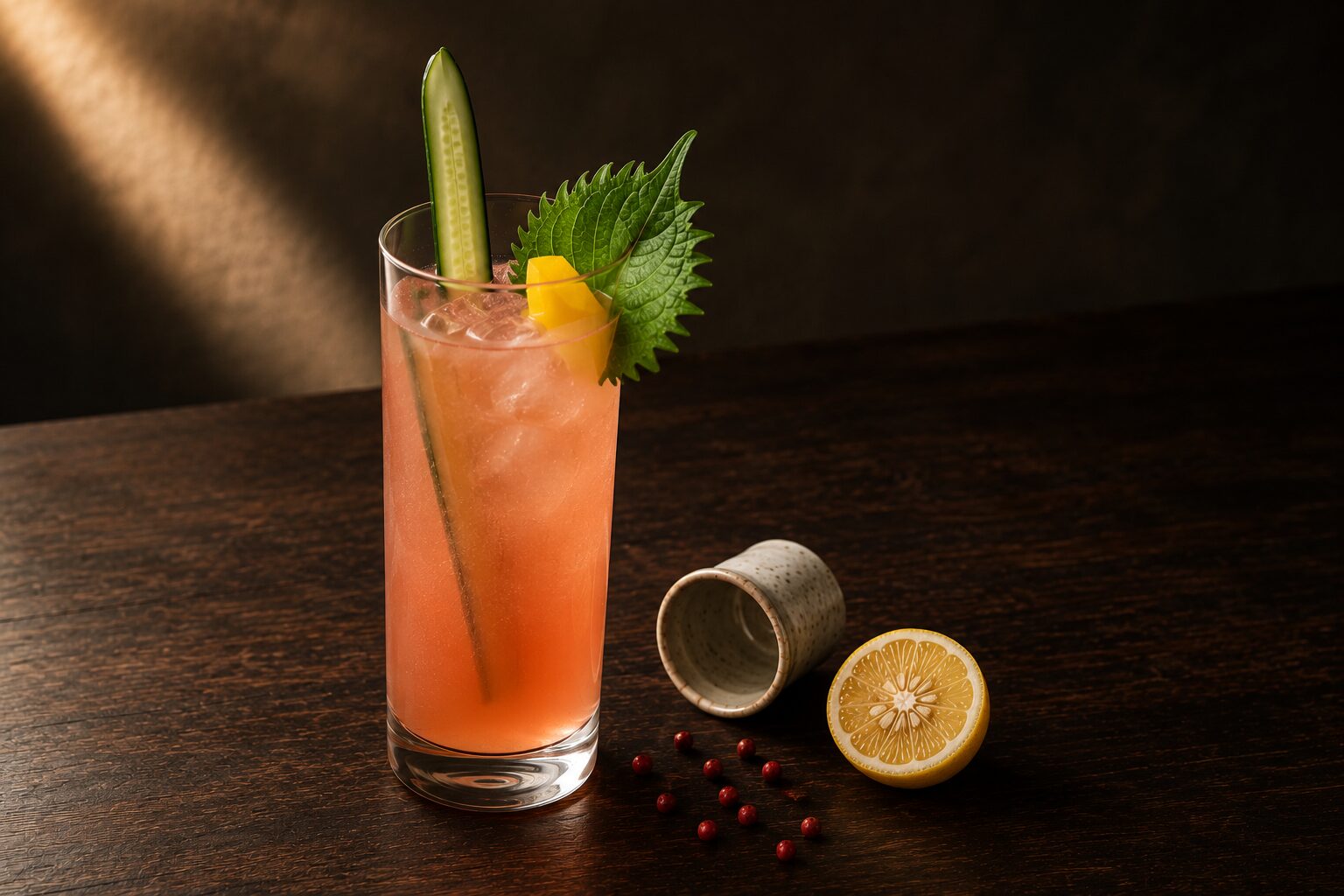
The Sake Mary is what happens when you put a Bloody Mary through a Japanese lens with restraint. It’s the elegant interpretation — lighter, more refreshing, lower alcohol, dramatically more drinkable in the morning. The brunch drink for people who think they don’t like Bloody Marys.
If you want the maximalist Japanese version with full umami and izakaya energy, see the Bloody Samurai. This one stays quiet on purpose.
The principle
Sake is about 15% ABV, compared to vodka’s 40%. It also carries character — delicate rice, slight sweetness, sometimes melon or pear top notes depending on the brewery. You can’t treat it like vodka. If you build a Bloody Mary the usual way and just swap vodka for sake, you crush the sake’s identity under Worcestershire and horseradish.
The fix is to swap the supporting cast for ingredients that complement sake instead of fighting it:
- Soy sauce replaces Worcestershire — same umami function, no anchovy or molasses to clash with the rice
- Fresh-grated wasabi (or wasabi paste) replaces horseradish — same heat compound, smaller dose, cleaner finish
- Yuzu juice replaces lemon — same acid function, lighter and more aromatic
- Shichimi togarashi replaces black pepper — same warm-heat function, Japanese 7-spice character
- Unsalted tomato juice (or tomato water) replaces V8 — lighter base, lets the sake show through
The result is a drink with the same Bloody Mary architecture but a completely different voice. Restrained, clean, intentional.
The recipe
For one drink in a tall slender highball:
- 2 oz junmai sake (chilled — a clean, dry style works best)
- 4 oz unsalted tomato juice (Lakewood Organic is the standard)
- ½ oz yuzu juice (bottled is fine, look for “100% yuzu juice” not a sweetened mix)
- 1 teaspoon soy sauce (Japanese shoyu or tamari, not Chinese-style)
- ¼ teaspoon wasabi paste (or ⅛ teaspoon fresh-grated wasabi)
- Pinch of shichimi togarashi
- Ice — large cubes if you have them
Garnish: long thin spear of english cucumber standing in the glass, single fresh shiso leaf perched on the rim, small piece of pickled daikon (takuan) on a wooden cocktail pick.
The method
Fill the glass two-thirds with ice. Add the sake, yuzu juice, soy sauce, and wasabi directly to the glass. Top with the tomato juice. Stir gently — five or six turns with a long bar spoon. Sprinkle the shichimi togarashi across the top. Add the garnishes.
That’s the whole drink. The first sip should hit shiso aroma, then yuzu brightness, then the subtle umami of sake-and-tomato underneath. The wasabi shows up two or three sips in — slow heat that builds rather than punches.
The sake selection question
Any decent junmai sake works. You don’t need anything expensive — a $15 supermarket sake is fine, and arguably better than a $50 junmai daiginjo because the premium sakes have delicate floral notes that get lost in the drink.
The styles to consider:
- Junmai — full-bodied, rice-forward, the default. Best general-purpose choice.
- Junmai ginjo — lighter and more aromatic. Excellent if you want the floral notes to come through.
- Honjozo — drier and slightly higher in alcohol (some have added distilled alcohol). Works well, especially if you find pure junmai too sweet.
- Nigori — unfiltered, milky, sweet. Skip it for this drink — the cloudiness fights the visual.
Drink the rest of the bottle chilled with the rest of breakfast. The sake left over from making one drink is the perfect amount for two or three small ochoko cups alongside.
Sourcing the ingredients
The Sake Mary requires some ingredients that aren’t in every American kitchen. The good news is that all of them keep well and are useful in other applications, so the initial investment pays off across many drinks and meals.
- Sake: Most decent liquor stores. Whole Foods carries it. If you have an Asian market nearby, the selection is dramatically better.
- Yuzu juice: Asian markets, or Amazon. Search for “100% yuzu juice.” A small bottle lasts months.
- Wasabi paste: The tubes at any grocery store work fine (and remember, most “wasabi” in tubes is dyed horseradish — see the horseradish post). Real wasabi is rare and expensive; not necessary here.
- Shichimi togarashi: Penzey’s, Whole Foods, or any Asian market. Wide availability now.
- Shiso leaves: The hardest to source. Asian markets in larger cities. If unavailable, substitute fresh mint — different flavor but similar aromatic role.
- Pickled daikon (takuan): Asian markets. Look for the bright yellow variety. Keeps months refrigerated.
The variation worth knowing
If you can’t find unsalted tomato juice, make tomato water instead. Roughly chop 2 lbs of ripe tomatoes, salt them with a teaspoon of kosher salt, let them sit in a strainer over a bowl for 30 minutes. The clear pinkish liquid that collects in the bowl is tomato water — pure tomato flavor without the body or color of tomato juice.
A Sake Mary built on tomato water is almost translucent — a pale pink drink that looks more like a Hibiscus cocktail than a Bloody Mary. Some people consider this the platonic version. It’s definitely more elegant. Try it once.
When to serve this
Morning brunches where the food is leaning Japanese or Asian — onigiri, tamagoyaki, fish, anything sushi-adjacent. Garden lunches in summer. Any moment where you want a Bloody Mary’s structure but not its weight. The 15% alcohol means you can have two without writing off the afternoon.
Not the right drink for a hangover. The whole point of a hangover Bloody Mary is the salt-fat-spice intensity. The Sake Mary is too restrained for that job — it’s the morning-after-the-night-before drink for people who didn’t actually go that hard.
A note on how this was written
This post was written with AI assistance. The ingredient substitutions are verified across multiple traditional Japanese cocktail references; the tomato water variation is from my own kitchen and worth the small extra effort.
Leave a Reply