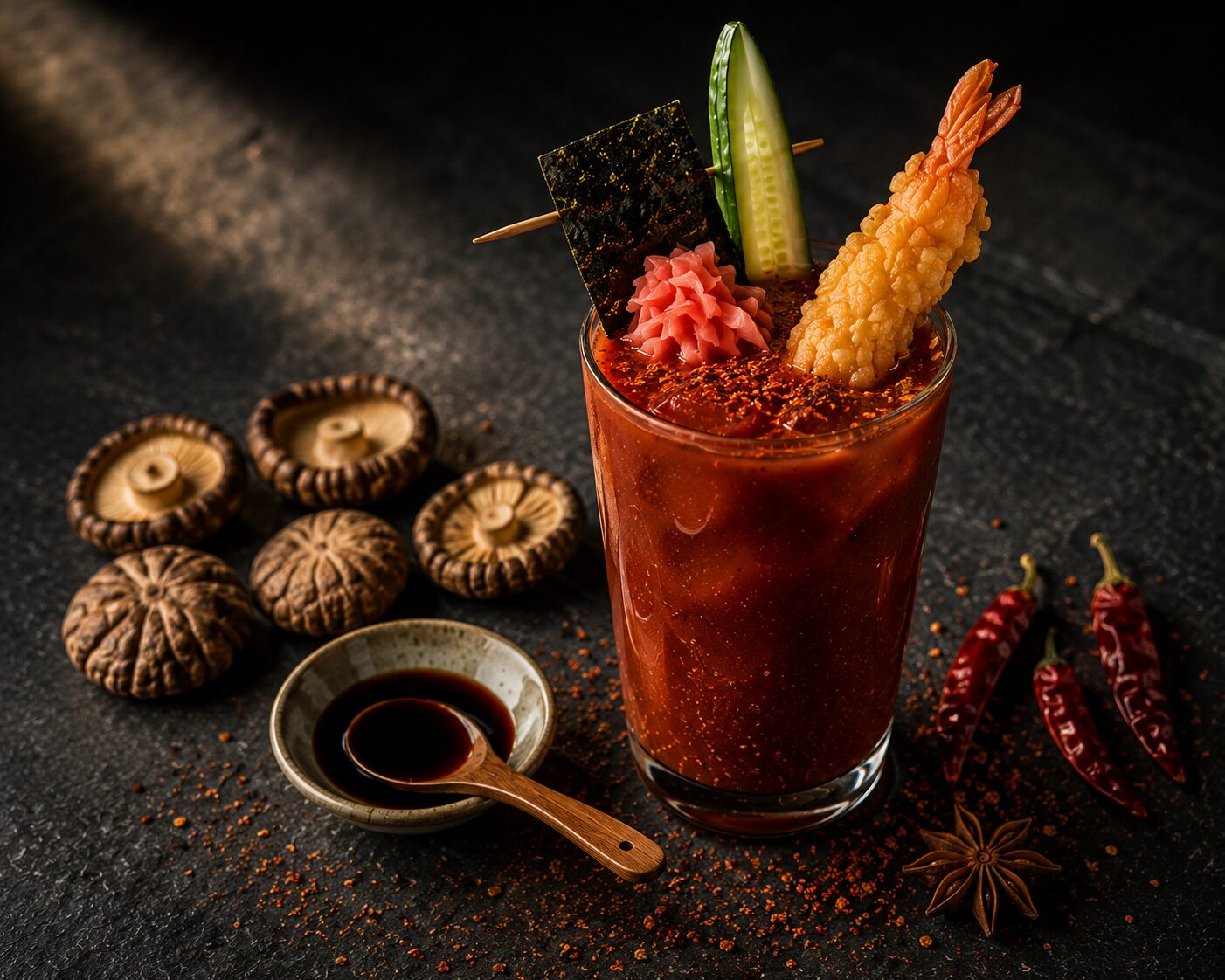
If the Sake Mary is the restrained Japanese interpretation, the Bloody Samurai is the maximalist one. Dashi, soy, miso, fish sauce, and shichimi all stacked into a single glass alongside a piece of shrimp tempura skewered on the rim like it’s daring you to drink and eat at the same time.
This isn’t a cocktail so much as an izakaya meal in a glass. The umami density is the point. People who have one will remember it for years.
The principle
Where the Sake Mary subtracts (lighter base, restrained accents), the Bloody Samurai adds. Five distinct umami sources work simultaneously: tomato glutamate, dashi inosinate, soy glutamate, miso glutamate, and fish sauce glutamate. Each contributes a different note of savory depth, and the combination is dramatically greater than the sum of its parts because of umami synergy — the phenomenon where glutamate and inosinate together register on the palate at roughly 8x the intensity either delivers alone.
This is the same chemistry that makes a good ramen broth taste so much more savory than its individual ingredients suggest. You’re bringing it to a cocktail.
The recipe
For one drink in a tall pint glass:
- 1.5 oz vodka OR 1 oz vodka + 0.5 oz shochu (mugi or imo style)
- 4 oz tomato juice (V8 or similar — full-bodied here, not the lighter version)
- 2 oz cold dashi (instant dashi powder mixed with water works — about ½ teaspoon dashi powder per 2 oz hot water, cooled)
- 1 teaspoon Japanese soy sauce (shoyu or tamari)
- ½ teaspoon white miso paste, whisked into the drink until dissolved
- ½ teaspoon fish sauce (Red Boat or Three Crabs)
- ½ teaspoon yuzukoshō (fermented green chile-yuzu paste) — or substitute ½ teaspoon sriracha + a small squeeze of lime
- Generous pinch of shichimi togarashi
- Ice — large cubes preferred
Garnish (don’t skip — they’re half the drink):
- Long english cucumber spear, standing in the glass
- Small piece of nori (toasted seaweed) skewered like a flag on a wooden cocktail pick
- Pickled ginger (gari — the pink kind from sushi), folded onto the same pick
- One piece of shrimp tempura perched on the rim, tail up — optional but transformative
The method
The miso step is the only tricky part. Miso doesn’t dissolve in cold liquid the way salt or sugar does — it needs to be coaxed.
In a small bowl, whisk together the miso, soy sauce, fish sauce, and yuzukoshō with a tablespoon of the dashi until you have a smooth paste. This pre-mix step is what separates a great Bloody Samurai from one with a clump of miso sitting at the bottom of the glass.
Fill the pint glass two-thirds with ice. Add the vodka (or vodka-shochu blend). Pour in the dashi-miso pre-mix. Add the tomato juice. Stir gently with a long bar spoon — eight or nine turns to fully integrate. Sprinkle shichimi togarashi across the top.
Garnish heavily. The cucumber spear stands in the drink. The nori-and-ginger skewer rests across the top. The shrimp tempura perches on the rim like a flag claiming the glass. Serve immediately while the tempura is still warm if possible.
The shochu question
Shochu is Japanese distilled spirit — clearer than whiskey, drier than vodka, around 25-35% ABV. It comes in several base ingredient styles:
- Mugi shochu (barley) — clean, slightly sweet, easiest substitute for vodka
- Imo shochu (sweet potato) — earthy, distinctive, polarizing (people either love it or hate it). Adds dramatic character.
- Kome shochu (rice) — soft, slightly sweet, the gentlest option
Replacing half the vodka with mugi shochu is the safest move and adds a layer of grain-derived depth. Replacing it with imo shochu makes a much more dramatic drink — earthy and distinctive in a way nothing else can replicate. Try both versions over time.
If you don’t want to track down shochu, the all-vodka version is excellent too. The drink doesn’t depend on the shochu.
The shrimp tempura argument
A piece of shrimp tempura on the rim transforms this drink from “interesting cocktail” to “small meal.” The hot crispy tempura against the cold drink is one of the best texture contrasts in cocktail garnishing. The drink already has dashi as a base, which means the tempura tastes like it belongs there.
If you don’t want to make tempura from scratch, frozen tempura shrimp from any Asian market will work. Air-fry or oven-bake from frozen, takes about 8 minutes. The texture won’t be as good as fresh but the difference is small.
Without the tempura, this is still a great drink. With it, it’s a memorable one.
Sourcing the ingredients
This drink requires a shopping trip. The good news is that all of these ingredients are foundational to Japanese home cooking, so the investment opens up a lot more than just one cocktail.
- Dashi powder: Asian markets. Hondashi brand is the standard. Lasts a year.
- White miso: Most grocery stores now carry it (refrigerated section). Marukome and Hikari are common brands.
- Yuzukoshō: Asian markets, harder to find. Worth the search — there’s no real substitute that captures the same fermented chile-yuzu character. Sriracha + lime is a workable approximation.
- Shochu: Larger liquor stores or Japanese specialty stores. iichiko is a widely available mugi shochu.
- Nori, pickled ginger, shrimp tempura: Any Asian market, or the international aisle of a decent grocery store.
When to serve this
Weekend dinners that lean Asian. Late lunches that should have been dinner. Any moment when you want one drink to be the meal. The Bloody Samurai is too heavy for early-morning brunch — it’s not a wake-up cocktail, it’s a sit-down-and-think cocktail.
It’s also the right drink to make for someone who claims they don’t like Bloody Marys. The umami density is so different from the standard American Bloody Mary that most skeptics revise their opinion mid-glass.
The two-recipe argument
The Sake Mary and the Bloody Samurai together represent the two ways Japanese cuisine can inflect a Bloody Mary. Restraint and abundance. Subtraction and addition. Morning and evening. Brunch and izakaya.
Make both within a week of each other. The contrast is more interesting than either drink alone.
A note on how this was written
This post was written with AI assistance. The umami synergy chemistry is verified against actual food science (the phenomenon was first formally described by Japanese researchers in the 1950s). The shrimp tempura garnish is from a Bloody Mary I had once at an izakaya in San Francisco that I’ve been trying to replicate ever since.
Leave a Reply