
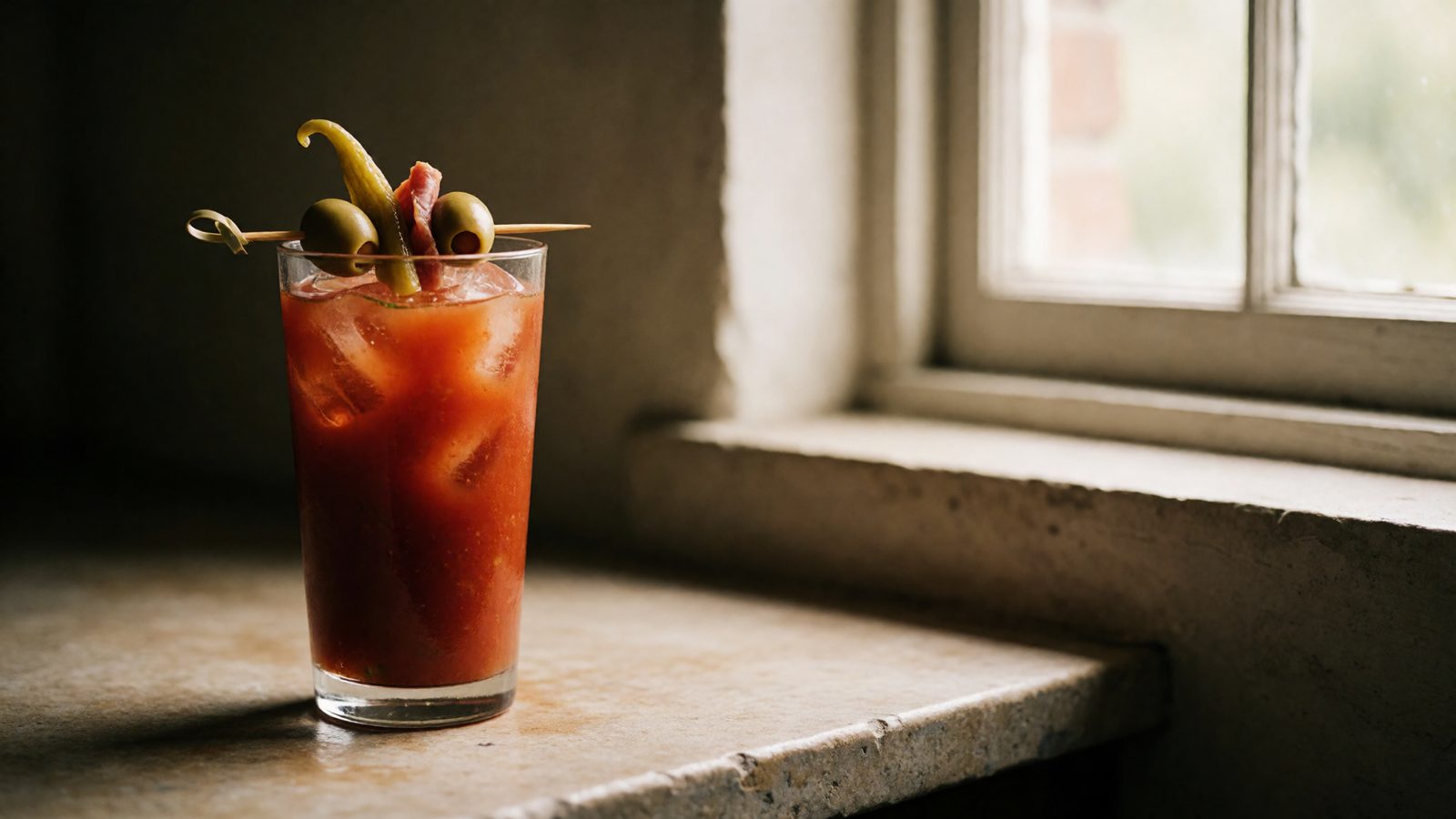
Somewhere along the way, the Bloody Mary garnish stopped being a garnish and became a competitive sport: sliders, whole fried chicken wings, entire cheeseburgers balanced on a rim. It makes for a striking photo and a genuinely confusing drinking experience. A garnish that actually works isn’t about volume. It’s structural engineering, the same discipline that goes into any weight-bearing design: each element has a job, a position, and a reason for being exactly where it is.
Bloody Mary Garnish: Think in Flavor Categories, Not Objects
A well-built garnish usually pulls from four categories: something acidic or pickled to brighten each sip, something savory or umami-rich to deepen it, something with real textural contrast, and one element that’s genuinely edible on its own rather than purely decorative. A single celery stalk technically checks one box. A loaded skewer that hits all four does actual work.
Pickled elements are doing more than adding tang
A cornichon, a pickled okra, a pepperoncini: beyond the acidity, the brine itself matters. Anything pickled has been sitting in a liquid that’s absorbed salt, vinegar, and often garlic or dill, and a few drops of that brine dripping into the glass as you drink continues seasoning the Bloody Mary in real time. This is part of why pickle-adjacent garnishes read as more integrated than something like a plain lemon wedge, which mostly just sits there.
Smoked and cured meats need restraint
Bacon, salami, and other cured meats bring real savory weight, but they’re also the easiest way to overload a garnish into something more like an appetizer plate than a drink accessory. One strip, crisped enough to hold its shape on a skewer without going soft in the glass, does the job. More than that competes with the drink instead of complementing it.
Seafood garnishes: the highest payoff, the highest risk
A shrimp, an oyster, or a piece of smoked fish can be genuinely spectacular on a Bloody Mary; the brine and mineral notes of good seafood pair naturally with tomato and horseradish. The risk is temperature and timing: seafood that’s sat out too long or isn’t properly chilled turns a great idea into a food safety problem fast. If you’re going this route, garnish immediately before serving, not thirty minutes ahead for a party.
Weight distribution: why order on the skewer isn’t cosmetic
Build from the glass outward, heaviest and sturdiest first: something that can sit in the liquid without falling apart, then pickled elements, then anything delicate or perishable last, closest to the mouth of the glass where it’s least likely to get soggy before the drink is finished. A heavy garnish (a slider, a whole shrimp, a thick-cut bacon slab) needs a wide base of support at the rim, not a single thin pick trying to cantilever all that weight off the glass edge. Two shorter, sturdier skewers spanning the rim will hold a heavy load that a single tall pick will tip over.
Rimming: before the ice, not after
Salt or spice the rim before adding ice, using a citrus wedge to wet the glass first so the salt has something to adhere to. Rimming after the glass is already full and cold means condensation, not citrus oil, is doing the wetting, which gives an uneven, patchy result. This is a small sequencing detail with an outsized effect on how the finished glass actually looks.
The printable blueprint
Download the one-page printable garnish blueprint for a quick visual reference of the four flavor categories and the glass-outward weight order, without re-reading the full article each time.
Frequently Asked Questions
How do you keep skewers from falling over in the glass?
Use two shorter skewers spanning the rim rather than one tall pick for a heavy garnish, and load the heaviest, sturdiest elements closest to the base of the skewer near the rim, not at the top.
Should you rim the glass before or after adding ice?
Before. Wet the rim with a citrus wedge while the glass is still empty, then add the ice and build the drink. Rimming a cold, condensation-covered glass gives a patchy, uneven result.
What is the best salt for a Bloody Mary rim?
Celery salt is the standard for good reason: it contributes real flavor, not just texture. See this site’s full celery salt guide for brand recommendations and a 5-minute DIY version.
Can you put a slider or a full appetizer on a cocktail skewer?
Structurally, yes, with the right support (two skewers spanning the rim rather than one), but it’s worth asking whether it serves the drink or just the photo. This guide leans toward garnish that extends flavor rather than volume for its own sake.
When did people start putting celery in Bloody Marys?
The celery stalk became closely associated with the drink in mid-20th-century America, though exact origin claims vary; it endures because it works as both an edible garnish and a built-in stirrer, not just tradition for its own sake.
Sources
- No claims in this piece require a specific scientific citation beyond standard food safety practice (garnishing perishable seafood immediately before serving) and general culinary technique.
A note on how this was written
This is a rebuild of an existing post on this site, keeping its original flavor-category and skewer-order reasoning while reorganizing it around a structural-engineering framing and adding the weight-distribution and rimming-sequence sections. Punctuation was updated to match this site’s current no-em-dash style. The printable blueprint PDF is flagged above as a still-pending asset.
Related Reading
- Celery Salt — The Most Important Ingredient You’re Probably Buying Wrong
- The 12-Person Brunch: An Hour-by-Hour Host Timeline
- For the classic build this garnish tops, see the bloody mary recipe.
Leave a Reply