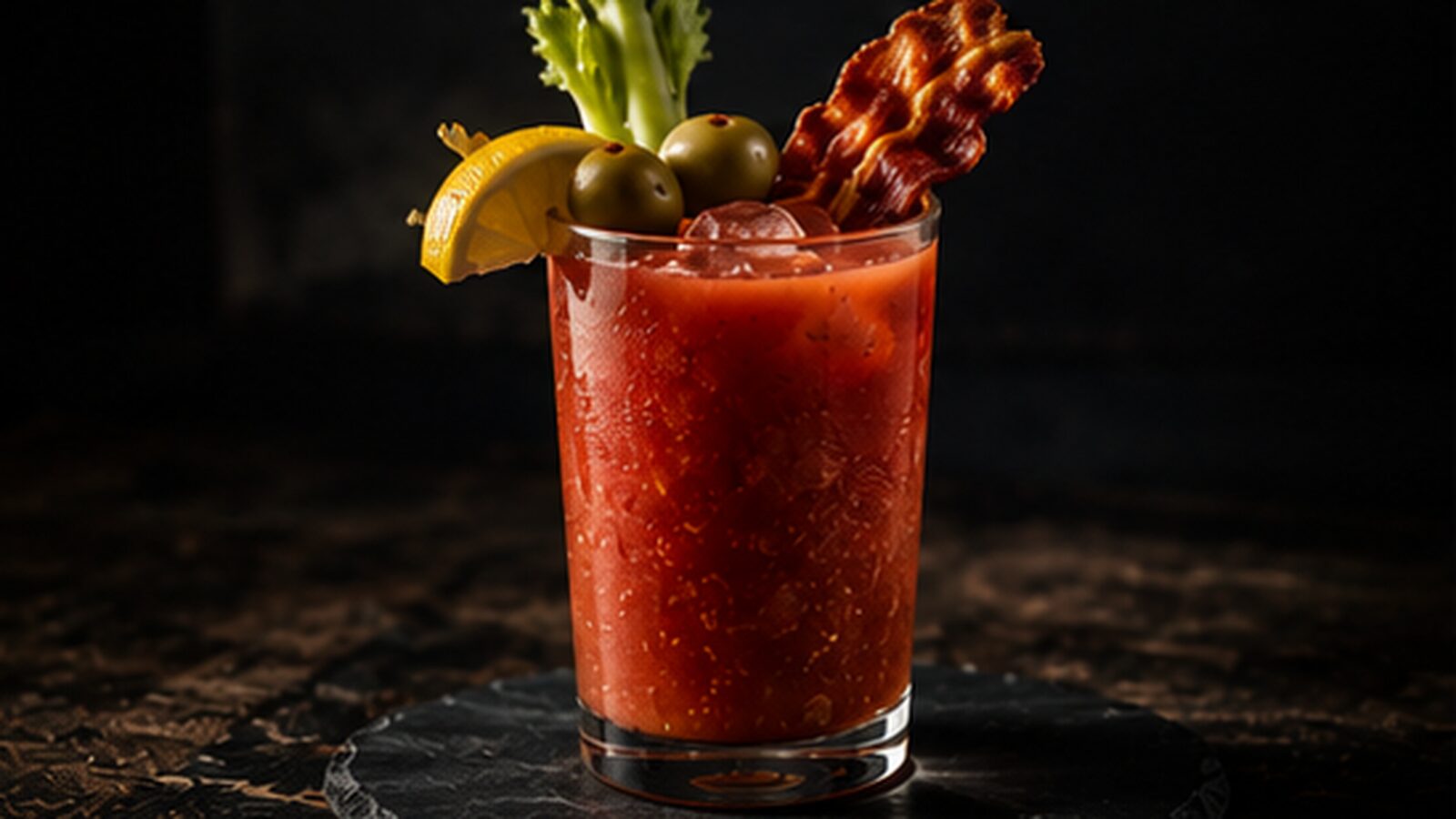
If the Caesar is what Canada does with Clamato, this is what happens when an American bartender meets the same mixer and decides the rim should be bigger, the spice should be louder, and the garnish should weigh more than the drink. It is a Bloody Mary, structurally — vodka, savory mix, garnish — but built on a base that does most of the heavy lifting.
The result is a Bloody Mary with the umami depth of a Caesar and the personality of a brunch. Use it when you want the drink to keep up with food.
The Clamato Bloody Mary
Makes 1 · Prep 3 minutes
Ingredients
- 6 oz Clamato
- 2 oz vodka
- ½ tsp prepared horseradish
- 2 dashes Worcestershire sauce
- 3 dashes hot sauce
- ½ tsp pickle brine (from the jar)
- ¼ tsp celery salt
- Fresh black pepper, several cracks
- Garnishes: 1 celery stalk, 1 lemon wedge, 1 large green olive, 1 strip of cooked bacon (optional but recommended)
Instructions
- Salt the rim of a tall pint glass with celery salt, using a lemon wedge to wet the rim.
- Fill the glass two-thirds with ice.
- Add vodka, horseradish, Worcestershire, hot sauce, pickle brine, and black pepper.
- Top with Clamato. Stir gently to combine — six to eight turns of a long bar spoon.
- Garnish aggressively. Celery stalk standing up. Lemon wedge on the rim. Skewer the olive with a cocktail pick. Lean the bacon strip diagonally across the top of the glass like a question.
- Serve immediately with the bacon as the first thing you eat.
Notes
Why Clamato instead of tomato juice: the umami chemistry does work that would otherwise require adding fish sauce, anchovy paste, or a heavy soy-sauce hand. Building on Clamato means you can dial back the seasoning and get more flavor, not less.
Garnish strategy: a Bloody Mary garnish should be edible, not architectural. Two or three items, all of which you’d actually eat with the drink. If you wouldn’t put a deep-fried slider on a steak, don’t put one on a Bloody Mary.
Heat scaling: dial the hot sauce up to taste. The Clamato base is more forgiving of heat than plain tomato juice because the umami underneath gives the spice somewhere to sit.
The first time you make this version side-by-side with a tomato-juice Bloody Mary, the difference will be obvious in one sip. The Clamato version has a fuller bottom-end, a savory depth that lingers, and a cleaner spice profile because the base has already done the work of grounding everything else. There is no good reason not to make every Bloody Mary this way.
A note on this post: I worked with an AI writing tool to help shape and refine some of the language here. The view that this version should be the American default is entirely my own.
Leave a Reply