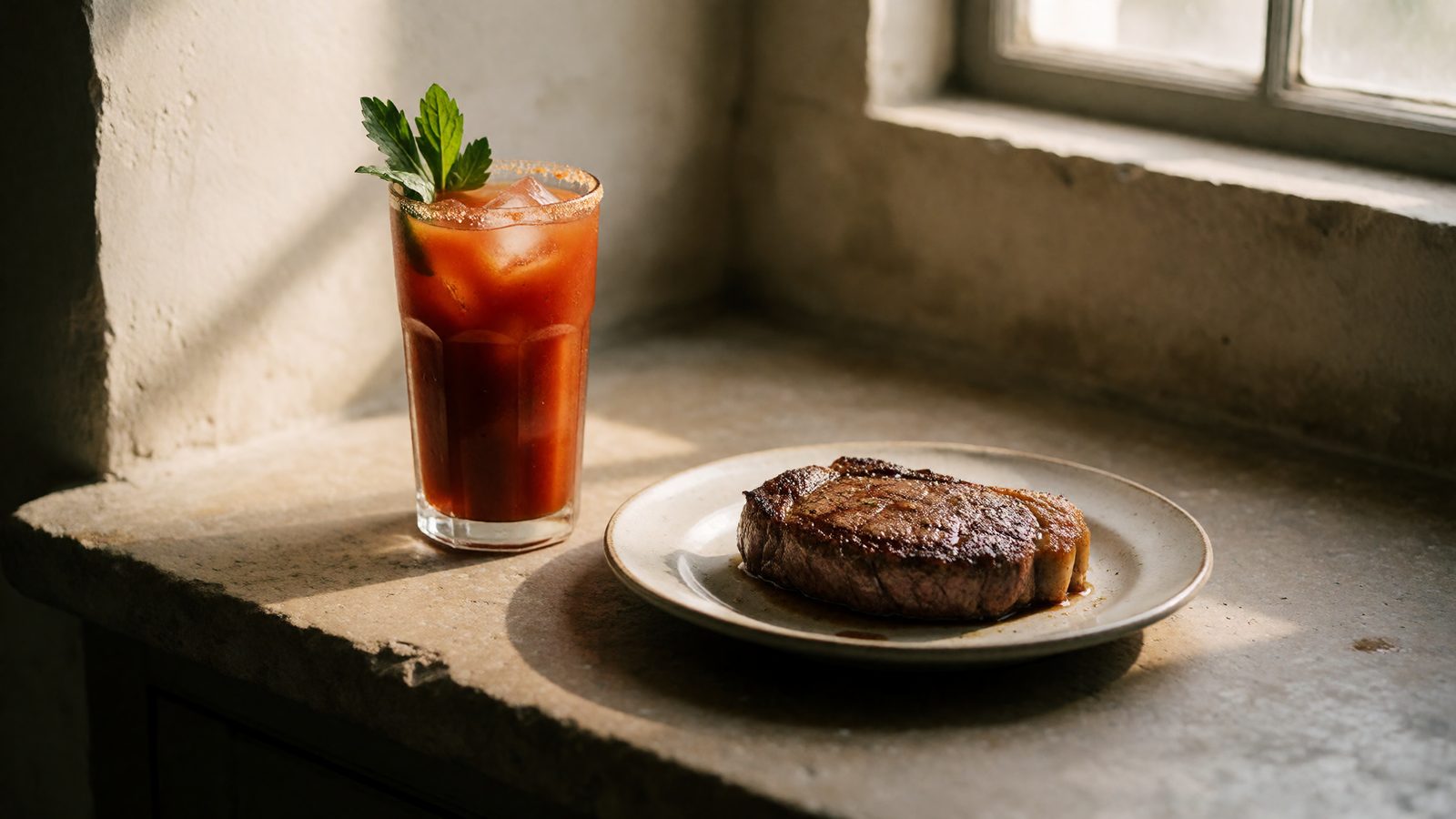
This site already has a brunch Bloody Mary food pairing guide, built around eggs and other classic morning food. This one is different on purpose: it’s about dinner, where a Bloody Mary’s acid, salt, and umami do a completely different job than they do next to a soft poached egg.
Red meat is the obvious pairing, for a real reason
A well-marbled steak is rich, fatty, and mineral in a way that needs a genuinely acidic, high-umami counterpunch — the same principle that makes a bold red wine work with red meat. A Bloody Mary brings tomato’s acid and glutamate, Worcestershire’s inosinate, horseradish’s sharp heat, and black pepper’s bite, all of which cut through fat the way a squeeze of lemon cuts through a rich pan sauce. It’s not a novelty pairing; it’s structurally the same job a steak sauce does, just in liquid form.
Where it beats wine
Wine pairs with red meat through tannin and acid. A Bloody Mary pairs through acid, salt, and umami synergy all at once — a wider set of tools working simultaneously. That makes it a genuinely useful pairing for dishes that fight most wine badly: something heavily spiced, something with a strong char or smoke element from the grill, or a dish built around Worcestershire or soy-based glazes that can make wine taste metallic or flat by comparison.
More Bloody Mary Food Pairing Ideas Beyond Steak
Grilled and smoked foods generally share red meat’s need for acid and salt to balance char and fat, which makes a Bloody Mary a natural match for barbecue, blackened fish, or a smoky roasted vegetable spread, not just a ribeye. Raw and cured seafood — oysters, a shrimp cocktail, ceviche — also pairs well, since a Bloody Mary’s briny, savory character echoes the sea rather than competing with it, similar to how a Caesar or a classic mignonette works alongside oysters.
Matching the build to the specific cut
A fattier cut like a ribeye or a short rib can take the full weight of a heavily spiced, horseradish-forward build without the drink getting lost; there’s enough fat on the plate to stand up to real heat. A leaner cut, a filet or a flank steak, does better with a slightly gentler hand on the spice, since there’s less richness on the plate to buffer against and an overly aggressive drink can end up dominating a delicate cut rather than complementing it. The same logic that governs pairing a big, tannic red with a fatty cut and a lighter red with a leaner one applies here, just with acid and heat standing in for tannin.
Lamb, with its distinct mineral, slightly gamey character, pairs particularly well with a Bloody Mary built around fresh herbs, rosemary or mint muddled lightly into the base, which echoes classic lamb seasoning rather than fighting it. Pork, especially something with a sweet glaze like a barbecued rib or a ham, wants a build with more acid and less sweetness than usual to cut through that glaze rather than compound it.
Batching for a dinner party
A dinner-oriented Bloody Mary is one of the easier cocktails to batch ahead for a group, since its seasoned base actually improves over a few hours in the fridge the same way a marinade does. Batch the tomato base with all the seasoning except the alcohol earlier in the day, then build individual glasses to order at the table so each guest controls their own spirit level. This also solves the pacing problem a dinner party creates that brunch doesn’t: guests moving between wine, a Bloody Mary, and whatever else is being poured need to be able to opt in and out of alcohol without you remixing a whole pitcher, and a pre-batched base with vodka added glass by glass handles that cleanly.
What doesn’t work as well
Delicate white-fish preparations and most poultry, especially anything sauced lightly with butter or cream, tend to lose out next to a Bloody Mary’s assertive acid and spice; the drink simply overwhelms food that’s built around subtlety rather than richness. This isn’t a hard rule, a Bloody Maria alongside a well-spiced fish taco holds up fine, but a delicately poached sole or a simple roast chicken is better served by something quieter. Save the Bloody Mary for the meal that can actually stand up to it.
Adjusting the build for an evening glass
A dinner-oriented Bloody Mary can afford to run bolder than a brunch build — heavier Worcestershire, a spicier hot sauce, a more aggressive horseradish pour — since it’s meant to stand up to a substantial plate of food rather than ease someone into a Sunday morning. A smoked salt rim (see this site’s celery salt vs. smoked salt comparison) also reads more at home on a dinner table than it does with eggs, echoing a grill or smoker rather than a brunch spread.
Glassware and serving temperature for an evening pour
A brunch Bloody Mary is almost always served long, over plenty of ice, in a tall glass meant to last through a leisurely morning. A dinner pour can afford to be smaller and slightly less diluted, closer to a rocks glass with a single large ice cube than a full highball packed with cubes that melt and water the drink down over the course of a meal. Less dilution means the drink stays at full strength and full seasoning through the whole plate, which matters more at dinner, where the drink is meant to actively work alongside food rather than just accompany a long, unhurried morning.
Garnish can also scale down for an evening pour. A brunch Bloody Mary garnished like a small meal (celery, olives, a strip of bacon) makes sense when it’s arriving instead of a full breakfast. At dinner, where a real plate of food is already on the table, a simpler garnish, a single lemon wedge or a sprig of the same herb used on the plate, keeps the drink from competing with the meal it’s meant to complement.
Frequently Asked Questions
What snacks or dishes pair best with a spicy Bloody Mary at dinner?
Red meat, grilled or smoked foods, and raw or cured seafood all pair well, since the drink’s acid and umami are built to cut through fat and richness the way a bold red wine does with steak.
Is a Bloody Mary too heavy to drink with a big meal?
Not if the build is balanced — the acid and spice are what make it work alongside rich food rather than compete with it, the same logic behind pairing a bold red wine with steak.
Should a dinner Bloody Mary be stronger or spicier than a brunch one?
It can afford to be, since it’s meant to stand up to a full plate of food rather than ease into a morning. A bolder Worcestershire and horseradish pour, and a smokier rim, both suit an evening build well.
What food doesn’t pair well with a Bloody Mary?
Delicate preparations built around subtlety rather than richness, a lightly poached white fish or a simply roasted chicken, tend to get overwhelmed by the drink’s assertive acid and spice. Save it for food with enough fat or char to stand up to it.
Can you batch a Bloody Mary base ahead of time for a dinner party?
Yes, and it’s one of the easier cocktails to prep ahead: batch the seasoned tomato base without the alcohol earlier in the day, then build individual glasses to order so guests control their own spirit level.
Sources
- No claims in this piece require a specific external citation; the pairing logic (acid and umami cutting through fat) is standard, widely known culinary reasoning.
A note on how this was written
The pairing logic here is standard food-and-drink reasoning (acid and umami balancing fat and richness) applied specifically to dinner contexts, not a personally tasted set of pairings. Treat the specific dish suggestions as a starting point.
Related Reading
- The Best Bloody Mary Brunch Pairings
- Celery Salt vs. Smoked Salt — Which Rim Is Right?
- For the classic build to pair, see the bloody mary recipe.
Leave a Reply