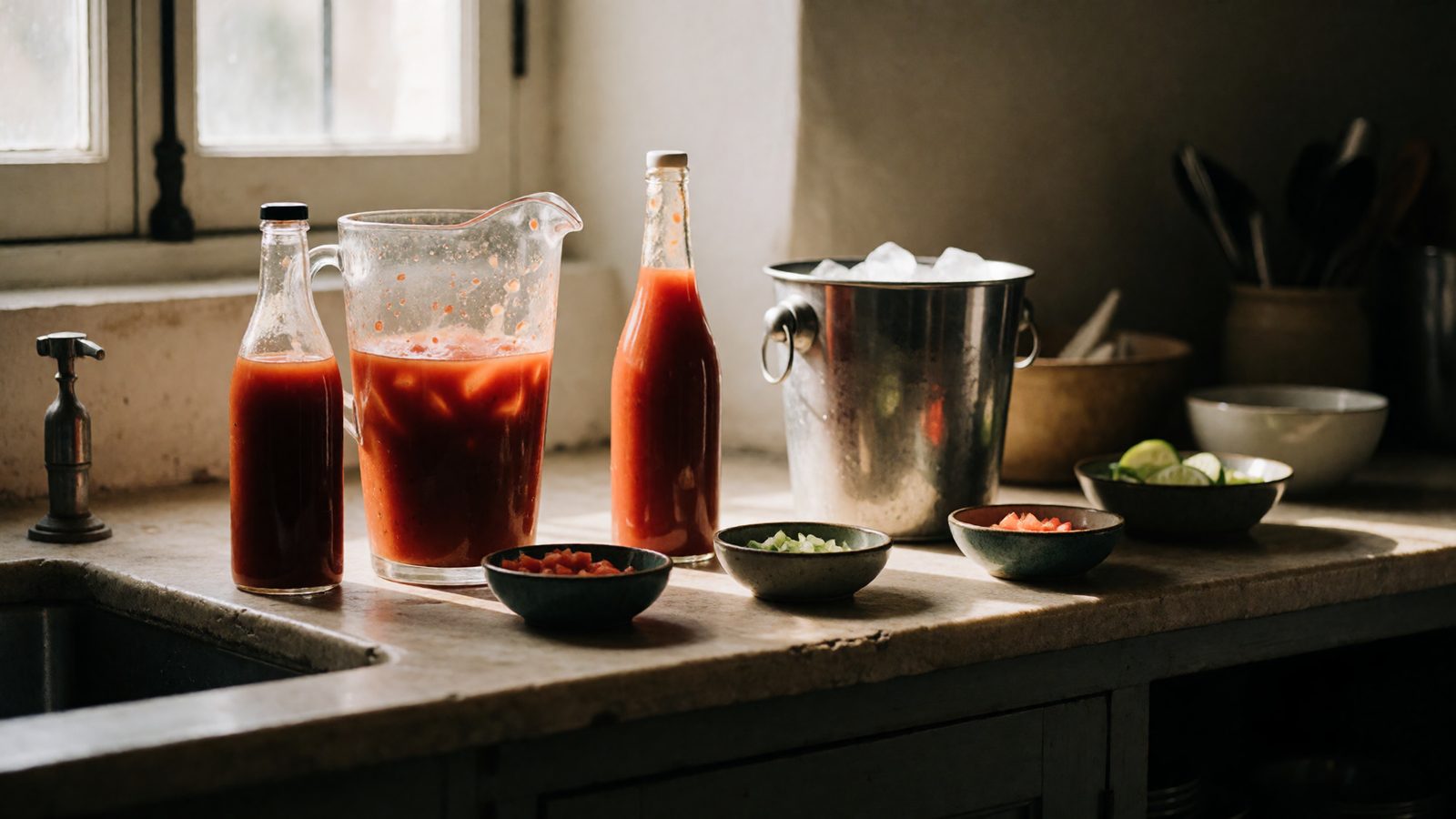
This site already has a blueprint for building a DIY Bloody Mary bar — batching ratios, station spacing, how much vodka to buy. This piece assumes you’ve read that and answers a different question: not what to set up, but when. A 12-person brunch fails or succeeds based on timing, not ingredients.
T-minus 24 hours
Batch the seasoned tomato base — juice, Worcestershire, hot sauce, horseradish, black pepper, everything except the alcohol — and refrigerate it overnight. The flavors round out and marry over a day the way they don’t in a base mixed an hour before guests arrive. This is also when you should do any grocery math: for 12 people at roughly 1.5 drinks each over a few hours, plan for about a liter and a half of vodka and a full gallon of base.
T-minus 3 hours
Prep every garnish component and store it separately, covered, in the fridge: celery stalks trimmed, lemon and lime wedges cut, olives on picks if you’re pre-skewering, bacon cooked and left whole (not sliced) so it stays crisp longer. Don’t assemble garnish combinations yet — a fully built skewer sitting for three hours gets soggy where a separated component doesn’t.
T-minus 1 hour
Set up the physical bar: base in a large pitcher or dispenser, vodka in its own bottle nearby (never pre-mixed into the base — guests have different tolerances and a self-serve bar needs to respect that), rimming salt in a shallow dish, ice in a bucket with a scoop, and every garnish component in its own small bowl. This is also when you salt-rim a stack of glasses in advance, since a pre-rimmed glass saves each guest a step and keeps the salt dish from getting soggy fingers dipped in it all afternoon.
T-minus 15 minutes
Taste the batched base one more time before guests arrive — a day in the fridge can mellow the heat and salt slightly, and this is your last chance to adjust before it’s a self-serve station you’re not standing over. Refill the ice bucket. Put out a small printed card or a simple sign listing what’s in the base, since at least one guest at every brunch this size has a dietary question (usually about the Worcestershire, which contains anchovies) and it’s easier answered once than four separate times.
Scaling Your DIY Bloody Mary Bar Up or Down
This timeline is built around 12 guests, but the sequence holds regardless of group size; only the quantities change. For a smaller group of 6, halve the base and vodka amounts and the same T-minus schedule still applies. For a larger group of 20 or more, the timeline actually gets more important rather than less, since the margin for error shrinks: with more people pulling from the same pitcher faster, running out of ice or a garnish component mid-event is more likely, not less, which is why the “T-minus 15 minutes” ice-bucket refill step matters more as the group grows.
For any group over about 15, consider a second, smaller backup batch of base kept in the refrigerator rather than trying to make one pitcher large enough to cover the whole event. A single oversized batch sitting out at room temperature for several hours is more of a food-safety consideration than a couple of smaller batches, one out and one refrigerated until needed.
Handling dietary questions without derailing the morning
Worcestershire sauce, a near-universal Bloody Mary ingredient, contains anchovies, which surprises people who don’t think of it as a fish product. If any guests keep kosher, halal, or a pescatarian-adjacent vegetarian diet, this is worth flagging on the printed card mentioned in the T-minus 15 minutes step rather than fielding the question one guest at a time. A simple fix, if it comes up: batch a small secondary portion of base using a Worcestershire substitute (a soy-sauce-and-balsamic blend approximates some of the same umami without the fish) and label which pitcher is which.
What to prep the night before, if the morning is already packed
If brunch is one part of a bigger event, a wedding morning, a holiday, a day with other logistics competing for your attention, push everything possible back to the night before rather than the T-minus 24 hour mark. The seasoned base can be made up to 48 hours ahead without losing quality, sometimes improving further with the extra day. Garnish prep (trimming celery, cutting citrus) holds for 24 hours refrigerated in an airtight container, though anything cut should go in the container dry, since wet-stored citrus and celery soften faster than the same items stored with a paper towel absorbing excess moisture. The only things that genuinely need same-day attention are the ice (which should be fresh, not a bag that’s been in the freezer accumulating freezer odors) and anything genuinely perishable, like a fresh seafood garnish.
During: your only job is topping off
If the first four steps were done on schedule, your only remaining job during the brunch itself is refilling the base pitcher and the ice bucket as they run low, and maybe restocking a garnish bowl that’s gone popular. Everything else — the actual mixing, the rimming, the garnishing — is the guest’s job now, which is the entire point of a self-serve bar: it exists so the host isn’t the bartender for three straight hours.
Frequently Asked Questions
How many ounces of vodka do you need for 12 guests?
Figure roughly 1.5 drinks per person over a few hours at 2 oz of vodka each, which comes to about 36 oz total — a standard 1.75-liter bottle (about 59 oz) covers that with room to spare.
Should you pre-batch the alcohol into the base, or let guests pour their own?
Let guests pour their own. Batching the vodka into the base removes their ability to control their own drink strength, and makes it harder to serve a non-drinker from the same pitcher.
How long does homemade Bloody Mary mix last in the fridge?
A batched, seasoned tomato base (without alcohol) keeps well for 3 to 4 days refrigerated in a sealed container, which is why making it a full day ahead for a brunch is safe and actually improves the flavor.
What’s the biggest timing mistake hosts make?
Assembling garnishes too early. A fully built celery-and-olive skewer sitting out for three hours wilts and gets watery; keeping components separate until just before serving (or letting guests build their own) keeps everything crisp.
Sources
- No claims in this piece require a specific external citation; the timeline is standard event-hosting logistics applied to this drink.
A note on how this was written
This timeline is a reasoned application of standard event-prep logistics to a Bloody Mary bar specifically, not a personally run 12-person event. The quantities and timing windows are sensible starting points; adjust based on your own guests’ habits.
After the last guest leaves
Leftover batched base keeps for another 3 to 4 days refrigerated, so a too-generous batch isn’t wasted; it becomes the start of next weekend’s smaller batch rather than something to pour out. Leftover cut garnish, celery and citrus especially, holds up less well and is better used within a day or two in something else (a Bloody Mary garnish plate’s leftover celery makes a perfectly good snack with the same seasoned salt used for the rim) than saved indefinitely. The ice bucket and any dairy-adjacent garnish (a cheese cube, a dollop of horseradish cream) should be the first things cleared, both for food safety and because they’re the least likely to be usable again.
Related Reading
- The Blueprint for the Ultimate Self-Serve Bloody Mary Bar
- Beyond Celery — The Architecture of a Structural Bloody Mary
- The Best Bloody Mary Brunch Pairings
- For the base recipe this timeline batches, see the bloody mary recipe.
Leave a Reply