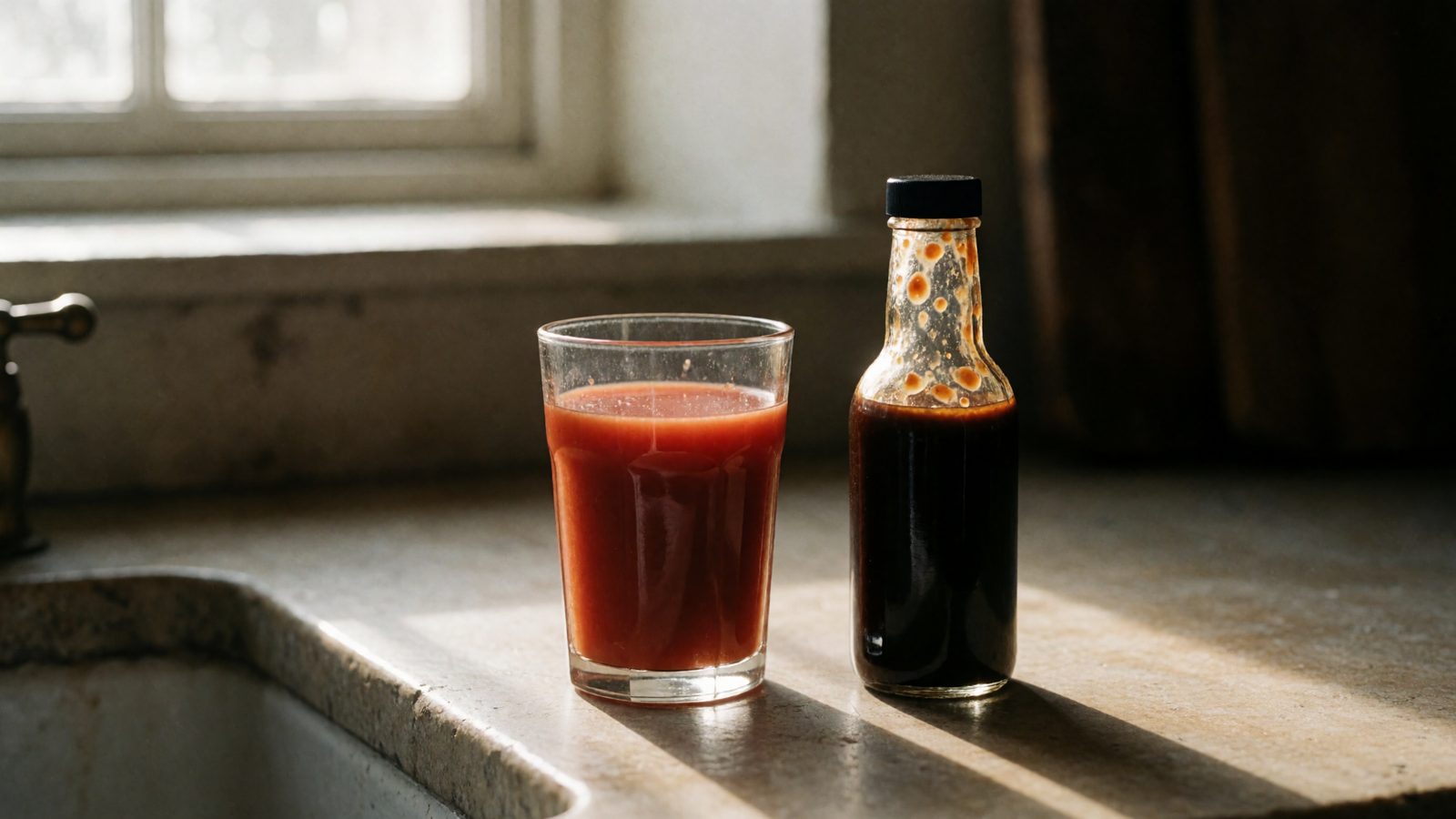
A Bloody Mary tastes more savory than a glass of straight tomato juice with vodka in it has any right to, and the umami synergy between its two main ingredients is why. Worcestershire sauce is most of the reason, and the reason isn’t just that Worcestershire tastes good. It’s that tomato and Worcestershire trigger a specific, measurable chemical synergy that makes the combination taste more intense than either ingredient predicts on its own.
The Umami Synergy Is a Taste, Not a Vibe
Sweet, sour, salty, and bitter were the accepted basic tastes for most of the 20th century. Umami — savory, brothy, meaty — joined the list once research confirmed a dedicated receptor mechanism for it, primarily triggered by glutamate, an amino acid naturally present in tomatoes, Parmesan, soy sauce, and dozens of other foods usually described as “savory.”
Glutamate alone is pleasant. What’s more interesting is what happens when you add a second class of compound to it.
The multiplier, not the sum
Ribonucleotides — inosinate and guanylate, mainly — are a separate class of umami-active compound, concentrated in things like dried fish, cured meats, and dried mushrooms. On their own, they barely register as flavorful. Combined with glutamate, the perceived umami intensity jumps well beyond what adding the two effects together would predict. Researchers documenting the mechanism describe glutamate and inosinate as binding at adjacent sites on the same taste receptor, which is the physical basis for why the combination reads as dramatically more intense rather than just “a bit more.”
This isn’t a folk theory. It’s the same principle behind Japanese dashi, built from kombu (glutamate) and dried bonito flakes (inosinate), and it’s why a soup made from both vegetables and meat consistently tastes deeper than either stock alone.
Where a Bloody Mary already gets this right
Tomato juice is one of the most glutamate-rich common beverages there is — part of why a Bloody Mary tastes savory even before any seasoning goes in. Worcestershire sauce, meanwhile, is fermented with anchovies as a core ingredient, which makes it a genuine inosinate source. Add Worcestershire to tomato juice and you’re not just adding a seasoning with its own flavor profile; you’re completing a synergy pair that multiplies both.
This is also why a Bloody Mary tolerates a heavier hand with Worcestershire than most drinks would tolerate with any single seasoning — you’re not just adding more of one flavor, you’re activating a receptor effect that doesn’t scale linearly with quantity the way a simple seasoning does.
A short history of noticing this by accident
Umami itself was identified as a distinct taste in 1908 by Japanese chemist Kikunae Ikeda, who isolated glutamate from kombu seaweed while trying to explain why dashi tasted more satisfying than its individual ingredients suggested it should. The synergy effect specifically, the dramatic amplification when glutamate meets a ribonucleotide, was documented decades later by researcher Akira Kuninaka, who found that combining glutamate with guanylate produced an umami intensity far beyond simple addition. Japanese cooking had been exploiting this pairing for centuries before either discovery, through dashi’s kombu-and-katsuobushi combination, without a name for the mechanism behind why it worked.
Western cooking arrived at the same principle independently and just as unknowingly: a French stock built from both bones and vegetables, an Italian sauce that layers Parmesan over a tomato base, a British Sunday roast finished with Worcestershire, all activate the same glutamate-ribonucleotide pairing without any chef involved ever needing to know the chemistry. A Bloody Mary belongs on that list, whether or not the person who first added Worcestershire to tomato juice knew why it worked.
Why this isn’t the same as just adding more salt
It’s worth being precise about what the synergy effect actually is, because it’s easy to confuse with simply making a drink saltier or more seasoned. Salt amplifies flavors broadly and works on an entirely different receptor pathway than umami does; a saltier Bloody Mary tastes more intense across the board, sweeter notes and sour notes included. The glutamate-inosinate synergy is narrower and more specific: it amplifies savoriness itself, not intensity generally, which is why a well-built umami-forward Bloody Mary can taste deep and satisfying without necessarily tasting saltier than a less deliberately built one. The two effects work together in a finished drink, but they’re not interchangeable tools, and reaching for more salt when what a recipe actually needs is a better umami pairing will make the drink louder without making it better.
Where else the synergy hides
Fish sauce works the same way Worcestershire does, for the same anchovy-derived reason — a small amount added to a tomato base activates the identical glutamate-inosinate pairing. Dried shiitake mushrooms bring guanylate instead of inosinate, a close chemical cousin with the same synergistic effect, which is the entire premise behind this site’s black garlic and shiitake recipe. Even a splash of soy sauce, an ingredient most people wouldn’t think to add to a Bloody Mary, is doing real chemistry rather than just adding saltiness.
None of this means more is always better — a Bloody Mary oversaturated with every umami-boosting ingredient at once tends to collapse into a muddy, one-note heaviness. The synergy is a tool for depth, not a rule that doubling every savory ingredient doubles the result again. Use it deliberately: one glutamate source (the tomato base), one or two inosinate or guanylate sources (Worcestershire, and optionally fish sauce or a mushroom element), and let the pairing do the work rather than piling on more of everything.
A practical checklist
Before adding another dash of anything to boost a flat-tasting Bloody Mary, check whether the base already has one clear glutamate source (tomato) and at least one clear ribonucleotide source (Worcestershire, fish sauce, or a mushroom element) working together. If it has glutamate but no ribonucleotide pairing, that’s usually the actual gap, not a need for more salt or more of the same seasoning already in the glass. If it already has both and still tastes flat, the problem is more likely elsewhere: insufficient acid, insufficient salt generally, or a base that’s simply diluted past the point either compound can do its job.
Frequently Asked Questions
Why does Worcestershire sauce make tomato juice taste better?
Worcestershire is fermented with anchovies, giving it a real inosinate content. Combined with tomato juice’s naturally high glutamate level, the two trigger a documented umami synergy effect that makes the pairing taste more savory than either ingredient predicts alone.
What is umami synergy, exactly?
The scientifically documented effect where combining glutamate with a ribonucleotide (inosinate or guanylate) produces a perceived umami intensity well beyond what simply adding the two effects together would predict.
Does fish sauce belong in a Bloody Mary?
Yes, on the same chemistry as Worcestershire — fish sauce is rich in inosinate from fermented fish, and a small amount pairs with tomato juice’s glutamate to the same effect.
Can you put A1 steak sauce or soy sauce in a cocktail and have it actually help?
Yes — both contain glutamate and, in the case of soy sauce, some inosinate from the fermentation process, so a small amount can meaningfully deepen a tomato base rather than just adding saltiness.
Why do chefs add MSG to tomato dishes?
MSG is a purified, stable form of the same glutamate naturally present in tomatoes. It amplifies umami directly, the same direction this synergy pairing works, just through a single compound rather than a combination of ingredients.
Sources
A note on how this was written
The umami synergy science in this piece comes from the peer-reviewed source linked above. The specific application to Bloody Mary ingredients (Worcestershire, fish sauce, shiitake, soy sauce) is a reasoned extension of that science by an AI research pass, not a personally tasted comparison of exact ratios.
Related Reading
- The Black Garlic and Shiitake Umami Bloody Mary
- The Altitude Effect — Why Tomato Juice Tastes Better at 30,000 Feet
- The Fish Sauce Secret
- The Worcestershire Question
- For the classic build this science already lives in, see the bloody mary recipe.
Leave a Reply