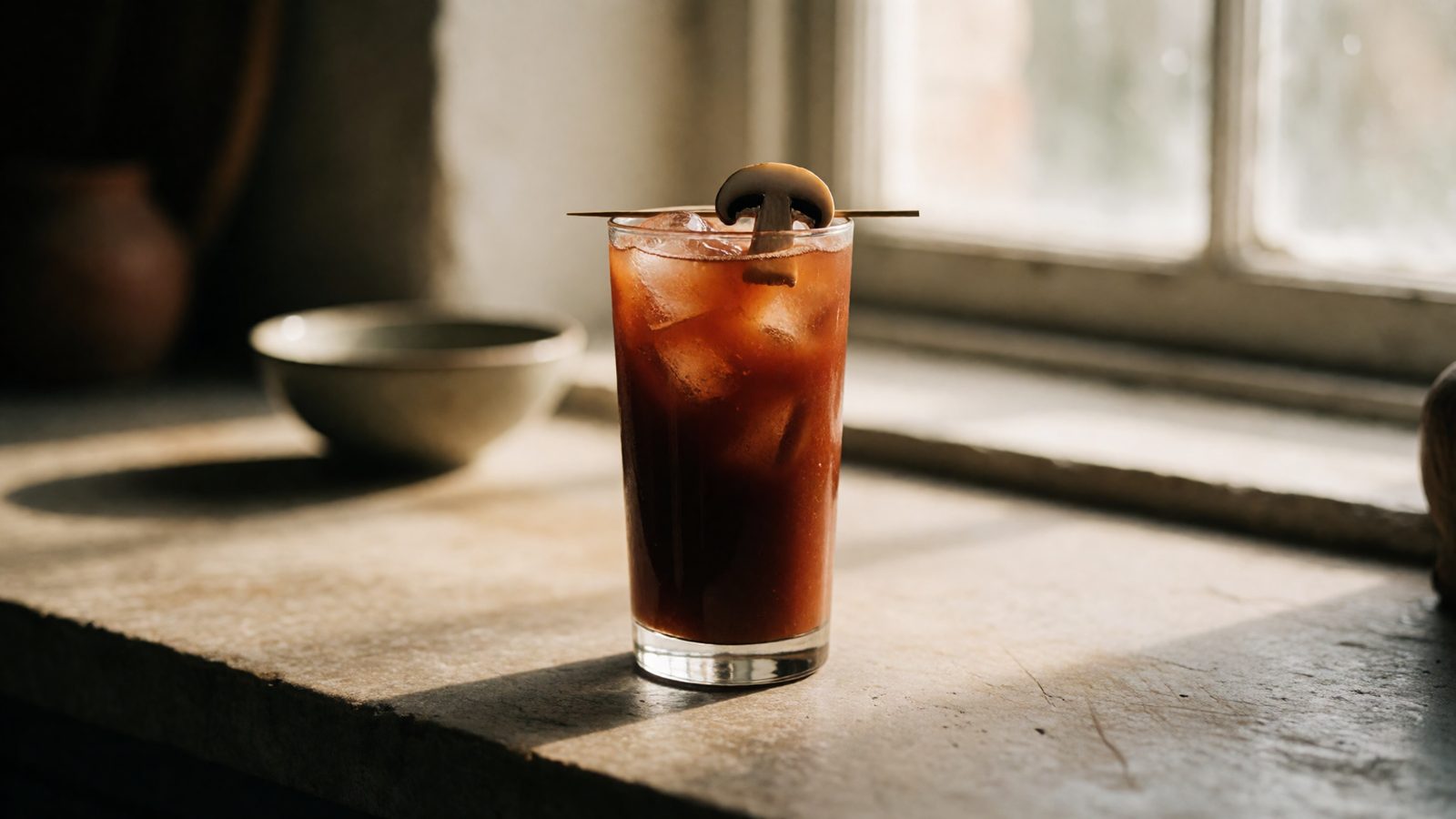
The Black Garlic
& Shiitake Mary
This umami Bloody Mary uses black garlic and dried shiitake to activate a real chemical synergy that turns flat tomato juice into something savory and deep.

Tomato juice is already high in glutamate, one half of umami’s two-part chemistry. Dried shiitake is one of the most concentrated natural sources of guanylate, the other half. Put them in the same glass and the umami reads as far more than either ingredient alone would suggest — the same principle that makes a Japanese dashi (kombu plus katsuobushi) taste bottomless rather than just salty.
- Dried shiitake mushrooms2 whole
- Hot water, for rehydrating2 oz
- Vodka2 oz
- Tomato juice4 oz
- Black garlic cloves, mashed to a paste2 cloves
- Shiitake soaking liquid (from above)0.5 oz
- Soy sauce1 tsp
- Lemon juice0.5 oz
- Fresh cracked black pepperseveral cracks
- Ice1 fill
- 1Rehydrate the dried shiitake in hot water for 15 to 20 minutes, until pliable. Reserve the soaking liquid — it carries most of the mushroom’s savory compounds and this recipe uses it, not just the mushroom itself.
- 2Mash the black garlic cloves into a smooth paste with the back of a spoon or a small mortar and pestle.
- 3In a shaker or mixing glass, combine the black garlic paste with the shiitake soaking liquid and stir until the paste dissolves into the liquid.
- 4Add vodka, tomato juice, soy sauce, lemon juice, and black pepper. Fill with ice and stir gently, six to eight turns.
- 5Strain into a highball glass over fresh ice.
- 6Garnish with one of the rehydrated shiitake caps, thinly sliced, fanned across a cocktail pick.
What umami synergy actually means
Umami, the fifth basic taste alongside sweet, sour, salty, and bitter, is triggered primarily by glutamate, an amino acid found naturally in tomatoes, aged cheeses, and fermented foods. On its own, glutamate reads as pleasantly savory. But when it’s combined with a second class of umami compound — ribonucleotides like inosinate or guanylate, found concentrated in dried fish, cured meats, and dried mushrooms — the perceived umami intensity increases dramatically, well beyond what simple addition would predict. This is the same synergy classical Japanese dashi runs on: kombu seaweed supplies glutamate, dried bonito flakes supply inosinate, and the combination tastes like more than either stock alone.
Why black garlic and shiitake specifically
Tomato juice already carries a meaningful glutamate load, which is part of why a Bloody Mary reads as savory even before any seasoning is added. Black garlic — garlic slow-fermented and aged until it turns soft, black, and sweet — develops significant glutamate of its own during that fermentation, on top of contributing its own distinct flavor. Dried shiitake mushrooms are one of the most concentrated natural sources of guanylate, the same ribonucleotide category as inosinate. Combining tomato’s and black garlic’s glutamate with shiitake’s guanylate is a direct, deliberate application of the synergy principle, not a random flavor pairing.
Why the soaking liquid matters
Guanylate is water-soluble, and rehydrating dried shiitake pulls a meaningful share of it directly into the soaking water. Using that liquid in the drink, rather than just the reconstituted mushroom itself, is what actually delivers the compound into the glass in a usable form — discarding the soaking liquid would mean leaving a large share of the point of using shiitake behind in the sink.
Umami Bloody Mary: Frequently Asked Questions
What is umami synergy?
The scientifically documented effect where combining glutamate (found in tomatoes, aged cheese, black garlic) with a ribonucleotide like inosinate or guanylate (found in dried fish, cured meat, dried mushrooms) produces a perceived umami intensity greater than either compound alone would suggest.
Does fish sauce belong in a Bloody Mary?
Yes, on the same synergy principle — fish sauce is rich in inosinate from fermented fish, and pairs with tomato juice’s glutamate the same way soy sauce and shiitake do here. A dash in place of or alongside the soy sauce in this recipe is a reasonable substitution.
Why do chefs add MSG to tomato juice?
MSG (monosodium glutamate) is a purified, stable form of the same glutamate naturally present in tomatoes, aged cheese, and black garlic. Adding it amplifies umami directly rather than through a synergy pairing — this recipe gets to a similar place through whole ingredients instead.
What is the ratio of glutamates to inosinates in a cocktail like this?
There’s no single fixed ratio — the synergy effect is documented as present across a range of proportions, which is why this recipe doesn’t measure the shiitake liquid or black garlic to a precise scientific ratio, just to a workable cocktail proportion.
Sources
- “Umami the Fifth Basic Taste: History of Studies on Receptor Mechanisms and Role as a Food Flavor” — PMC/NCBI, for the glutamate-ribonucleotide synergy mechanism.
A note on how this was written
The umami synergy science comes from the peer-reviewed source linked above. The specific application — black garlic and shiitake soaking liquid in a Bloody Mary, in these proportions — is a reasoned application of that science, not a personally tasted and tuned result; treat the ratios as a starting point.
Related Reading
- 1+1=8: The Chemical Secret of the Perfect Glass
- The Altitude Effect — Why Tomato Juice Tastes Better at 30,000 Feet
- The Fish Sauce Secret
- For the classic build this one departs from, see the bloody mary recipe.