
The Doenjang
Bloody Mary
Korea’s bolder answer to miso — deeper, more pungent, less sweet. Not for the faint of heart.
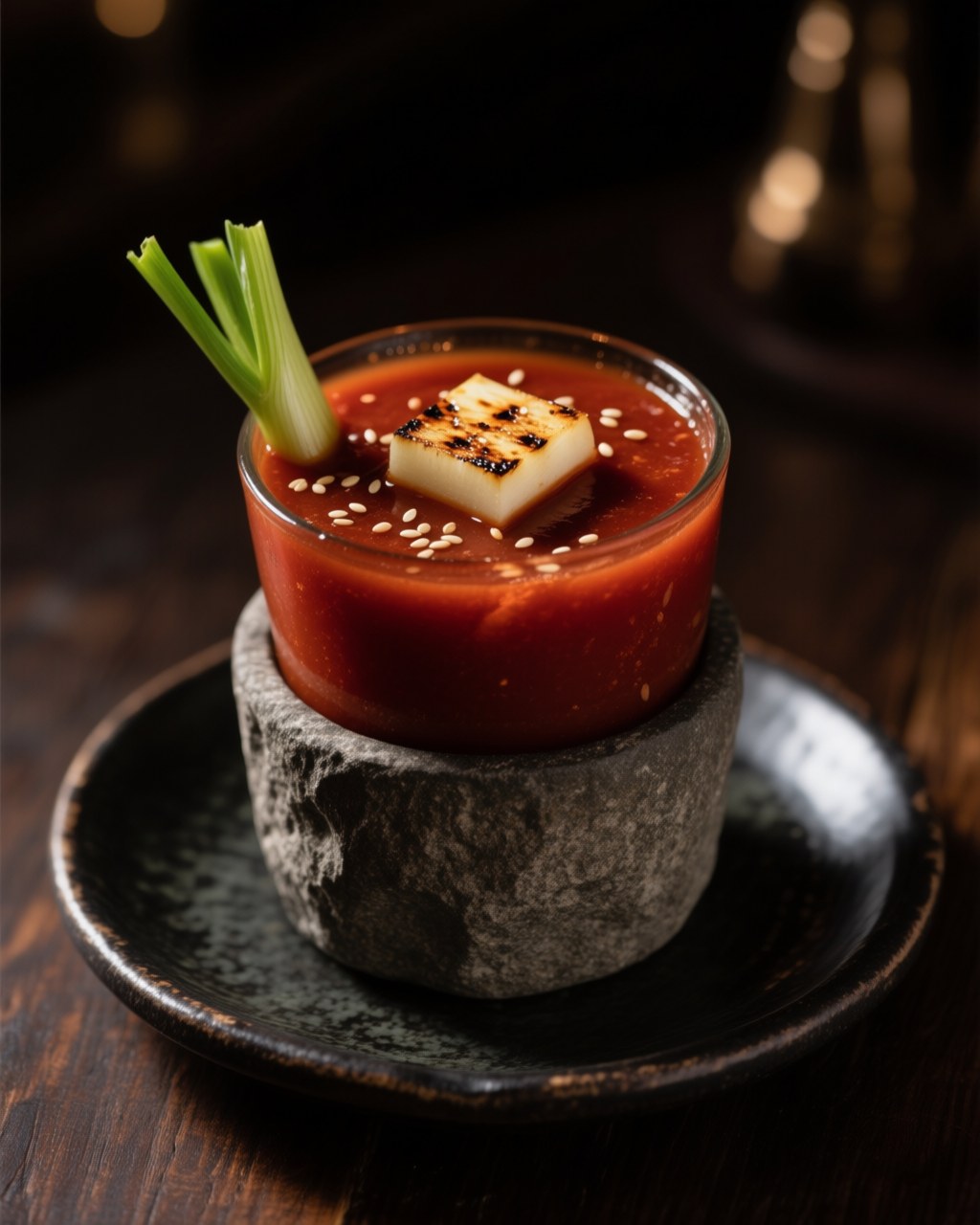
If our Miso Mary is the ferment that convinces skeptics, this is the one for people who already know they like the deep end. Both are fermented soybean pastes, but they are not interchangeable.
- Vodka2 oz
- Tomato juice4 oz
- Doenjang (Korean fermented soybean paste), dissolved in 1 oz warm water and cooled1 tsp
- Fresh lemon juice0.5 oz
- Soy sauce1 dash
- Fish sauce1 dash
- Black pepper1 grind
- Toasted sesame seed mix, for the half rimAs needed
- Ice1 fill
- Perilla leaf and scallion curl, for garnish1 each
- 1Whisk the doenjang into warm water until fully dissolved; let cool to room temperature. Small bits of soybean solids are normal and fine — doenjang is coarser than miso.
- 2Half-rim a rocks glass with a toasted sesame seed mix; fill with ice.
- 3In a mixing glass, combine vodka, tomato juice, cooled doenjang mixture, lemon juice, soy sauce, fish sauce, and black pepper.
- 4Stir well for 15 to 20 seconds.
- 5Strain into the prepared glass over fresh ice. Garnish with the folded perilla leaf and scallion curl.
How doenjang is actually made
Doenjang starts with meju — soaked, steamed, crushed soybean blocks left to ferment openly, developing wild bacteria and fungi — which are then submerged in high-salt brine (roughly 18%) for a period before the liquid is drained off (that liquid becomes ganjang, Korean soy sauce) and the remaining solid paste ferments further, for months. Research on doenjang fermentation found Bacillus and Enterococcus to be the most abundant bacteria, and linked others, such as Tetragenococcus and Lactobacillus, to the compounds behind its savory taste (Frontiers in Microbiology study on bacterial communities in doenjang fermentation).
Why it tastes so different from miso
Doenjang’s longer, more open, less standardized fermentation — bacteria-driven rather than the more controlled koji-mold process behind most miso — is a big part of why it tastes earthier and muskier, more overtly “funky” in the way aged cheese or natto can read as funky to an unfamiliar palate. Miso, especially mild white varieties, tends toward round and gently sweet; doenjang skips that and goes straight to deep and savory-pungent.
Doenjang Bloody Mary: Frequently Asked Questions
Can I substitute miso for doenjang in this recipe?
You can, but you’ll get a milder, sweeter result closer to the Miso Mary — the whole point of this recipe is doenjang’s more pungent, earthier character, which miso doesn’t have.
Where do I find doenjang?
Most Korean grocery stores carry it, usually in a tub rather than a jar, and it’s increasingly available at well-stocked international grocery aisles.
What if I can’t find perilla leaf?
Shiso leaf, a close botanical relative common in Japanese cooking, is the nearest substitute for the garnish.
Sources
- Frontiers in Microbiology — Functional Characterization of Bacterial Communities Responsible for Fermentation of Doenjang, for the meju/brine fermentation process.
A note on how this was written
The doenjang fermentation process and microbiology come from the peer-reviewed study linked above. The comparison to miso’s flavor profile and the drink build are this site’s own recipe development; treat quantities as a starting point, especially given doenjang’s potency.
Related Reading
- Ingredient guide: The fish sauce secret
- Want the story behind this one? Read Funkier Than Miso, On Purpose →